Posts

^Visible light

^Visible light

  1. Produced by hot bodies like sun, electric bulbs and tubes etc. as a result of electronic transitions. Our eyes are sensitive to visible light which helps us to collect the information about our surrounding.
  2. Properties: Reflection, refraction, interference, diffraction, polarization, photoelectric effect, photographic action, sensation of sight.

^Infra red waves


^Infra red waves

(a) Also called heat waves & are produced by hot bodies and molecules.

(b) Properties: Heating effect, reflection, refraction, diffraction & propagation through fog.

(c) Used

  1. In taking photographs during the conditions of fog, smoke etc. as these waves are scattered less than visible rays and hence can travel longer distances through atmosphere under fog, smoke etc.
  2. In weather forecasting
  3. In checking the purity of chemicals
  4. In the study of molecular structures
  5. For producing dehydrated fruits
  6. In green houses to keep the plants warm
  7. To provide electrical energy to satellites using solar cells.
  8. To treat muscular strain.
  9. In solar water heaters and cookers.

^Micro waves

^Micro waves

(a) Produced by special vacuum tubes like klystrons & magnetrons. Due to their shorter wavelengths the microwaves don’t spread or bend around the corners of any obstacle coming in their way, hence can be transmitted as beam signals in a particular direction.

(b) Properties: Reflection, refraction, diffraction and polarization.

(c) Used in

  1. Radar systems used in aircraft navigation.
  2. In communication via satellites.
  3. Speed guns to determine speed of moving automobiles, cricket balls etc.
  4. Ovens for cooking
  5. In the study of atomic and molecular structure.

^Apparent dip

^Apparent dip

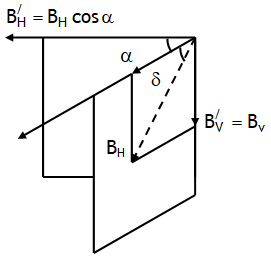
Let respectively be the vertical component, horizontal component & dip angle in a vertical plane inclined at some angle say α to magnetic meridian, then .

On dividing we wet tanδ/ = tanδ secα

From above relation we can write

  • As sec α > 1, thus for any vertical plane inclined at some angle say α to magnetic meridian dip angle is greater than its value in magnetic meridian i.e. δ/ > δ.
  • δ/ = 900 if α = 900e. in a plane perpendicular to magnetic meriadian dip needle will be vertical.

In a similar way it can be proved that if δ1 and δ2 be the angles of dip observed in two vertical planes at right angles to each other and δ is the true angle of dip, then cot2 δ1 + cot2 δ2 = cot2 δ.

^The analogy

The analogy

Both electricity & magnetism has several uses in daily life. Both have the following common features:

1. Are fundamental & conservative forces of nature.

2. Obey inverse square law.

3. Can interact with other materials through induction.

4. Repulsion is the surest test of both magnetism & electricity.

5. Change in electricity produces magnetism & vice – versa.

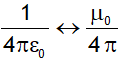
By following interchange of symbols the relations of electricity are applicable to magnetism.

1. E (Electric field) ↔ B (Magnetic field)

2. + (positive charge) ↔ N (north pole)

3. – (negative charge) ↔ S (south pole)

4. q (charge) ↔ m (pole strength)

5. p (Elec. dipole moment) ↔ M (Mag. dipole moment)

6.

*||gm law of resultant of two vectors

*||gm law of resultant of two vectors

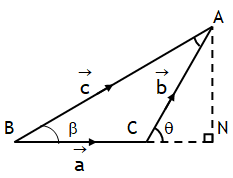
Resultant of two vectors inclined at an angle θ is given by the diagonal of the parallelogram formed by them. If 

are along adjacent sides of a parallelogram , then  will be the diagonal of the same parallelogram provided 

all have same order. act at an angle θ have, then

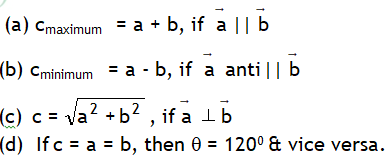
c2 = a2 +b2 + 2 ab cosθ    [Law of cosine


^Facts

Facts

  1. → Induced magnetic field or magnetic induction vector or magnetic flux density.
  2. SI unit of : weber/meter2 or tesla (T)
  3. CGS unit: maxwel/cm2 or gauss (G)
  4. 1 T = 1 N A-1 m – 1 = Wb m-2 = 10 4 Gauss
  5. μ0 = 4 π x 10 – 7 A– 1 Tm = 12.75 x 10 – 7 A– 1 Tm (known as the permeability of air or vacuum).
  6. 1 A– 1 Tm = 1 H m–1 = 1 Wb A– 1 m– 1
  7. = 10 – 7 A– 1 Tm

^Faraday laws of electrolysis

Faraday laws of electrolysis

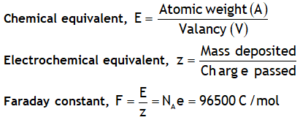
1st law: m ∝ q or m =  z I t

2nd law:  m ∝ E for constant q

^MECHANICS

^MECHANICS

^Cu voltameter

Cu voltameter

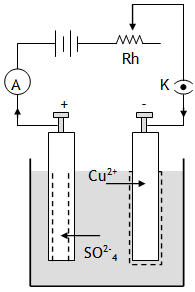
It consists of a glass vessel containing an aqueous solution of CuSO4 as electrolyte & two copper rods as electrodes. Copper sulphate in aqueous solution dissociated as .

Due to the applied p.d. the SO2-4 ions drift towards the anode & the Cu2+ ions drift towards the cathode.

The SO2-4 ions on reaching the anode react with Cu atoms of anode to form CuSO4. i.e.

Cu + SO2-4 → Cu2+ SO2-4 + 2 e

Also the oxidation reaction at the anode is

Cu → Cu2+ + 2e

These Cu2+ ions dissolve into the solution, while the electrons so released flow towards the positive terminal of the battery via the external circuit. The Cu2+ ions on reaching the cathode get neutralized by the electrons flowing in from the negative terminal of the battery i.e. reduction occurs at the anode, Cu2+ + 2e → Cu.

The net effect of electrolysis is that one copper atom is deposited at the cathode for each pair of electrons flowing through the connecting wires, thus copper is dissolved from the anode and deposited at the cathode in such a way that the concentration of CuSO4 in the solution remains constant & there is no accumulation of charge any where.

error: Content is protected !!
Call 9872662552