Posts

^Intensity of fringes

^Intensity of fringes

Intensity of fringes at point P is

Here I0 is the intensity of central maxima. For nth secondary maxima,

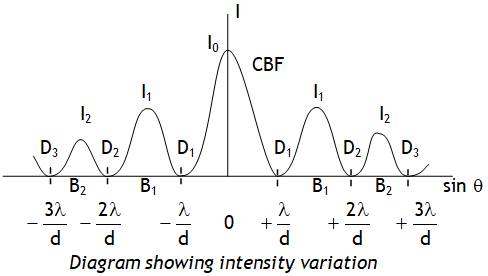
From above points we have the following plot.

Also using the relation of intensity we can say

  • Maximum intensity is central maxima.
  • Most of the light is diffracted between the two first order minima.
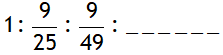
  • The intensities of secondary maxima relating to the intensity of central maximum are in ratio,
  • The intensity of the first secondary maximum is just 36 % of that of the central maximum.
  • As the width of a secondary maximum thus as the slit width is increased, the secondary maxima get narrower. If the slit is sufficiently wide, the secondary maxima disappear and only the central maximum is obtained which is the sharp image of the slit and not a diffraction, thus a distinct diffraction pattern is possible only if the slit is very narrow.

^Position of maxima

^Position of maxima

Also it is found that at P for nth maxima

In a similar way the angular position of nth bright fringe is

i.e. angular positions of 1st, 2nd, 3rd maxima are

From above relation we can say that each secondary maxima occupies an angular width of , thus linear width of each secondary maxima is . As the central maxima is a spread between the angular positions to , thus its angular width is i.e. central maxima is twice wider than secondary maxima. Linear width of central maxi. is 

^Position of minima

^Position of minima

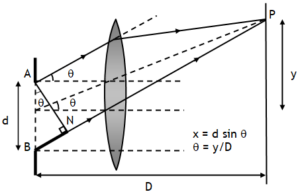
Path difference between the wavefronts reaching P from the end of the slits B & A is, x or p = BP – AP = AN Also p = d sinθ =

A detailed mathematical analysis shows that at P for nth minima p = d sinθ = nl, n = ± 1, ± 2, ± 3, _ _ _

For small θ, sinθ » θ

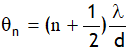
Thus angular position of nth dark fringe is

i.e. angular positions of 1st, 2nd, 3rd minima are

^Diffraction & Huygens’ theory

^Diffraction & Huygens’ theory

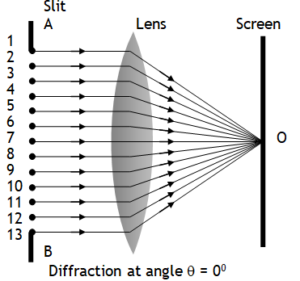
Diffraction can be explained using Huygens’ theory. According to this theory all parts of the slit AB will become source of secondary wavelets, which all start in the same phase at that position. The wavefronts from any two corresponding points such as (1, 13), (2, 12), (3, 11) etc. from the two halves of the slit travel identical distances to reach O thus have zero path difference, hence they add constructively to produce a bright fringe at point O, centre called central maxima or central bright fringe.


^Diffraction of light

^Diffraction of light

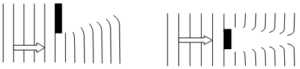
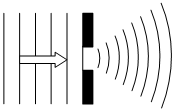
When a wave (light or sound) strikes an obstacle it doesn’t go straight, rather it bends round the obstacle.

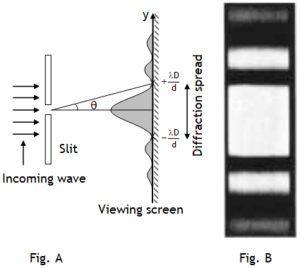
Also when a light wave passing from a narrow slit of width AB = d reaches screen placed at a distance D (>>d) from the slit, (Fig. A) then a bright spot on screen at a point just opposite to slit is expected & all other points on the screen are expected to be dark (called regions of geometrical shadow), but in actual practice light spreads into the region of geometrical shadow and alternate patterns of bright & dark bands (Fig. B) of varying intensity are formed.

This phenomena of spreading or bending is called diffraction of wave.

a) Diffraction dominates for longer wavelengths.

b) If the wavelength of the wave is smaller than the dimensions of obstacle diffraction is negligible & the wave behaves like a ray & travels along straight line (called, rectilinear propagation).

c) Diffraction in case of radio waves & sound waves is generally observed, because their wave length is not so small & obstacles/ apertures of theses sizes are readily available.

d) Diffraction with light is generally not observed, because light has very small wavelength (»mm) & obstacles of such small size are readily not available.

^Young’s double slit experiment

^Young’s double slit experiment

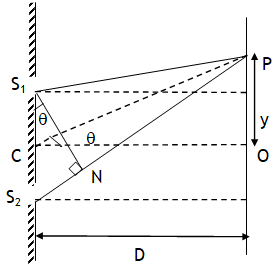
A common experiment to study interference of two light waves is YDSE. In this experiment overlapping of wave fronts of light waves coming from two slits S1 & S2 is studied by placing a screen at some distance from the slits. Let slits are separated by a distance ‘d’ & screen is situated ‘D >>d’ distance away from slits. Wavefronts reaching O from S1 & S2 are of equal path length produce no phase difference & thus we get maximum intensity at O (called central maxima, CM).

If the overlapping of waves is studied at a point P situated ‘y’ distance above or below the central maxima, then the intensity of the resultant wave depends on the phase difference between the waves S2P & S1P. If point P is situated ‘y’ distance above point ‘O’, then the path S2P is longer than S1P by an amount d sinθ. As here d << D, thus
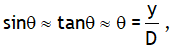
thus path difference (p or Δx or simply x) can be expressed as

Phase & path difference for a sinusoidal wave are related as
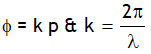
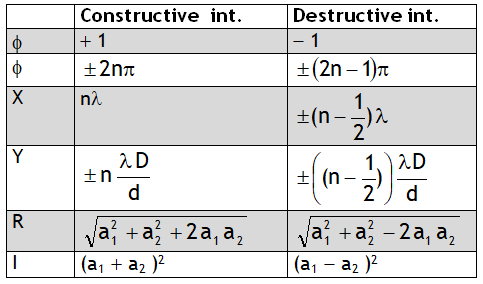
Using above relation for conditions of maximum intensity we can say that maximum intensity is achieved at following positions from  central maxima

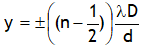
Using above relation for conditions of minimum intensity we can say that minimum intensity is achieved at following positions from  central maxima
For two waves of equal intensities the intensity of the resultant wave varies as square of the cos of Φ/2 i.e.
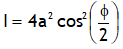
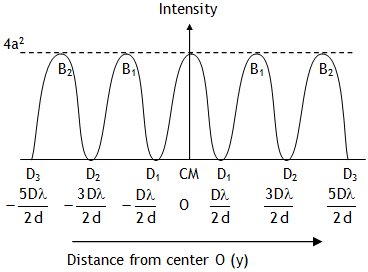
Here 4a2 is the maximum intensity of the resultant wave at central maxima.
Facts

1. Fringe width of any dark or bright fringe is same & is

2. When interference is studied with white light, each of the seven colours produces its own fringe pattern, having different fringe width & due to overlapping blurred fringes are observed. However central fringe is white, on either side the nearest fringe is blue and farthest fringe is red & then uniform illumination.

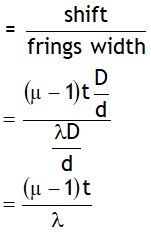
3. If a transparent sheet of thickness ‘t’ & refractive index ‘m’ is introduced in one of paths of interfering waves, the entire fringe pattern displaces towards the side in which the sheet is inserted by a distance   without any change in the fringe.

Also no. of fringes shifted is
^Interference with independent light sources

^Interference with independent light sources

Two independent light sources can’t produce a sustained interference, rather they produce uniform illumination on the screen, as the phase of the light emitted by them very rapidly (108 times in every one second) in other words two independent light sources are incoherent.

^Coherent sources

^Coherent sources

If the positions of constructive & destructive interference remain fixed (or sustained) with time if the phase difference between the overlapping waves remains constant with time, such waves are called coherent & sources producing such waves are called coherent. Coherence is essential condition to observe interference pattern.

Coherence: Φ ∝ time0 or constant

^Interference of waves

^Interference of waves

Let two waves of amplitudes a1 & a2 having a phase difference ΔΦ (or simply Φ) superpose (overlap) at a point P. Let R be the amplitude of the resultant wave, from principle of superposition (POS) R is

As for any wave intensity is proportional to square of its amplitude, i.e.

Let I be the intensity of the resultant wave, then

When the intensity the resultant wave becomes maximum, the situation is called constructive interference (CI), physically it implies crest of one wave exactly overlaps with crest of other & trough with trough, this happens if

Here n = ±1, ±2, ±3, _ _ _ i.e. only integers, n =+ve means above O &– ve below O. Also

When the intensity the resultant wave becomes minimum, the situation is called destructive interference, physically it implies crest of one wave exactly overlaps with trough of other, this happens if

As the value of cosf varies between – 1 to + 1, thus intensity of the resultant wave varies between Imin = (a1 – a2)2 to Imax = (a1  + a2)2 so the average intensity is

This phenomenon of non-uniform distribution of intensity is called interference of waves.  It is possible for any no. of waves, however for the simplicity we have discussed it for two waves only. Also it is a property of both types of waves, mechanical & EM wave.

^Myopia versus Hypermetropia

^Myopia versus Hypermetropia

error: Content is protected !!
Call 9872662552