^Rules of differentiation
^Rules of differentiation
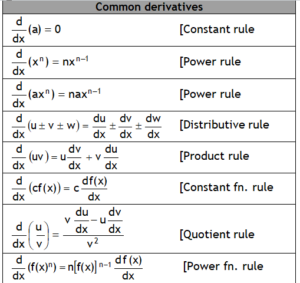
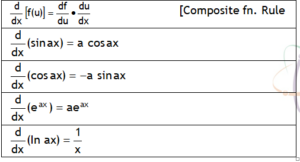
Following table displays some commonly used differentials in physics.

^Rules of differentiation
Following table displays some commonly used differentials in physics.
Electrostatic force
Electrostatic force has following properties
1. Force on any charged particle situated in its electrostatic electric field is given by
 [Called electrostatic Lorentz force
2. This force is independent of direction or amount of their velocity.
3. It acts in the direction of field on a positive charge & acts opposite to the direction of field on a negative charge.
4. Acceleration of a charge particle due to force exerted by the electric field using NSL is 
5. Both +ve & -ve charge particle when accelerate under this force always moves in the direction of decreasing potential energy, mathematically this situation is expressed as

Called law of conservative force.
6. Dropping integral & vector sings & rearranging the above relation can be expressed as  i.e. a conservative force is equal to negative of potential energy gradient.
7. Loss of potential energy of a system implies equal amount of gain in the KE so that the mechanical energy (i.e. K + U) of the system moving in electrostatic electric field is always conserved (i.e. constant). This is why electrostatic force is called conservative.
*Properties of charge
1. Charge is scalar, i.e. has no direction.
2. Charge is additive i.e. total charge on a body is given by addition of individual charges for discrete distribution & by integration for continuous distribution.
3. Charge is conserved in any isolated process

4. Charge is quantized i.e. charge smaller than electronic charge, e = 1.6 x 10 – 19 C (also called elementary charge.) is not possible and exists in integral multiple of e i.e. mathematically.
Q = Ne, here N is an integer.
5. Charge is invariant of space, time & velocity.
6. Charge is can’t exist without mass.
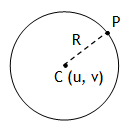
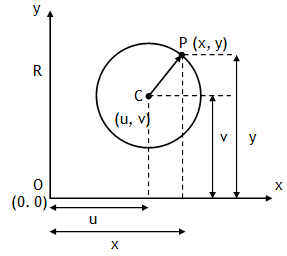
*Circle The locus of a point P (x, y) which moves in a plane so that its distance from a fixed point is always a constant. The fixed point is called the centre C (u, v) of the circle and the constant distance is called its radius (R).
Also a radius of a circle is a straight line joining the centre any point on the circumference. As CP = R, thus using displacement formula we can write
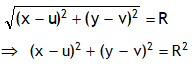
The above expression is called Central form of a circle.
A circle can also be expressed as
ax2 + by2 + 2 gx + 2 fy + c = 0
This expression is called general form of a circle.
Here (-g, -f) is the center of the circle
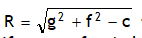 is radius
If centre of a circle coincides with origin O (0, 0) then the above expression can be written as,
x2 + y2 = R2.
This expression is called Standard form of a circle.
*Intercept form
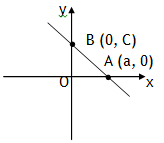
Suppose a line cuts x axis at point A (a, 0) and cuts y axis at a point B (0, C), then it can be described by the equation,
[called intercept form].
*Harmonic progression
If a, a + d, a + 2d, _ _ _ _ _ _ _ are in AP, then their reciprocals 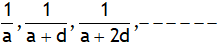 are in harmonic progression (HP).
*Logarithms
Let a is an arbitrary positive real number except 0. If ax = y, then logay = x
Conversely, the antilogarithm of x is the number y i.e. y = antilogax.
Here ax = y is called arbitrary exponential function and loga y = x is read is log of y to the base a is equal to x. If a = 10, log is called common & if it is e, then called natural.

*Slope of a straight line
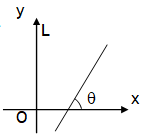
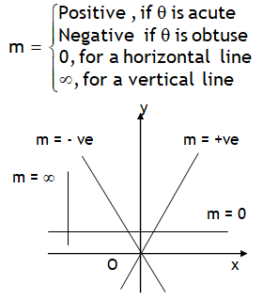
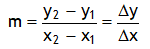
*Finding values of θ > 900
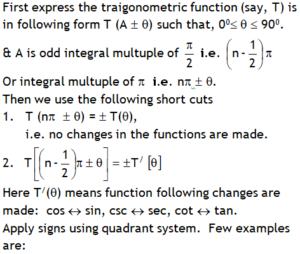
*Expansion formulae
sin (A ± B) = sin A cos B ± cos A sin B
cos (A ± B) = cos A cos B ± sin A sin B
 Call 9872662552