^Virtual focus
^Virtual focus
- A position on the principal axis where two or more reflected (or refracted) rays appears to meet
- situated infront of mirror
- g. focus of a convex mirror & that of a concave lens (placed in rarer surroundings)

^Virtual focus
^Real focus
^Virtual image
^Real image
^Virtual object

1. A position at which incident rays converge
2. situated behind the mirror i.e. towards the polished side
3. u = + ve for both lenses & mirror
^Real object
1. A position from which incident rays diverge
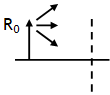
2. situated infront of mirror i.e. towards the reflecting side
3. u = – ve for both lenses & mirror
4. Unless mention assume object to be real, transverse, producing paraxial rays.
^Convex mirror & Concave lens
A convex mirror has Inner or depressed side polished. A concave lens is thick near edges & thin near the center. They have following common features
^Concave mirror & Convex lens
A concave mirror has outer or bulged side polished. A convex lens is thick near center & thin near the edges. They have following common features
^Plane mirror
1. Image formed by a plane mirror is virtual, erect, undiminished, unmagnified, behind the mirror such that both the object & image are at equal distances from the mirror.
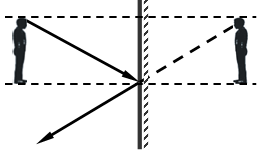
2. A plane mirror forms real image for a virtual object.
^Spherical aberration
The various rays in a wide beam falling on a concave mirror of large aperture after reflection don’t meet at a single focus, marginal rays get focused somewhere between F & F while paraxial between C & F , consequently the image formed is not bright & single but a large no. of blurred images are produced.

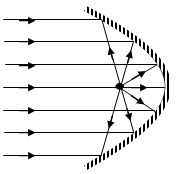
In order to minimize the spherical aberration defect we shall use
(a) Objects with low heights
(b) Paraxial incident rays
(c) Mirrors of small aperture (called parabolic mirror, used as reflectors of head lamps of vehicles).
 Call 9872662552