Posts

^Millikan oildrop experiment

^Millikan oil-drop experiment

In 1913, Millikan measured the charge on an electron precisely using oil-drop experiment. He found that the charge on an oil-droplet was always an integral multiple of an elementary charge, 1.602 × 10⁻¹⁹ C. Millikan’s experiment established that electric charge is quantised. From the values of charge (e) and specific charge (e/m), the mass (m) of the electron could be determined.
^Electrons

^Electrons

J. J. Thomson was the first to determine experimentally the speed and the specific charge (e/m) of the cathode ray particles.  He found

  1. cathode rays travel with speeds ranging from about 0.1 to 0.2 times the speed of light.
  2. e/m = 1.76 × 10¹¹ C/kg.
  3. the value of e/m is independent of the nature of the material/metal used as the cathode (emitter), or the gas introduced in the discharge tube. This observation suggested the universality of the cathode ray particles.

^Intensity of photons

^Intensity of photons

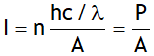
Intensity of photons is also called power density & is defined as the rate of photons (i.e. number of photons per second) crossing a given area at right angles. Mathematically intensity of photons can be expressed as,

All photons of light of a particular frequency f, or wavelength λ, have the same energy and momentum, whatever the intensity of radiation may be. By increasing the intensity of light of given wavelength, there is only an increase in the number of photons per second crossing a given area, with each photon having the same energy. In other words photon energy is independent of intensity of radiation.

^Power of photons

^Power of photons

Rate of energy of photons is called power of photons. If n photons each of wavelength ‘l’ are crossing a given area at right angles every second, then power of photons is defined as,

^Momentum of photons

^Momentum of photons

^Energy of photons

^Energy of photons

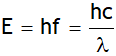
Max plank suggested that any source of radiation emits or absorbs energy discontinuously in the form of energy particles or packets of energy called photons. Amount of energy of an EM wave of frequency f possessed by a single photon is,

Total energy of EM wave having N photons is

E = Nhf.

Here h is Planck’s constant. It’s value is

h = 6.63 x 1034 Js = 4.14 x 10¹⁵ eVs

Dimensions of Planck’s constant & angular momentum are same & are [ML2 T – 1].

^Frequency of photons

^Frequency of photons

Frequency of photon does not change when it travels in different media while there is a change in velocity of photon in different media (due to change in wavelength). For any wave frequency is related to its wave length as i.e. light of shorter wavelength has more frequency.
^What are photons

^What are photons

Photons are electrically neutral energy particles of zero rest mass emitted by a source of radiation & travel along a straight line with a speed equal to speed of light. Zero rest mass implies that the photons can’t exist at rest. Photons travel in a straight line with a speed equal to speed of light. Being electrically neutral, photons are not deflected by electric and magnetic fields.

^Photons & neutrino

^Photons & neutrino

Both photon & neutrino are charge less & zero rest mass. But the spin of photon is 1 & that of neutrino is 1/2.

^Appearance of sky

^Appearance of sky

The appearance of sky from earth at various locations depend on the amount & nature of impurities present in the air & climatic conditions also.

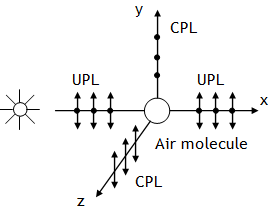
Also it is found that the light scattered

(a) at right angles to the direction of incidence is completely plane polarized light (CPL)

(b) along the direction of incidence is unpolarized, &

(c) at all other angles to the direction of incidence is partially plane polarized light (PPL)

On the Moon, there is no blue sky because there is no atmosphere & thus no scattering. Even during the day, the sky is as black as at night, although the Sun and the Earth may be brightly shining.

If we look at the blue portion of the sky through a Polaroid and rotate the polariod, the transmitted light shows rise and fall of intensity, which indicates that the light from the blue portion of the sky is plane polarized.

error: Content is protected !!
Call 9872662552