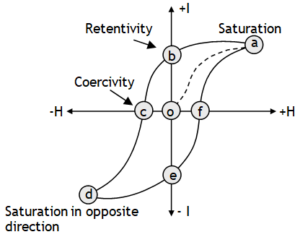
^Retentivity (ob) :
The value of I even when the H is reduced to zero.

The value of I even when the H is reduced to zero.
Hysteresis
Hysteresis is the lag of intensity of magnitisation (I) behind the magnetising field (H) is called hystersis.
Ferromagnetism
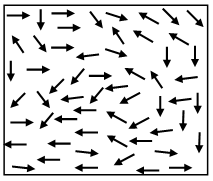
The existence of domains leads to strongest magnetism in ferromagnetics. Due to the presence of cohesive forces in ferromagnetics the unpaired electron spins to line up parallel with each other in a region called a domain. A ferromagnetic domain is a region of crystalline matter whose volume may be between 10–12 m3 to 10–8 m3. Each domain contains about 1017 – 1021 atoms. The various atomic magnets are aligned in the same direction in a domain even in the absence of external magnetising field but different domains have magnetic moments in different directions such that within the domain, the magnetic field is intense, but in a bulk sample the material will usually be unmagnetized because the many domains will themselves be randomly oriented with respect to one another. When a ferromagnetic material is kept in external magnetising field, its domain experience force and torque which tends to align them along a definite direction, till magnetic saturation. This is called Magnetostriction effect. The extent of alignment is found to depends directly upon the intensity of the magnetising field & inversaly upon the temperature of the material.

Paramagnetism
About 90% paramagnetism is due to spin motion of electrons. Paramagnetics are permanent weak magnets & posses magnetism even in the absence of external magnetising field. On placing a paramagnetic in external magnetising field its atomic dipoles tend to align so as to get weakly magnetized in the direction of the magnetizing field. Paramagnetism varies inversely with the temp, with the increase temperature difficulty of ordering the magnetic moments of the individual atoms increases.
Diamagnetism
Diamagnetics are temporary weak magnets posses magnetism only when placed in external magnetising field. It is found in the atoms or molecules having even number of electrons. In the unmagnetized form of a diamagnetic the magnetic moments of the two electrons having same value of principle quantum number ‘n’ have equal & opposite value cancel out, thus producing net zero magnetic moment. However when placed in an external magnetic field the electron having dipole moment opposite to external magnetic field is accelerated & other one retards, producing a net non zero magnetic moment in a direction opposite to the applied magnetic field. Diamagneitcs get repelled weakly by magnetizing fields. Now when external magnetic field is switched off, the magnetic force on electrons again becomes zero, due to which the two magnetic moments again become equal & cancel each other.
Cause of magnetism
1. Electrons, protons, neutrons all posses magnetic moment  due to both orbital & spin motions. This magnetic moment is ultimately responsible for magnetism.
2. due to spin is also called intrinsic magnetic moment or permanent magnetic moment & can be understood using quantum mechanics only.
3. associated with the orbital motion of a charge can be explained even by classical concepts, for it an electron orbiting around a nucleus in a circle or radius r at a velocity v it is 
4. The minimum value of produced due to the orbital motion of an electron around an atomic nucleus is called Bohr magneton (μ).

5. The nuclear magnetic moment typically is much smaller than the electron magnetic moment 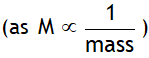 .
.
6. Net magnetic moment of an atom is the vector sum of is magnetic moments of all of its electrons, protons & neutrons, both due to orbital motion & as well as spin motion.
7. Generally magnetic moments of atoms are randomly aligned & thus for any volume containing more than several thousand atoms net dipole moment is usually zero (for all types of material, dia, para, ferro).
The analogy
Both electricity & magnetism has several uses in daily life. Both have the following common features:
1. Are fundamental & conservative forces of nature.
2. Obey inverse square law.
3. Can interact with other materials through induction.
4. Repulsion is the surest test of both magnetism & electricity.
5. Change in electricity produces magnetism & vice – versa.
By following interchange of symbols the relations of electricity are applicable to magnetism.
1. E (Electric field) ↔ B (Magnetic field)
2. + (positive charge) ↔ N (north pole)
3. – (negative charge) ↔ S (south pole)
4. q (charge) ↔ m (pole strength)
5. p (Elec. dipole moment) ↔ M (Mag. dipole moment)
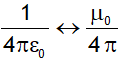
6. 
Properties of a magnet
1. The pole strength ‘m’ of a magnet depends upon the nature of material of a magnet, its state of demagnetization & area of cross section of the magnet but is independent of any bend in the magnet.
2. For a bar magnet 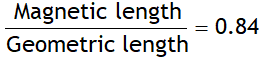

3. On cutting a magnet in two identical pieces longitudinally (along the length) the pole strength of each part is halved as a result the dipole moment of each part becomes half.
4. On cutting a magnet in two identical pieces transversally (normal to length) the dipole moment of each part becomes as length of each part is halved.
5. A flexible magnet of length L, pole strength m & dipole moment M is bent into a semi circle. The dipole moment of this semicircle will be  .
.
6. Demagnetization can be due to heating, hammering, passing AC through an electromagnet, applying demagnetizing field (i.e. a magnetic field in the reverse direction), aging.
Motional emf
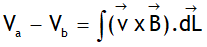
No motional emf will be produced across the conductor if any two vectors  are parallel to each other.
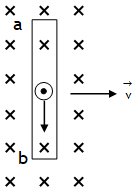
Polarity of the emf can be checked knowing the direction of drift of electrons using 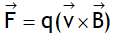 .
.
Some more useful situations
1. The ratio of magnetic dipole moment to angular momentum for a uniformly charged configuration 
2. A current loop behaves like a magnetic of dipole moment M = A N I, here I → current in loop, A → loop area & N → its no. of turns.
3. A current loop placed of dipole moment  in external uniform magnetic field
  experiences a torque,
  .
.
4. A current carrying conductor placed in uniform magnetic field experiences a force. 
5. For a closed loop of any shape net force on it is zero, however depending upon direction of current & external magnetic field a tension T = RBI may produce.
6. Two straight parallel conductors experience a force  per unit of their length due to the magnetic field of each other.

 Call 9872662552