^Agonic line
^Agonic line
Lines joining the places of zero declination. Along Agonic lines a compass needle will point geographical north. Thus the places east of agonic line will have the west declination as the compass needle point west of north.

^Agonic line
Lines joining the places of zero declination. Along Agonic lines a compass needle will point geographical north. Thus the places east of agonic line will have the west declination as the compass needle point west of north.
^Isodynamic lines
Lines joining the places of equal horizontal component of earth’s magnetic field (BH).
^Isoclinic lines
Lines joining the places of equal dip (δ).
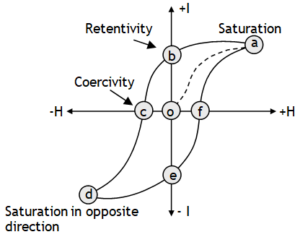
The value of I even when the H is reduced to zero.
Hysteresis
Hysteresis is the lag of intensity of magnitisation (I) behind the magnetising field (H) is called hystersis.
Ferromagnetism
The existence of domains leads to strongest magnetism in ferromagnetics. Due to the presence of cohesive forces in ferromagnetics the unpaired electron spins to line up parallel with each other in a region called a domain. A ferromagnetic domain is a region of crystalline matter whose volume may be between 10–12 m3 to 10–8 m3. Each domain contains about 1017 – 1021 atoms. The various atomic magnets are aligned in the same direction in a domain even in the absence of external magnetising field but different domains have magnetic moments in different directions such that within the domain, the magnetic field is intense, but in a bulk sample the material will usually be unmagnetized because the many domains will themselves be randomly oriented with respect to one another. When a ferromagnetic material is kept in external magnetising field, its domain experience force and torque which tends to align them along a definite direction, till magnetic saturation. This is called Magnetostriction effect. The extent of alignment is found to depends directly upon the intensity of the magnetising field & inversaly upon the temperature of the material.

Paramagnetism
About 90% paramagnetism is due to spin motion of electrons. Paramagnetics are permanent weak magnets & posses magnetism even in the absence of external magnetising field. On placing a paramagnetic in external magnetising field its atomic dipoles tend to align so as to get weakly magnetized in the direction of the magnetizing field. Paramagnetism varies inversely with the temp, with the increase temperature difficulty of ordering the magnetic moments of the individual atoms increases.
Velocity selector
A beam of charged particles is passed in a region of electric & magnetic fields acting at right angles (called cross fields) with such a velocity that the electric & magnetic force balances each other & the beam of charge particles pass undeflected through the region of cross fields. i.e.
Felectric = Fmagnetic ⇒ qE = Bqv ⇒ 
Sign of thermoelectric power
Sign of S is sign of cold side i.e., potential of cold side. By convention, the sign of S represents the potential of the cold side with respect to the hot side. If electrons diffuse from hot to cold end, then the cold side is negative with respect to the hot side and the Seebeck coefficient is negative. In a p – type semiconductor, on the other hand, holes would diffuse from the hot to the cold end. The cold side would be positive with respect to the hot side which would make S a positive quantity.
The total voltage difference between two points where temp. are T0 and T, from equation (1), is given by 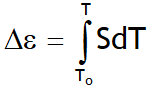 _ _ _ _ (2)
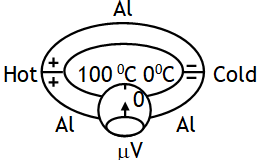
In practice one rarely measures the absolute thermopower of the material of interest. This is due to the fact that electrodes attached to a voltmeter must be placed onto the material in order to measure the thermoelectric voltage.
The temperature gradient then also typically induces a thermoelectric voltage across one leg of the measurement electrodes.
Therefore the measured thermopower includes a contribution from the thermopower of the material of interest and the material of the measurement electrodes. Suppose that we try to measure the voltage difference DV across the aluminium rod (heated at one end and cooled at the other end) by using aluminium connecting wires to a voltmeter as shown.

The same temperature difference, however, now also exists across the aluminium connecting wires and therefore an identical voltage also develops across the connecting wires, opposing that across the aluminium rod.
Consequently no net voltage will be registered by the voltmeter.
It is, however possible to read a net voltage difference, if the connecting wires are of different material, i.e. have a different coefficient than that of aluminium , so that across this material the thermoelectric voltage is different than that across the aluminium rod.
The voltage across each metal element depends upon on its Seebeck coefficient so that the potential difference between the two wires will depend on SA – SB. The emf between the two wires, VAB = DVA – DVB, by virtue of eqn. (2), is then given by
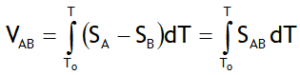
Here SAB is defined as the thermoelectric power for the thermocouple pair A – B.
The Seebeck coefficients are non-linear as a function of temperature, and depend on the conductors’ absolute temperature, material, impurities, imperfections, and structural changes. If the Seebeck coefficients are effectively constant for the measured temperature range, the above formula can be approximated as:
VAB = (SA – SB)·(T – T0)
The thermopower is an important material parameter that determines the efficiency of a thermoelectric material. A larger induced thermoelectric voltage for a given temperature gradient will lead to a larger efficiency. Ideally one would want very large thermopower values since only a small amount of heat is then necessary to create a large voltage. This voltage can then be used to provide electric power.
Typically metals have small thermopowers because most have half-filled bands. Electrons (negative charges) and holes (positive charges) both contribute to the induced thermoelectric voltage thus canceling each other’s contribution to that voltage and making it small. In contrast, semiconductors can be doped (adding impurities) with an excess amount of electrons or holes and thus can have large positive or negative values of the thermopower depending on the charge of the excess carriers.
^Thermal properties of matter & thermodynamics
 Call 9872662552