Posts

^Appearance of sky

^Appearance of sky

The appearance of sky from earth at various locations depend on the amount & nature of impurities present in the air & climatic conditions also.

Also it is found that the light scattered

(a) at right angles to the direction of incidence is completely plane polarized light (CPL)

(b) along the direction of incidence is unpolarized, &

(c) at all other angles to the direction of incidence is partially plane polarized light (PPL)

On the Moon, there is no blue sky because there is no atmosphere & thus no scattering. Even during the day, the sky is as black as at night, although the Sun and the Earth may be brightly shining.
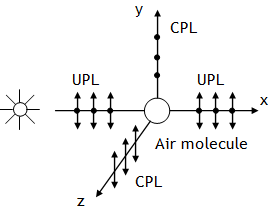
If we look at the blue portion of the sky through a Polaroid and rotate the polariod, the transmitted light shows rise and fall of intensity, which indicates that the light from the blue portion of the sky is plane polarized.
^Clouds appears white

^Clouds appears white

Hence when white light encounters obstacles of size a >> λ, all colours are scattered equally & resultant scatted light appears white. Due to this reason clouds appears white.

If the earth had no atmosphere, the sky would appear black and stars could be seen during day time also. In fact at a height of above 15 km, there is almost no air & the appears black.

^Sun appears red at Sun rise & sun set

^Sun appears red at Sun rise & sun set

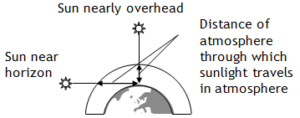
This is because at Sun rise & sun set light passes through greater thickness of atmosphere, as a result more scattering takes place & blue colour & low wavelengths are scattered away by the scattering caused by the atmosphere & the colour which reaches us is unscattered red.

General scattering

When size of obstacles encountered by the light is much greater than the wavelength of light used, all wavelengths of light are scattered equally.

^Dangers signals are made red

^Dangers signals are made red

Danger signals, traffic lights etc. are made red. Red light being longest wavelength is scattered least & hence can go to large distance without any appreciable loss due to scattering.

^Scattering of light

^Scattering of light

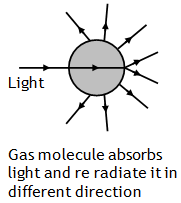
When unpolarized light falls on a gas or air molecules light falling on air molecules. The electric field of light polarises the air molecule makes it an electric dipole, which starts oscillating under the influence of oscillatory electric field of light & these dipoles radiate electromagnetic waves in all directions. This process is called scattering of light & the radiated light is called scattered light, it is unpolarized & intensity is found to be strongest along a line perpendicular to the oscillation, & drops to zero along the line of oscillation. The amount of scattering depends on the obstacle size coming in its way e.g. dust particles, rain drops, ice particles etc. We have divided scattering in two type.

1. Rayleigh scattering

When size of obstacles encountered by the light is much smaller than the wavelength (a << λ) of light used, the amount of scattering is inversally proportional to the fourth power of the wavelength of light.

^Oblique projectile from ground

^Oblique projectile from ground

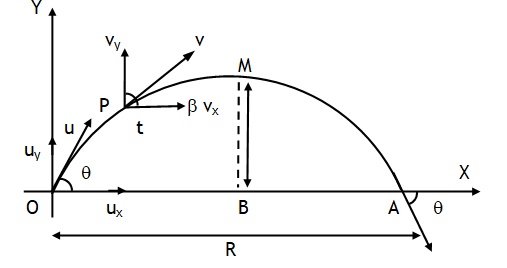
Suppose a body is projected from the ground from point O at an angel q with the horizontal and with the velocity u. Let at time t the projectile is at point P where its velocity is v directed at angle b to the horizontal.

1  Using trigonometry x & y components of initial velocity are ux = u cosθ  & uy = u sinθ

Describing position

2.   Using vector addition law the position vector of point P w.r.t. origin is

3.  Using s – t relation for the motion O to P along x & y axis we can write

(a) x – t relation: x = u t

(b) y – t relation: y =

Eliminating t from above two relations we get y – x relation:

^Brewster’s law

^Brewster’s law

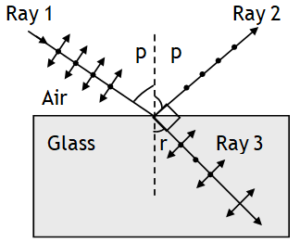
Brewster discovered that when ordinary light is incident on the surface of a transparent medium the reflected light is partially plane polarized.

The extent of polarization depends on the angle of incidence. For a particular angle of incidence (called polarizing or Brewster angle (ip or p)

1. the reflected light is found to be completely polarized with its vibrations perpendicular to the plane of incidence.

2. the reflected & transmitted rays are perpendicular to each other, as shown in figure.

3. μ = tan p                           [called Brewster law

At i = p Ray 1: Incident ray (unpolarised)

Ray 2: Reflected ray (completely polarised)

Ray 3: Refracted ray (partially polarised)

For a ray incident form air to glass

g = 3/2, so p = tan-1  3/2  ⇒ p = 56.30

For a ray incident form air to water

w = 4/3,  so p = tan-1  4/3 ⇒  p = 53.10

^Malus law

^Malus law

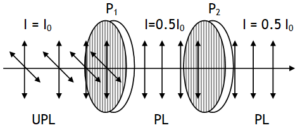
Let I0 be the intensity and ‘A’ the amplitude of the unpolarized light falling on the polarizer & θ be the angle between the pass axis of the polaroid & amplitude vector, then the component Acosθ, parallel to the pass axis (y) of polarizer passes through it & the component Asinθ, perpendicular to pass axis is blocked by the polarizer, thus the intensity of light transmitted by the polarizer is

I = k (A cosθ)2 = k A2 cos2 θ

or         I = I0 cos2 θ        [called Malus law

Actually the phase angle for a beam of unpolarised light can have any value from 00 to 3600. Now as the average value of cos2 θ for the range 00 to 3600 is 0.5, thus the average intensity of light transmitted by a polarizer is only 0.5 I0.  Following observations can be explained on the basis of Malus law.

1. Two polarizes with parallel pass axis (y & y)

2. Two polarizes with crossed pass axis (y & z)

^Light through a polarizer

^Light through a polarizer

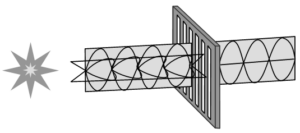
Let ordinary light propagating along +x axis falls normally on a tourmaline crystal having pass axis parallel to y axis as shown in the following diagram.  On passing through the tourmaline crystal the electric field vibration parallel to pass axis are transmitted while the electric field vibration normal to pass axis are absorbed by the tourmaline.

^How do polarisers work

^How do polarisers work 

A Polaroid is a thin commercial sheet containing long chain of hydrocarbons which become conducting at optical frequencies & absorb the electric field parallel to chains & transmit the electric field perpendicular to the chain length. This is why a direction perpendicular to the chain length is called the transmission axis or pass axis of the polarizer. For shown drawing y axis is pass axis.

error: Content is protected !!
Call 9872662552