^What is optics?
^What is optics?
The branch of Physics which deals with light, it’s nature, cause, source, properties & it’s effects is called Optics.

^What is optics?
The branch of Physics which deals with light, it’s nature, cause, source, properties & it’s effects is called Optics.
^What is light?
In general light means following three parts
As these are parts of EM spectrum, thus light is electromagnetic, thus properties of light are same as that of any EM wave. Light can behave like a ray, a wave & as a particle, depending on its interaction with the objects it encounters on its way.
^Electromagnetic Force
EM – force acts between charged particles. It binds electrons with nuclei to form atoms & binds atoms together to form molecules. It is responsible for the properties of solids, liquids, & gases. Force of attraction/repulsion between two static charges is described by the Coulomb’s law i.e 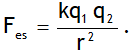
Electric forces and magnetic forces were considered to be separate forces until the 1860s when James Clerk Maxwell was able to demonstrate that they were different manifestations of the same force – the electromagnetic force. Infact, all contact forces such as: Frictional force (f), Viscous force (Fv), Air drag (fd) Spring force (Fspring or Fr), Normal reaction (N), Tension force in ropes, strings & muscles (T), Buoyant force (B or U), Surface tension force (FS) are actually due to the electromagnetic force.
^Maxwell equations
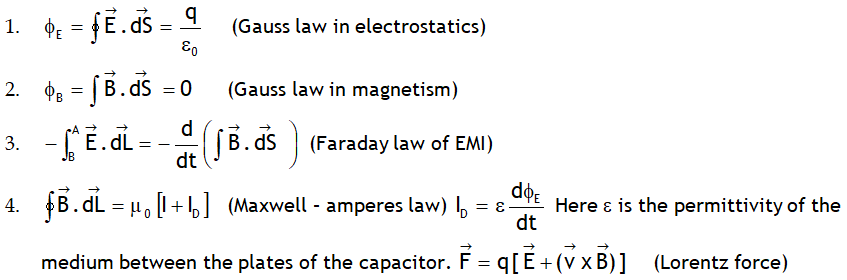
Following five equations give a complete description of all em– interactions and are called Maxwell eq:
^γ – rays
(a) Produced in nuclear reactions and are also emitted by radioactive nuclei (such as Co 60 & Cs 137).
(b) Properties: Effect on photographic plate, fluorescence, ionization, diffraction, high penetrating power & can cause serious damage if absorbed by living tissues.
(c) Used
^Ultraviolet light
(a) Produced by special lamps like mercury and iron are lamps and by very hot bodies like sun.
(b) Properties: Effect on photographic plate, fluorescence, ionization, highly energetic, tanning of the human skin.
(c) Used
^Visible light
^Infra red waves
(a) Also called heat waves & are produced by hot bodies and molecules.
(b) Properties: Heating effect, reflection, refraction, diffraction & propagation through fog.
(c) Used
^Micro waves
(a) Produced by special vacuum tubes like klystrons & magnetrons. Due to their shorter wavelengths the microwaves don’t spread or bend around the corners of any obstacle coming in their way, hence can be transmitted as beam signals in a particular direction.
(b) Properties: Reflection, refraction, diffraction and polarization.
(c) Used in
^Shm & waves
 Call 9872662552