Posts

^Convex mirror & Concave lens

^Convex mirror & Concave lens

A convex mirror has Inner or depressed side polished. A concave lens is thick near edges & thin near the center. They have following common features

  1. Virtual focus
  2. Diverge light rays striking on them
  3. Negative optical power
  4. Can form only a diminished & virtual image of a real object.
^Concave mirror & Convex lens

^Concave mirror & Convex lens

A concave mirror has outer or bulged side polished. A convex lens is thick near center & thin near the edges. They have following common features

  1. Real focus
  2. Converge light rays striking on them
  3. Positive optical power
  4. Can form several type of images such as diminished, enlarged, same size, real virtual image of a real object
  5. Can’t form a diminished & virtual image of a real object.

^Plane mirror

^Plane mirror

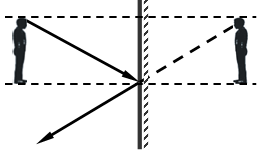
1. Image formed by a plane mirror is virtual, erect, undiminished, unmagnified, behind the mirror such that both the object & image are at equal distances from the mirror.

2. A plane mirror forms real image for a virtual object.

^Spherical aberration

^Spherical aberration

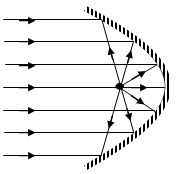
The various rays in a wide beam falling on a concave mirror of large aperture after reflection don’t meet at a single focus, marginal rays get focused somewhere between F & F while paraxial between C & F , consequently the image formed is not bright & single but a large no. of blurred images are produced.

In order to minimize the spherical aberration defect we shall use

(a)  Objects with low heights

(b)  Paraxial incident rays

(c)  Mirrors of small aperture (called parabolic mirror, used as reflectors of head lamps of vehicles).

^Paraxial & marginal rays

^Paraxial & marginal rays

In a wide beam of incident rays the rays travelling close to principal axis are called paraxial & the rays away from principal axis are called marginal.

^Law of reflection

^Law of reflection

  1. The Incident ray, Reflected ray & normal to the reflecting surface at the point of incidence all are coplanar i.e. lie in the same plane
  2. Angle of incidence = Angle of reflection Maximum value of angle of incidence & angle of reflection is 900 & minimum is 00.
  3. Normal lies between Incident ray & reflected ray.

Using law of reflection we can say

(a) For normal incidence (i.e. i  = 0) rays of light reflect back & retrace the path.

(b) Light ray passing through pole along principal axis of a mirror of any kind retraces its path i.e. suffers a deviation of 1800.

(c) Light rays parallel to principal axis passes through the focus after reflection.

(d) Light rays through focus become parallel to the principal axis after reflection.

(e) Light ray incident at some angle to principal axis emerges at equal angle with the principal axis after the reflection.

^Reflection of light

^Reflection of light

  1. Most of the light on striking a denser boundary comes back in same medium.
  2. There is a phase change of π if reflection takes place from a denser medium.
  3. Frequency, wavelength & speed of the light all remains the same.
  4. Intensity and hence, amplitude (I ∝ A2) usually ↓ es due to absorption at the boundary.

^Visible light

^Visible light

Visible light is a mixture of photons λ = 380 nm (violet) to 780 nm (violet) in appropriate proportion. Colour of light is determined by its frequency & not wavelength.

^Energy of a photon

^Energy of a photon

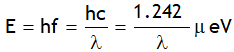
Energy ‘E’ of a photon depends upon its frequency ‘f’ or wavelength ‘λ’ & is described by Max Planck quantum radian law

[called energy condition

Energy of visible light is greater than that of infra red but smaller than ultraviolet. Red colour photons have maximum wavelength thus are least energetic. Also violet colour photons have minimum wavelength thus are most energetic.


^Optical frequencies

^Optical frequencies

Using the relation c = f λ, with c = 3 x 10⁸ m /s & λ = 380 nm to 780 nm we can check that the optical frequencies are of the order of 1015 Hz.

error: Content is protected !!
Call 9872662552