Posts

^Full wave rectifier

^Full wave rectifier

If during the positive half cycle of the input the end A becomes positive and the end B becomes negative with respect to the center tap C then diode D1 gets towards biased and conducts current D2 is reverse biased and does not conduct. During the negative half cycle the diode D1 gets reverse biased and does not conduct & D2 conducts current. As during both half cycles of input ac the current through load RL flows in the same direction F to C.
^Half wave rectifier

^Half wave rectifier

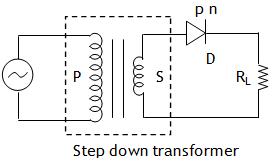
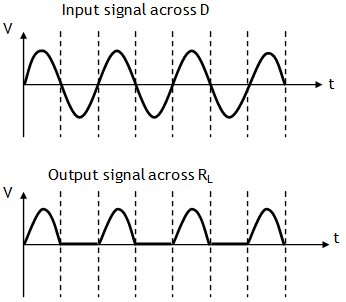
It gives output only for half cycles of the applied input, thus there is a discontinuity in the current. The same process is repeated again & again for the next positive & negative half cycles. The output voltage is unidirectional but pulsating.


^Principle

^Principle

A diode so offers very low resistance in forward biasing & very high resistance during the reverse biasing. For an ideal diode we assume it offers zero resistance in forward biasing & infinite resistance during the reverse biasing & thus will conduct for only during those cycles in which it is forward biased & doesn’t conduct when reverse biased.

^Rectifier

^Rectifier

A device used to convert AC to DC is called a rectifier. It is based on the unidirectional property of conduction.

^Uses of diode

^Uses of diode

A diode can be used as

  • rectifiers (to convert dc to ac),
  • LED (produce light on forward biasing a diode)
  • solar cells (using solar energy to produce emf)
  • photodiodes (to produce reverse current which can be controlled with intensity of light)
  • Zener diodes (to converting fluctuating dc to constant dc)
  • fast switching OR – gate & AND – gate

^Current in diode

^Current in diode

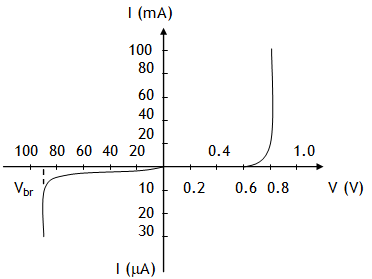
In forward bias strong diffusion current plus a weak & nearly constant drift current, so that a net current of the order of few mA. & is found to increase with the increase in forward bias voltage.

In reverse bias strong drift current plus a weak & diffusion current so that a net current of the order of few mA flows & is found to be voltage independent upto a critical reverse bias voltage, known as breakdown voltage (Vbr).

^Biasing of a diode

^Biasing of a diode

^Junction diode

^Junction diode

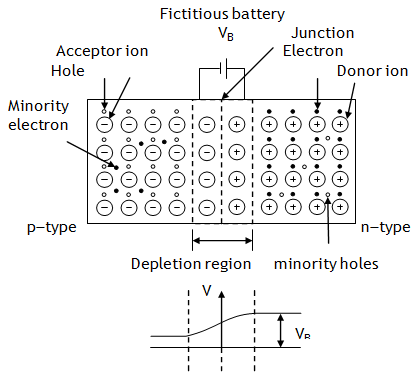
It is formed by joining p-type crystal with a n-type crystal. Majority charge concentration gradient across junction diffuses majority charge carriers diffusion from p to n (called diffusion current) & combine with each other near the junction and get neutralised. Due to electron hole neutralization near the junction the impurity atoms become uncovered & a thin region of uncovered unbalanced immobile charges is created. This region is called depletion region (thickness » 1 μm).  This resulting in potential gradient across junction which drifts minority charge carriers drifting from n to p (called drift current). Initially, diffusion current is large and drift current is small. As the diffusion process continues, the space-charge regions on either side of the junction extend, thus increasing the electric field strength. This electric field (» 106 V/m) offers a barrier (called potential barrier, it depends upon the nature of the SC (e.g. 0.7 V for Si & 0.3 V for Ge), the temperature of SC & the amount of doping) to the further diffusion of es & holes towards each other but increases the drift current till the steady state (i.e. until the diffusion current equals the drift current & thus no net current flows or the diode doesn’t conduct).

^n-type versus p-type

^n – type versus p – type

^Intrinsic versus extrinsic SCs

^Intrinsic versus extrinsic SCs

error: Content is protected !!
Call 9872662552