Posts

^Facts

Facts

  • If the liberated mass doesn’t react with electrodes, the electrode is called inert otherwise soluble.
  • Cu – anode with any metallic cathode in Cu –voltameter forms inert electrode.
  • Platinum electrodes in water voltameter, Platinum anode in Cu – voltameter are the examples of inert electrodes.
  • During electrolysis mass of cathode increases, (Reduction takes place at cathode) while that of anode decreases & concentration of electrolyte remains constant.
  • Alternating current can’t be used in electrolysis. As the frequency of AC changes periodically, so there will be no deposition on any electrode actually.
  • The back EMF or polarization EMF in water is 1.5 V. This is why to carry out electrolysis of H2O we need a voltage greater than 1.5 V.
  • Electrolysis is useful in, electroplating, extraction of metals from ores & their purification, electrolytic etching to mark logo, to produce H2 and O2 commercially, to separate non-metallic particles from the metallic ones, to ascertain the polarity of a battery, in finding equivalent weights & atomic weights.
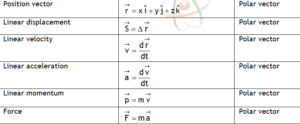
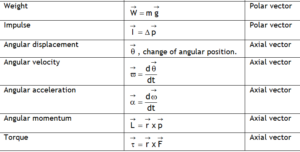
*Physical quantities

*Physical quantities

Quantity (symbol) Definition / Relation Type
Mass (m) Quantity of matter contained in a substance Scalar
Distance (D) Actual path length Scalar
Speed (v) Distance covered per unit time spent Scalar
Time (t) Reference to measure duration of an event. Scalar
Electric current (I) Rate of flow of charge. Scalar
Pressure (P) Normal force per unit area Scalar
Surface tension (S) Tangential force per unit length Scalar
Work (W) Line integral of force Scalar
Power (P) Rate of work Scalar
Energy (E) Capacity to do work Scalar
Heat (H) Energy in transit due to temperature difference Scalar
Electric potential (V) Line integral of electric field Scalar
Electric flux (f) Surface integral of electric field Scalar
Specific heat (s) Heat per unit temp. change per unit mass Scalar
Latent heat (L) Heat per unit mass for changing state of a material Scalar
Temperature (T) Degree of hotness or coldness Scalar
Electric charge (q) Measure of amount of electrification Scalar
Density (r) Mass per unit volume Scalar
Moment of inertia (I) Reluctance for rotational changes Scalar


^Circuit to find ‘r’ of a cell

Circuit to find ‘r’ of a cell

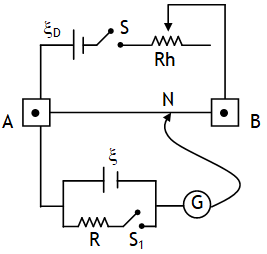
When the switch S is closed & the switch S1 is kept open, then the cell of emf ξ is said to be in open circuit. Let here the balancing length is b1, then ξ ∝ b1 Now when the switches S & S1 are closed, then the cell of emf ξ is said to be in closed circuit.

Let here the balancing length is b2, then V ∝ b2

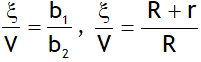
Dividing above two relations we get

^Wheatstone bridge

Wheatstone bridge

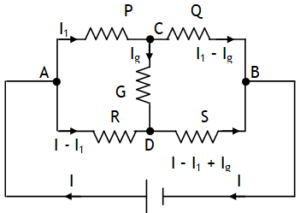
It is the quadrilateral arrangement of four resistors P, Q, R & S connected to a cell & galvanometer G as shown. Here P & Q are called ratio arms, R known arm & S unknown arm.

1. If , then VC = VD & the bridge is said to be balanced i.e. the potential difference across the arm CD is zero, consequently no the current through the arm CD & thus arm CD can be removed. Also the position of cell & galvanometer can be interchanged.

2. If , then VC ≠ VD & bridge is said to be in the unbalanced state. If  then current flows from up & if  then current flows down.

3. Wheatstone bridge is said to be sensitive if all the four resistances are of the same order i.e. when the current in the four branches is of the same order. In this case error associated with the measurement of X is mini.

^Fuse

Fuse

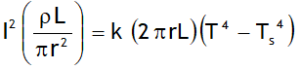
A fuse is a thin wire made up of an alloy of lead (75 %) & tin (25 %). Both its resistance and melting point are low. It is connected in series to the circuit in to protect the circuit from sudden strong currents by breaking the circuit. When the rate at which heat produced by the current becomes equals to the rate at which heat lost by radiation, the temperature of the wire further stops increasing. This stage is called steady state, then rate of heat supplied = Rate of heat lost i.e.

(a) For constant ρ, T & Ts we can write I2  ∝ r 3, L0

(b) As TS = 0 for vacuum & other terms are constants thus T 4 ∝ r – 3 or T  ∝ r – 3 / 4

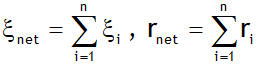
^Finding net emf

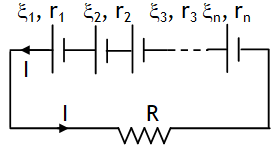
Finding net emf

Here cells 1 & 2 are in parallel

^Average velocity

^Average velocity

Velocity between two instants is called average. Mathematically it is measured as the displacement covered per unit time spent. It is also a vector quantity directed in the direction of displacement.

For motion along x – axis,   

^Mixed grouping of identical cells

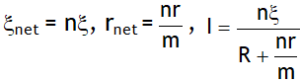
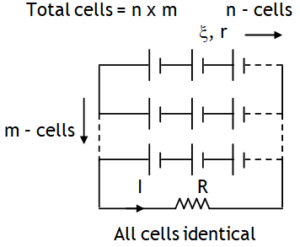
Mixed grouping of identical cells

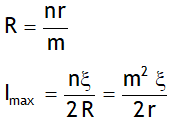
For maximum current

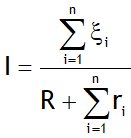
^n – cells in series

n – cells in series

As all the cell supply current in same direction thus

^Power delivered

Power delivered

Power delivered by a dc circuit element can be calculated using the relation

Using above relation we can say

1. The rate of heat generated in a wire is doubled when both the radius & length of the wire is doubled.

2. For constant voltage, the time taken to boil water by a heater directly varies with its resistance. i.e. t ∝ R.

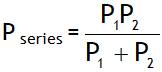
3. Equivalent power of two bulbs of same voltage rating connected to a supply of voltage equal to voltage rating of either is

(i)        (ii) Pparallel = P1 + P2

error: Content is protected !!
Call 9872662552