^Paraxial & marginal rays
^Paraxial & marginal rays
In a wide beam of incident rays the rays travelling close to principal axis are called paraxial & the rays away from principal axis are called marginal.

^Paraxial & marginal rays
In a wide beam of incident rays the rays travelling close to principal axis are called paraxial & the rays away from principal axis are called marginal.
^Law of reflection

Using law of reflection we can say
(a) For normal incidence (i.e. i = 0) rays of light reflect back & retrace the path.

(b) Light ray passing through pole along principal axis of a mirror of any kind retraces its path i.e. suffers a deviation of 1800.

(c) Light rays parallel to principal axis passes through the focus after reflection.

(d) Light rays through focus become parallel to the principal axis after reflection.

(e) Light ray incident at some angle to principal axis emerges at equal angle with the principal axis after the reflection.

^Reflection of light
^Visible light
Visible light is a mixture of photons λ = 380 nm (violet) to 780 nm (violet) in appropriate proportion. Colour of light is determined by its frequency & not wavelength.
^Energy of a photon
Energy ‘E’ of a photon depends upon its frequency ‘f’ or wavelength ‘λ’ & is described by Max Planck quantum radian law
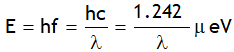 [called energy condition
Energy of visible light is greater than that of infra red but smaller than ultraviolet. Red colour photons have maximum wavelength thus are least energetic. Also violet colour photons have minimum wavelength thus are most energetic.
^Optical frequencies
Using the relation c = f λ, with c = 3 x 10⁸ m /s & λ = 380 nm to 780 nm we can check that the optical frequencies are of the order of 1015 Hz.
^What is visible light
EM-radiation that can be detected by the human eye is called white light or simply visible light. It is mainly through visible light and the sense of vision that we know and interpret the world around us. Sensation of colour of light perceived by the human eye is determined by its frequency of the wave falling on ratina cells and not on its wavelength.
Visible light is a mixture of photons of wavelengths from 380 nm to 780 nm in appropriate proportion. Following table displays the wavelength range for colours.
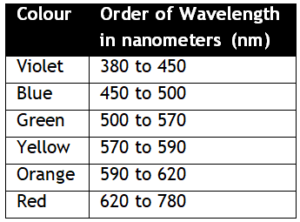
In terms of micrometer (μm) & angstroms (A0) we can write 570 nm = 0.57 μm = 5700 A0
^Quantum optics
Quantum optics treats light as a particle (localised energy packet) called photon’ to deal with photoelectric effect, Raman effect & LASER, etc.

^Wave optics
Light behaves as a wave when the size of obstacle is comparable with the wavelength of light. Wave optics branch explains the following phenomena
^Physical optics
Physical optics is further divided into two parts, viz., wave optics and quantum optics.
 Call 9872662552