Posts

^Image formation by a lens

^Image formation by a lens

(a) A concave lens always form virtual, erect & diminished image irrespective of the position of the object.

(b) With a convex lens following possibilities are there

Position of object
Ray diagram
Image produced
At ∞
At F
Real (inverted)
Extremely Diminished
m < < 1
Beyond C i.e.
Between ∞ and 2 F
Between F & C
Real (inverted)
Diminished
m < 1


At C
At C
Real (inverted)
Same as size of object
m = 1
Between F and C
Beyond C
Real (inverted)
Magnified
Object at F
At ∞
Real (inverted)
Infinite size
m → ∞
Between F and P
Beyond 2 F Virtual (erect)
Magnified
m > 1

^Image formation rules

^Image formation rules

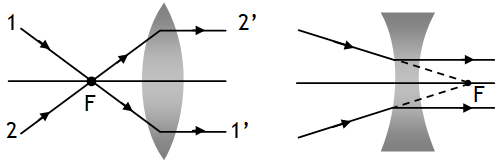
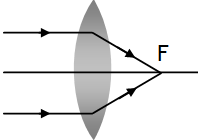
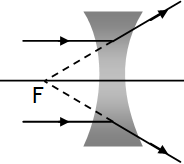
1. A ray passing through optical center of any lens convex or concave at any angle to principal axis goes undeviated.

2. An oblique passing through focus of any lens convex or concave at any angle to principal axis becomes parallel to principal axis after refraction.

3. A ray parallel to principal axis of any lens convex  or concave axis meets or appears to be meeting focus after refraction.


^Curved surface refraction formula

^Curved surface refraction formula

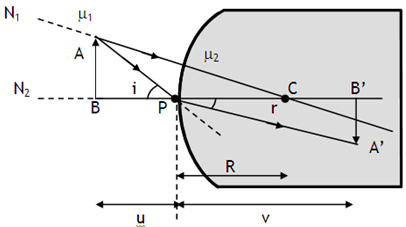
It is a general expression, applicable to both convex & concave surface, for both point & extended object placed in any medium rare or denser, for any type of image formed (real or virtual).

While using this result keep in mind following points:

  1. All distance are measured from the pole P (i.e. the centre of surface at which incident ray strikes.
  2. μ1 → Medium from which incident ray comes.
  3. μ2 → Medium towards which incident ray is sent.

^Porro – prisms

^Porro – prisms

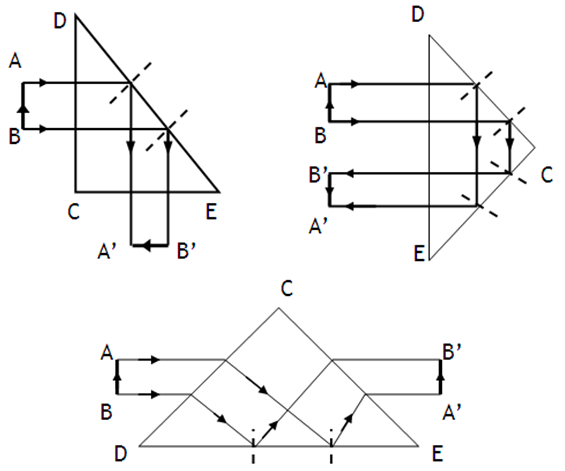
A Porro – prisms is a totally reflected is a right handed isosceles prisms having ∠C = 420, μ = 1.5 and ∠i = 450.  These prisms are used to bend light by 90º or by 180º & to invert images without changing their size. Following are few advantages of TRPs over plane mirrors.

  • Unlike plane mirror, do not require silvering.
  • Almost 100 % reflection is possible in TRP (where as in case of a good plane mirror it is never more than 95%). Hence comparatively brighter image is produced.
  • When used for a long time, the silvered face of mirror deteriorates which reduces the quality of the image. (in TRP there is no such deterioration).


^δ without θ

^δ without θ

Under this condition

This combination is also called Achromatic prism combination.

^θ without δ

without δ

Under this condition

Such a combination is called a direct vision prism. The required condition is

^Dispersive power

^Dispersive power

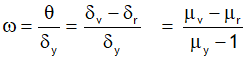
It is independent of A but depends upon nature μmaterial.

From a single prism it is not possible to get deviation without dispersion, or to get dispersion without deviation, however the two or more be combined in such a way that a white ray of light it may undergo:

(a) Dispersion without deviation (i.e. θ without δ)

(b) Deviation without dispersion (i.e. δ without θ)

^Angle of dispersion

θ = δv – δr = [μv – μr] A

^Small angle deviation

^Small angle deviation

δ = A (μ – 1)

δ depends on i, A, μprism, μmedium,

The cause of dispersion is that the speeds of different colours of light in a transparent medium are different.

Also as μv > μr thus δv > δr   i.e. the angles of deviation for different colours are different. It is maximum for violet & is minimum for red colour.

^Maximum deviation

^Maximum deviation

A prism shows maximum deviation when incidence angle is maximum i.e. 900, also then

  1. δmax. = 900 + e – A
  2. r1 = C
  3. e = sin1 [μ sin (A – C)]
error: Content is protected !!
Call 9872662552