Posts

^Malus law

^Malus law

Let I0 be the intensity and ‘A’ the amplitude of the unpolarized light falling on the polarizer & θ be the angle between the pass axis of the polaroid & amplitude vector, then the component Acosθ, parallel to the pass axis (y) of polarizer passes through it & the component Asinθ, perpendicular to pass axis is blocked by the polarizer, thus the intensity of light transmitted by the polarizer is

I = k (A cosθ)2 = k A2 cos2 θ

or         I = I0 cos2 θ        [called Malus law

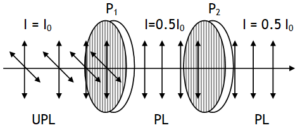
Actually the phase angle for a beam of unpolarised light can have any value from 00 to 3600. Now as the average value of cos2 θ for the range 00 to 3600 is 0.5, thus the average intensity of light transmitted by a polarizer is only 0.5 I0.  Following observations can be explained on the basis of Malus law.

1. Two polarizes with parallel pass axis (y & y)
2. Two polarizes with crossed pass axis (y & z)

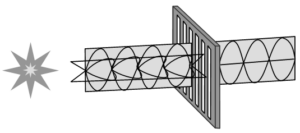
^Light through a polarizer

^Light through a polarizer

Let ordinary light propagating along +x axis falls normally on a tourmaline crystal having pass axis parallel to y axis as shown in the following diagram.  On passing through the tourmaline crystal the electric field vibration parallel to pass axis are transmitted while the electric field vibration normal to pass axis are absorbed by the tourmaline.

^How do polarisers work

^How do polarisers work 

A Polaroid is a thin commercial sheet containing long chain of hydrocarbons which become conducting at optical frequencies & absorb the electric field parallel to chains & transmit the electric field perpendicular to the chain length. This is why a direction perpendicular to the chain length is called the transmission axis or pass axis of the polarizer. For shown drawing y axis is pass axis.

^Polarisers

^Polarisers

Any device or material that plane polarizes the unpolarised light passed through it is called a polarizer.  Nicol prism, Tourmaline crystal, Polaroid etc. are some commonly used Polarisers.

^Plane polarized light

^Plane polarized light

If the electric field vector of a light wave vibrates just in one direction perpendicular to the direction of wave propagation, then it is said to be linearly polarized along that direction. Human eyes can’t distinguish between an unpolarised light and a polarized light, but the eyes of a bee can.

^Ordinary or unpolarized light

^Ordinary or unpolarized light

Light is made up of the superposition of a huge number of light waves emitted by individual atoms whose electric fields are in random directions. As a result the direction of vibration (DOV) of electric field vector at any given point of space keeps on changing very rapidly & randomly but always remain perpendicular to the direction of propagation (DOP). Such a light is called randomly polarized or simply unpolarized light. If a light wave propagates along x axis then tip of the electric field vector traces an irregular planar curve & there can be infinite directions of vibrations of electric field vector in the yz plane as shown in the diagram.

Light from a light bulb, candle, Sun is unpolarized. Usually we represent electric field vibrations in a ordinary light by dots & double arrows. Here double arrows represent the vibrations in the plane of paper (let xy plane) i.e. along ± y – axis and small dots represent vibrations perpendicular to the plane of paper along i.e. ± z – axis.

^Polarisation

^Polarisation

A wave having vibrations is only in one direction & that is normal to its direction of propagation is called a polarized wave & the phenomenon of restricting the oscillation of a wave to just one direction in a direction transverse plane or normal to its direction of propagation is called polarisation of waves. Only transverse waves can be polarized or longitudinal waves can’t be polarized. Any transverse wave can be linearly polarized in any direction perpendicular to the direction of propagation.

^Interference versus diffraction

^Interference versus diffraction

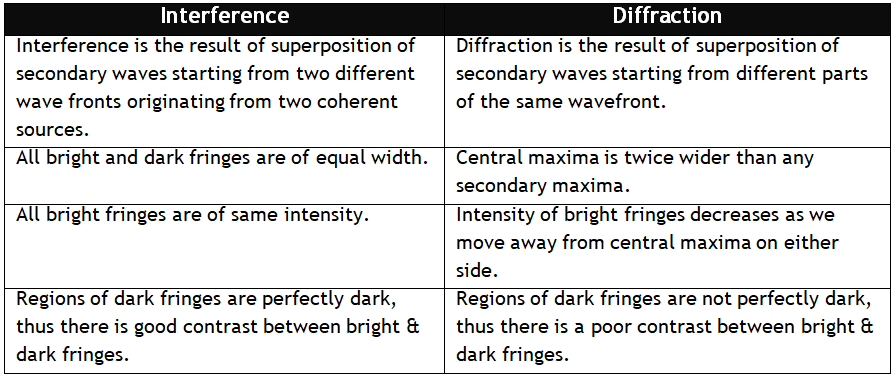
Following table gives some important points of difference between interference and diffraction

^Resolving power of a compound microscope

^Resolving power of a compound microscope

Here, λ = wavelength of light used

μ = refractive index of the medium between the object & objective lens

θ = Half angle of the cone of light from each point object.

Also μ sinθ is called numerical aperture.

From above relation it is clear that the resolving power of a compound microscope can be increased by increasing refractive index of the medium. It is due to this reason that oil immersion objectives are used to increase the resolving power. Also, higher the value of numerical aperture, larger will be the resolving power of the microscope.

^Resolving power a telescope

^Resolving power a telescope

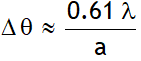
For the two stars to be just resolved,

Implying, Resolving limit of a telescope is,

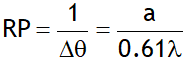
Resolving power of a telescope is,

Thus Δθ will be small if the diameter (2 a) of the objective is large. This implies that the telescope will have better resolving power if a is large. It is for this reason that for better resolution, a telescope must have a large diameter objective. Also a bigger objective collects more light & hence produces more bright images. We can also say by increasing the diameter of the objective lens we can increase the range of a telescope.  The stars which are not resolved in the image produced by the objective can’t be resolved by any further magnification produced by the eyepiece. The primary purpose of the eyepiece is to provide magnification of the image produced by the objective.

error: Content is protected !!
Call 9872662552