Posts

^Pair production effect

^Pair production effect 

When a photon of energy atleast 1.02 MeV interacts with a nucleus a pair of particles (one electron & one positron) is produced. This is called Pair production effect. The probability of the Pair production effect increases with energy of photon striking the  nucleus & atomic number of the target nucleus.

γ + Nucleus → e+ + e

^Photocell

^Photocell

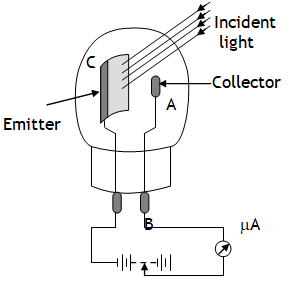
Also called electric eye works on the photoelectric effect. Its electrical properties are affected by the amount of light.

It can be used as light meters to measure the intensity of light in scientific work. In the reproduction of sound in motion pictures and in the television camera for scanning and telecasting, as burglar alarm, as fire alarm, as automatic door, opener, in electronic ignition circuits, as automatic counter to count the no. persons entering an auditorium.

^Photoelectric current

^Photoelectric current

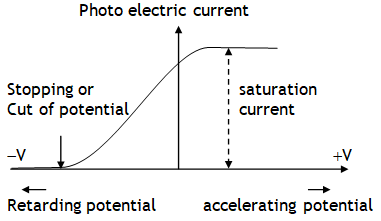
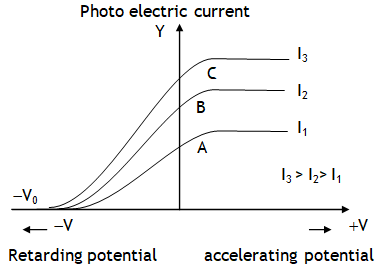
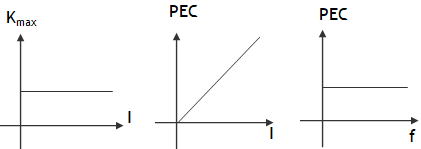
For a given metal & frequency of incident radiations the no. of photo electrons ejected per second is called photoelectric current it is directly proportional to the intensity of incident light but independent of energy of incident light.

^Kinetic energy of the photoelectrons

^Kinetic energy of the photoelectrons

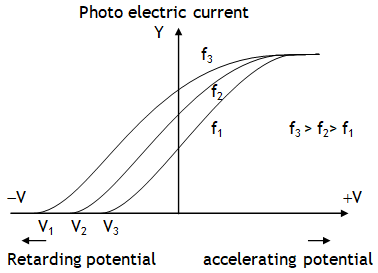
The kinetic energy of the photoelectrons varies from 0 to Kmax. Maximum KE of photoelectrons is independent of intensity of incident light but depends upon energy or frequency of incident light. It is given by Einstein’s photoelectric equation

Kmax = h(f inci. – fth) = eVs

Stopping potential versus incident frequency

^Photoelectric effect

^Photoelectric effect

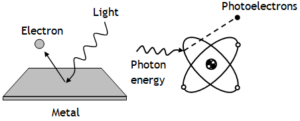
1. An instantaneous process (10-8 s) of emission of free electrons from the surface of a metal (also called cathode) when light photons of energy greater than threshold frequency are incident on it.

2. Einstein experimentally confirmed that the Photoelectric effect is a one-photon-one electron process & verifies the quantum nature of light as it is the result of particle-particle interaction.

3. Threshold energy (or work function) is the least energy required by an electron to come out of the metal. Its value is few eV & it depends only on the nature of metallic surface & impurities present in it & is independent of the energy or incident photons. W = W0 = E th = hf th.

4. Alkali metals like Li, Na, K, Cs, Rb etc. show PEE with visible light. Metals like Zn, Cd, Mn etc. are sensitive only to UV-light. Cs (Cesium) is the best photosensitive metal.

^Heisenberg’s uncertainty principle

^Heisenberg’s uncertainty principle

It is impossible to specify preciously and simultaneously the values of both members of canonically conjugate quantities (CCQ) i.e. those quantities which on multiplication give units of action (i.e. Js) e.g.

1. Linear momentum and Linear displacement

2. Energy and Time

3. Angular momentum and Angular displacement.

Let c1 and c2 be the two CCQ, then according to

Heisenberg’s uncertainty principle

In our daily life uncertainty principle has no significance.


^Einstein’s massenergy equivalence

^Einstein’s mass-energy equivalence

The relation

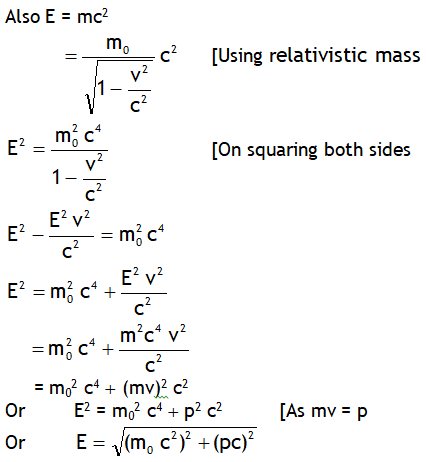
is called relativistic energy or Einstein’s mass-energy equivalence as it reveals that mass & energy are interconvertible.  Here the quantity m0 c2 is the energy associated with the rest mass of the body, K is the kinetic energy of the body & the sum of KE & rest mass energy is called the total energy (E) of the body.

Differentiating this relation we get

c2.2 m dm – m2.2v dv – v2.2m dm = 0

or c2 dm = mv.dv + v2 dm            _ _ _ _ (1)

Also according to Newton’s second law of motion, force acting on a body is defined as the rate of change of its momentum i.e.
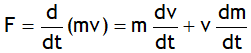
Now if this force F displaces the body by a distance dx, its energy increases by

Equating (1) & (2) we get

dK = dm.c2                                            _ _ _ _ (3)

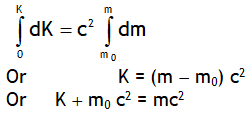
If particle is accelerated from rest to a velocity v, let its mass m0 increase to m, then its total increase in KE can be obtained by integrating equation (3) , i.e.
Suppose a body of rest mass m0 moves with a velocity v << c.  Its mass at speed v is

As mc2 is the total energy and m0 c2 is the rest mass energy. Therefore the term (mc2 – m0 c2) represents the kinetic energy, thus KE of the body is

This is the same result that we obtain by classical Newtonian mechanics.

Facts

1. Zero rest mass i.e. m0 = 0 means massless particle & for such particles, E = pc i.e. even a massless particle can possess energy.

2. An electron and photon have same de-broglie wavelength. Which has more total energy?

Ans. Same λ means same p (as, p = h/λ) & quantity having more m0 will have more E, i.e. Electron.

3. An electron and proton have same total energy. Which has more de-broglie wavelength?

Ans. In order to have same E the quantity having less m0 must have more p or less λ (as, p = h/λ), i.e. Electron.

4. Also KE of a particle is

5. If a photon and electron has same de Broglie wavelength, then the KE of the photon is  times the kinetic energy of the electron.

Commonly used values

1. Charge of electrons = e = – 1.6 x 10⁻¹⁹ C

2. Rest mass of electrons = m0 = 9.1 x 10⁻³¹

3. Sp. charge of electron = e/m0 = 1.76 x 10¹¹ C/ kg

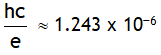
4. hc = 1.989 x 10⁻²⁵  » 2 x 10-25

5.
^Relativistic mass & energy

^Relativistic mass & energy

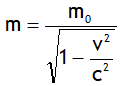
Mass of a particle moving at speed v (also called relativistic mass) is related to its rest mass m0 & speed of light c as

Note here m0 and c are constants.

^Electron microscope

^Electron microscope

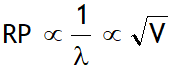
The wave properties of electrons have been utilised in the design of electron microscope. Resolving power of an electron microscope is expressed as .

Resolving power of electron microscope can be up to 105 times that of optical microscope.

^de-Broglie hypothesis

^de – Broglie hypothesis

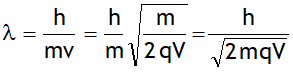
All material microscopic particle have dual nature, i.e. they can behave like particle as well as like a wave. Wavelength associated with a particle of momentum p is given

de Broglie waves are also known as Matter waves, pilot waves, stationary waves or probability waves. Theses are neither mechanical (as can be propagated even in vacuum) nor electromagnetic (as not produced by accelerated charges necessarily).

1.  For charged particles

Using values of h, m & q for an electron one can write:

For a 120 V accelerating potential, the above equation gives λ = 1.12 A0. This wavelength is of the same order as the spacing between the atomic planes in crystals.

In a similar way we can write

2.   For Neutral particles

(a) For neutron we need to put K & m.

error: Content is protected !!
Call 9872662552