*Integral calculus

*Integral calculus

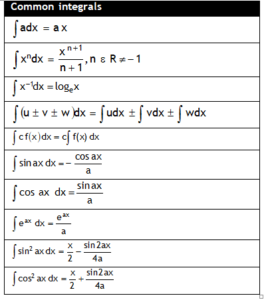
Integration is the reverse process of differentiation, thus also called anti-differentiation.

Suppose we have a function g (x) whose derivative.
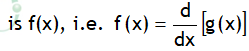
The function g (x) is known as the indefinite Integral of f (x) and is denoted as:

1/d is usually abbreviated by the symbol ∫ (called integral), so one can write

∫ f (x) dx = g (x) + c

Here c is called constant of integration. Its value is arbitrary and can be calculated form the information given in the problem.

Integral of the form     is called definite integral. Here x = a & x = b are called limits of integration. x = a is called lower limit & x = b is called upper limit. If limits are not given, then the integration is called indefinite integration.

Definite integral is a number. Indefinite integral has no limits; it is a function. No integration constant is required in the final answer in definite integrals. Following examples explain how one can derive integration from differentiation.
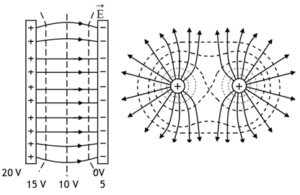


^Equipotential surfaces

Equipotential surfaces

  1. An equipotential surface is an imaginary surface on which every point has one and the same value of electric potential. It can be curved or plane surfaces.
  2. No work is done in moving any charge over an EPS.
  3. Electric field is always ⊥ to EPS.
  4. EPS tells us about direction of electric field.
  5. EPS helps to distinguish regions of strong field from that of weak field. As the separation between two equipotential surfaces is more, where the field is weak & vice – versa.
  6. No EPS can intersect each other.

*Maxima & minima

*Maxima & minima


^Electrostatic potential (V)

Electrostatic potential (V)

Electrostatic potential energy per unit victim charge is called electrostatic potential i.e. using this result & F = q E, LCF can be expressed as .

If a charge particle is moved from ∞ → P, then the above relation can be expressed as

Choice of potential is arbitrary & matter of Convenience, usually we assume V = 0 at infinity.

Bothe field & potential are high when observation point is near a positive charge. Whereas near a negative charge field is high & potential is low.

^Partial derivatives

^Partial derivatives

Let y = f (u, v, w), then ∂y/∂u means partial derivative y w.r.t. u i.e. differentiating y w.r.t. u, keeping v & w constants. Similarly ∂y/∂v means taking partial differentiation of y w.r.t. v, keeping u & w constants.

^Potential energy of point charges

Potential energy of point charges

1. For a system of two point charges

2. For a system of three point charges

3.

4. For a stable system U is minimum, its first derivative w.r.t. position (= – F) is zero & its second derivative w.r.t. position is +ve.

^Rules of differentiation   

^Rules of differentiation   

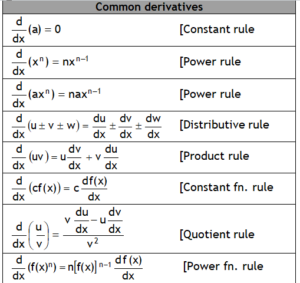
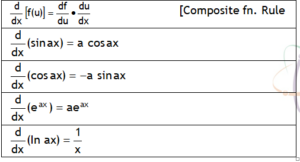
Following table displays some commonly used differentials in physics.

^Work done by a electrostatic force

Work done by a electrostatic force

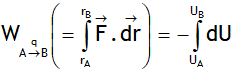
Work done by a electrostatic force ‘F’ in moving a point charge ‘q’ from a point A to point a point B situated in conservative electrostatic field

1. is path independent

2. depends only upon the initial & final positions

3. is equal to loss of potential energy of the point charge between these positions. i.e.

4. zero for a cyclic path.

^Electrostatic force

Electrostatic force

Electrostatic force has following properties

1. Force on any charged particle situated in its electrostatic electric field is given by

  [Called electrostatic Lorentz force

2. This force is independent of direction or amount of their velocity.

3. It acts in the direction of field on a positive charge & acts opposite to the direction of field on a negative charge.

4. Acceleration of a charge particle due to force exerted by the electric field using NSL is

5. Both +ve & -ve charge particle when accelerate under this force always moves in the direction of decreasing potential energy, mathematically this situation is expressed as

Called law of conservative force.

6. Dropping integral & vector sings & rearranging the above relation can be expressed as  i.e. a conservative force is equal to negative of potential energy gradient.

7. Loss of potential energy of a system implies equal amount of gain in the KE so that the mechanical energy (i.e. K + U) of the system moving in electrostatic electric field is always conserved (i.e. constant). This is why electrostatic force is called conservative.

^Electrostatic field

Electrostatic field

If the electric field of a charge at a point doesn’t vary with the time, then the electric field is called electrostatic electric field. It’s effect on other charges is studied by defining two quantities; one a scalar field function called electric field potential ‘V’ & second a vector field function called electric field intensity  are related as

Here the –ve sign implies that electric field intensity due to both positive & negative charged configuration is always in the direction of decreasing field potential i.e. from a region of high potential to a region of low potential.

error: Content is protected !!
Call 9872662552