^Capacitance

Capacitance

1. Capacitance of a system is a measure of the its capacity to hold charge for a given potential difference.

2. Capacitance can be defined as

3. Capacitance is defined even if a capacitor is neutral.

4. SI unit of capacitance is Farad (F).

5. 1F = 1 C V – 1 = 9 x 10¹¹ stat farad.

6. Farad is a too big unit. Practical capacitors are of the order of mF, nF & pF etc.

7. Generally the two plates have equal and opposite charges. Even if, we give different charges to the plates then the inner surfaces facing each other posses equal and opposite charges.

8. The plates are separated by a distance much smaller than dimensions of a capacitor.
^Capacitor

Capacitor

A capacitor is an arrangement of two conductors (called plates) separated from each other by a dielectric medium & used to trap (or store) electric energy in the form of electric field between its plates.

^Field due to charged conductors

Field due to charged conductors

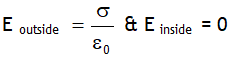
Under electrostatic conditions for a conductor of any shape,

^Field due to sheets

Field due to sheets

Using Gauss law we can prove that electric field sheets of charge density σ

1. near a infinite sheet or thick sheet

2. near a finite sheet or thin sheet
^Potential due to concentric spheres

Potential due to concentric spheres

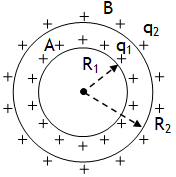
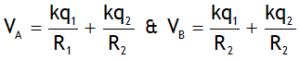
Consider two identical concentric spheres of radii R1 & R2 carry charges q1 & q2 respectively as shown in the diagram. Then total potential on A & B will be equal to sum of potentials due to charge on A & B & given by

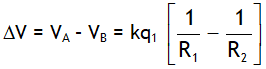
The potential diff. between two surfaces is

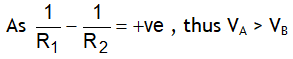
From above relation we can say

1.  The potential difference is independent of the charge on the outer sphere.

2.

3. When the two conductors are joined by a thin wire, their potentials becomes same i.e. potential difference between them becomes zero. This is possible only when q1 is zero i.e. actually this will happen only when the entire charge on A moves to sphere B.

4. If q1 is negative, even then entire charge on A moves to sphere B, as we know negative charge moves from low to high potential.

^Point charge

Point charge

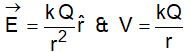
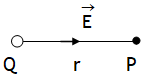
A body of almost no size is called a point body or discrete body i.e. a sphere of radius R → 0 is a point like body.  Both field & potential are not defined on a discrete charge, as r → 0 implies E & V → ∞. Outside the point charge field & potential are

Field of a point charge has following properties

1. radially outward if charge is positive & inwards if it is negative.

2. at finite distance around it, field is spherically symmetric & obeys inverse square law i.e. it is not uniform

3. at infinite distance from the it, field is zero

4. maxi. it the charge is placed in vacuum or air.

^E & V due to uniformly charged sphere

E & V due to uniformly charged sphere

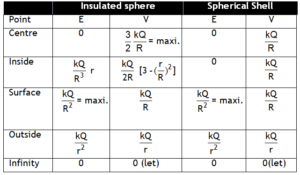
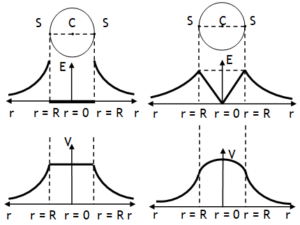
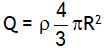
Charge on a insulated sphere of uniform volume charge density r & radius R is ,

Charge on a spherical insulated shell or a conducting sphere of uniform surface charge density s & radius R is, Q = σ 4 πR2

Using Gauss law we can write

^Factors deciding flux

Factors deciding flux

Electric flux depends only upon

(a) the number of charges enclosed by Gaussian surface

(b) nature of charges enclosed by Gaussian surface

(c) nature of the medium. & is independent of

(d) size of surface

(e) distance between charges inside the surface

(f) distribution of charges.

Diagram explains that the net electric flux through each surface is the same irrespective of the shapes of the closed surfaces surrounding a charge q.

Diagram explains that the no net flux is linked with the closed surface if a point charge is located outside a closed surface as in this case the number of lines entering the surface equals the number leaving the surface.

Diagram explains that the net electric flux through any closed surface depends only on the charge inside that surface. The net flux through surface SA is q1/e0, the net flux through surface SB is and net flux through surface SC is zero.

*Principle of homogeneity

*Principle of homogeneity

According to principle of homogeneity of quantities (PHQ) only those quantities can be added or subtracted which have same physical nature.

e.g. Force can’t be added in velocity, similarly or distance can’t be subtracted from time.

Also according to PHQ: L + L = L and L – L = L

L + T = not possible and T – M = not possible.

However there is no restriction on multiplication or division i.e. quantities having same or different dimensions can be both multiplied as well as divided. e.g. v = x/t, F = m.a, P = F/A, W = F.x etc.


^Rules for writing units

^Rules for writing units

  • The initial letter of a unit symbol named after a scientist is written in capital letters, however the full name begins with small letter. e.g. five newtons should be written as 5 N or 5 newtons but not as 5 n.
  • Symbols for various units are never used in plural form. e.g. 5 N should be written as 5 N and not as 5 Ns, however we can write 5 newtons but not 5 Newtons.
  • Symbols are never followed by a full stop.
  • Not more than one solidus is used. e.g. Nm– 2s– 1 shouldn’t be written as N/m2 /s.
  • The use of double prefix is avoided, when single prefix is available. e.g. instead of writing  μμN we should write pN.

In calculations the prefix is attached with the numerator and not with the denominator.

error: Content is protected !!
Call 9872662552