*Physical constants

*Physical constants

CONSTANT SYMBOL VALUE IN SI UNITS DIMENSIONS
Absolute zero K -273.15 K [K]
Astronomical unit AU 1.5 x 10 11 m [L ]
Atomic mass unit or unified mass u 1.66 x 10 – 27 kg [M ]
Avogadro’s constant N0 6.023 x 10 23 moleucles/mol [mol– 1]
Bohr magneton mB 1.41 x 10 – 26  J/T [AL2]
Bohr’s radius b 5.29 x 10 – 11  m [L]
Boltzmann’s constant k 1.38 x 10 – 23 J mol – 1 K-1 [ML 2 T – 2 K – 1]
Coulomb’s constant k 9.00 x 10 9 N m 2 C – 2 [M1 A 2 L 3 T – 4]
Elementary charge e 1.6 x 10 – 19  C [AT]
Gravity g 9.8 ms – 2 [LT – 2]
Gravitational constant G 6.673 x 10 – 11 Nm 2 kg – 2 [M – 1 L 3 T – 2]
Mass of earth M 5.98 x 10 24 kg [M ]
Mass of electron at rest m 9.1 x 10 – 31 kg [M ]
Mechanical heat equivalent J 4.186 J cal – 1 no dimensions
Molar volume of ideal gas at STP Vm 2.27 x 10 – 2  m 3/mol [L3 mol – 1]
Loschmidt constant N0 2.69 x 10 25 m – 3 [L – 3]
Permittivity constant e0 8.85 x 10 – 12  F/m [M – 1 A 2 L – 3 T 4]
Permeability constant m0 1.26 x 10 – 6  H/m [M A– 2 L T – 2]
Planck’s constant H 6.626 x 10 – 34 Js [ML 2 T – 1]
Radius of earth R 6.4 x 10 8 m [L ]
Rydberg constant R 1.10 x 10 – 7 m – 1 [L – 1]
Specific charge of electron e/m 1.76 x 10 11  C/kg [ATL – 1]
Speed of light in vacuum c 3.0 x 10 8 m/s [L T – 1]
Standard atmospheric pressure 1 atm 1.013 x 10 5 Nm – 2 [ML – 1 T – 2]
Solar constant S 1.4 x 10³ Wm – 2 [MT – 3]
Stefan – Boltzmann constant s 5.67 x 10 – 8 Wm – 2 K 4 [MT – 2 K – 4]
Triple point of water Ttr 273.16 K [K]
Universal gas constant R 8.31 J mol – 1 K – 1 [ML 2 T – 2 K – 1]
Wien’s displacement constant b 2.89 x 10 – 3 mK [LK]

^Thermoelectric power

Thermoelectric power

The potential difference de across a piece of metal due to temperature difference dT is called the thermoelectric power or the Seebeck coefficient (S) of that material & is defined as, _ _ _ _ (1)

Its units is V/K. Values in the hundreds of μV/K, negative or positive, are typical of good thermoelectric materials.


*Quantities having same dimensions

*Quantities having same dimensions

Momentum, impulse. [MLT – 1]
Surface tension, spring constant. [MT – 2]
Latent heat, gravitational potential. [L2  T – 2]
Gravity, gravitational field intensity. [LT – 2]
Angular momentum, Planck’s constant. [ML2  T – 1]
Solar constant, pointing vector & wave intensity. [MT – 3]
Frequency, angular frequency, velocity gradient, decay constant. [T – 1]
Thermal capacity, gas constant, Boltzmann constant and entropy. [ML2 T – 2 K – 1]
Length, breadth, height, distance, displacement, radius of gyration & wavelength. [L]
Work, torque (or moment of force), Energy of any kind e.g. internal, potential, kinetic, heat etc. [ML2 T – 2]
Pressure, stress, elasticity of any kind e.g., Young’s, bulk’s, modulus of rigidity, energy density. [MLT – 2]
Strain, refractive index, relative density, angle, solid angle, dielectric constant, relative permeability. [M0 L0  T0]
Energy gradient, force of any kind e.g. gravitational (weight), EM (upthrust, friction) nuclear etc. [MLT – 2]
Momentum, impulse. [MLT – 1]
Surface tension, spring constant. [MT – 2]

^Thermoelectric effect

Thermoelectric effect

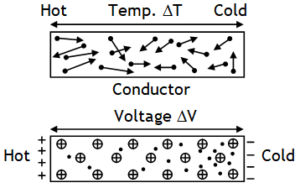
Consider an metal rod heated at one end & cooled at the other end as shown.

The electrons in the hot region are more energetic and therefore have greater velocities than those in the cold region. Consequently there is a net diffusion of electrons from the hot end towards the cold end which leaves behind positive metal ions in the hot region and accumulated electrons in the cold region. This situation prevails until the electric field developed between the positive ions in the hot region and the excess electrons in the cold regions prevents further electron motion from the hot to cold end. A voltage developed between the hot and closed ends with the hot end at positive potential at the steady state.

This effect in which a temperature gradient between two points in a material (may be a conductor or semiconductor) gives rise to a built in electric field or a voltage difference between two points. This phenomenon is called the Seebeck effect or the thermoelectric effect.


^Facts

Facts

  • If the liberated mass doesn’t react with electrodes, the electrode is called inert otherwise soluble.
  • Cu – anode with any metallic cathode in Cu –voltameter forms inert electrode.
  • Platinum electrodes in water voltameter, Platinum anode in Cu – voltameter are the examples of inert electrodes.
  • During electrolysis mass of cathode increases, (Reduction takes place at cathode) while that of anode decreases & concentration of electrolyte remains constant.
  • Alternating current can’t be used in electrolysis. As the frequency of AC changes periodically, so there will be no deposition on any electrode actually.
  • The back EMF or polarization EMF in water is 1.5 V. This is why to carry out electrolysis of H2O we need a voltage greater than 1.5 V.
  • Electrolysis is useful in, electroplating, extraction of metals from ores & their purification, electrolytic etching to mark logo, to produce H2 and O2 commercially, to separate non-metallic particles from the metallic ones, to ascertain the polarity of a battery, in finding equivalent weights & atomic weights.

^Faraday laws of electrolysis

Faraday laws of electrolysis

1st law: m ∝ q or m =  z I t

2nd law:  m ∝ E for constant q

^Shm & waves

^Shm & waves

*Bulk properties of matter

*Bulk properties of matter

^Rotational motion

^Rotational motion

error: Content is protected !!
Call 9872662552