^What is a vector

Description of motion along a straight line the role of direction is played by +ve & -ve signs of that direction, however to describe motion in 2 & 3 dimensions we need vectors.

^What is a vector

If both magnitude and direction are required to completely described a physical quantity, then it is called a vector. A vector quantity is  represented by putting on arrow above it or by bold letter e.g. it Q is vector then we represent it as  or Q. If a quantity can have any direction it is called polar vector. If its direction is along axis (axis of rotation), then called axial vector.

*Uniform acceleration

*Uniform acceleration

If in equal intervals of time velocity changes by equal amounts, then the acceleration is called uniform & such a motion is called Uniformly Accelerated Motion (UAM).

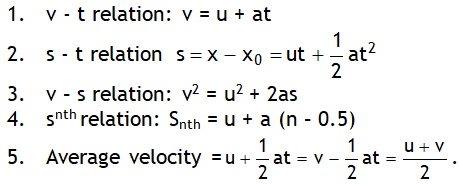
1 D Kinematic equations of UAM

In the above relations S is displacement & not distance.

As in a circular motion & SHM acceleration is not a constant thus these relations are not applicable there. If motion is 2 D or 3 D then kinematics equations are applied either in vector form or separate equations each along x, y & z directions are considered.

Facts

  1. Magnitude of instantaneous velocity is always equal to instantaneous speed, but magnitude of average velocity is equal to average speed only for uniform motion.
  2. Zero velocity not necessarily means zero acceleration e.g. if a body stops momentarily under the influence of a retarding force, then at that moment its velocity is zero but its acceleration is equal to net force divided by  its mass.

Special situations of UAM

  1. The two ends of a train moving with a constant acceleration pass a certain point with velocities u and v.  Then the velocity of the midpoint of the train when it passes the same point will be RMS of u and v

   (using v – s relation)

2.   A boy is standing ‘d’ meters away from a stationary bus. Let the bus begins to move with constant acceleration ‘a’. In order to       catch  the bus, the boy starts running with a uniform velocity ‘u’ towards the bus as soon as the bus started. Let the boy catches the bus in time t. This is possible only if the total distance travelled by the boy is exactly equal to that travelled by the bus in same time (at2/2).

i.e. d + ut = at2/2

or at2 – 2ut – 2d = 0

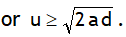
In order to catch the bus the roots of above equation must be real, for this the discriminant should not be negative

i.e. (-2u)2 > 4 (-2d) (a) ≥ 0

Simplifying the quadratic time taken by the boy to catch the bus can also be calculated.

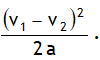
3.The driver of a train moving at a speed v1 observes another train at a distance d ahead of him on the same track moving in the same direction with a slower speed v2. He applies the brakes and gives his train constant deceleration a. To prevent collision ‘d’ should be greater than

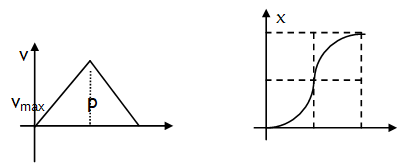
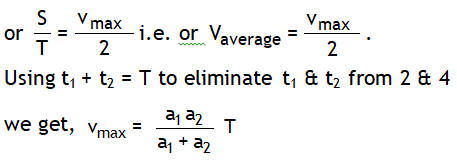
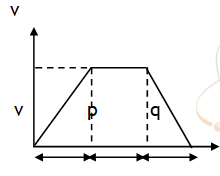
4.If a particle accelerates from rest for time ‘t1’ & covers a distance ‘x1 ‘ at the rate ‘a 1’  & then retards to rest at the rate ‘a2’ over a distance ‘x2in time ‘t2’ .  Let the maxi. velocity of the particle is Vmax , total distance covered be S and total time spent is t1 + t2 = T (say) as shown in the v – t graph.

Curved portions in the x – t graph are parabolic.

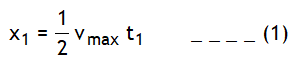
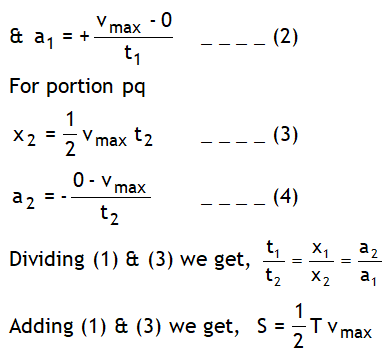
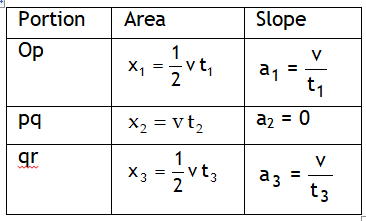
Using area under v – t graph with t axis is equal to displacement and slope of v – t graph is acceleration we can write,

For portion op

Now the above result to ready to use, don’t put the sign of retardation of a2 again in this relation.

5. The velocity of a train increases at a constant rate a1 from 0 to v in time t1 & covers a distance x1 in this time and then remains constant for time t2     

covers a distance x2 in this time and then finally decrease to zero at a constant rate a3 in time t3 & covers a distance x3 in this time, then we can write

*Uniform motion

*Uniform motion

Uniform motion means uniform velocity i.e. both the speed & the direction remain same w.r.t. time.

This is the case when the net force acting on it is zero or   of body is zero. This case is also called dynamic equilibrium.

  1. For uniform motion average speed is equal to instantaneous velocity.
  2. A body can never have a uniform velocity but a varying speed.

^Instantaneous acceleration

^Instantaneous acceleration

Acceleration at a particular instant of time is called instantaneous acceleration. Mathematically it is measured as the limiting value of the average acceleration.

For motion along x – axis,=

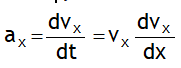
For 1 D motion along x – axis we have,

i.e. instantaneous acceleration is equal to slope of velocity time graph (v – t).

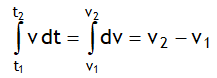
On separating the variables & integrating this relation can be rearranged as

i.e. area under v – t graph bounded with the time axis for a time interval is equal to change in velocity for that time interval.

i.e. instantaneous acceleration is slope of velocity time graph (v – t) or velocity times slope of v – x graph.

*Average acceleration

*Average acceleration

Average acceleration is defined as the change in the velocity per unit time spent. If the velocity of a moving body a time t1 when it was at point A is v1.  Let at time t2 it reaches point B where is velocity is v2.

Change in its velocity per unit time spent is called average acceleration for an interval.

For motion along x – axis,


^Variation of emf with temp.

Variation of emf with temp.

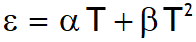
The magnitude of & direction depends upon nature of materials of the wires forming thermocouple & difference in temperature of two junctions. For majority of the thermocouples, the temperature dependence of the thermo-emf can be expressed by a quadratic equation,

                                      _ _ _ _ (1)

where α and β are constants  for the given pair of metals, called thermoelectric coefficients while θ is the temperature difference between hot and cold junctions.

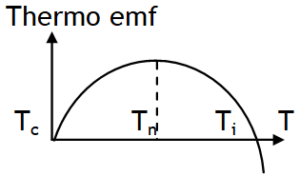
The above relation holds for a limited range of temperature. Also the variation of thermo emf drawn against temperature difference between hot and cold junctions is found to be parabolic as shown.

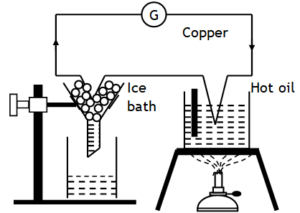
Following experimental setup may be used to the effect of temp. on thermo emf for a given thermocouple:

One junction is kept hot by immersing in hot oil bath & the other junction is kept cold by immersing in ice. The temperature of the hot junction can be measured by a thermometer T. The deflection in the sensitive galvanometer G gives a measure of thermo emf.

*Instantaneous speed

*Instantaneous speed

Speed at a particular instant of time is called instantaneous, also speed means magnitude of instantaneous velocity. Reading of a speedometer of a vehicle is the instantaneous speed. It is scalar & always positive. Mathematically it is measured as the limiting value of the average speed i.e.

Instantaneous speed =

^Thermocouples

Thermocouples

The arrangement of two different metals (or semiconductors) joined at their ends to form a loop is called a thermocouple. Ends are called junctions. Temperature difference applied to a thermocouple creates a voltage in it & vice versa. This effect of direct conversion of temp. differences to electric voltage & voltage differences to temp. is called the thermoelectric effect or thermoelectricity.

Traditionally, the term thermoelectricity encompasses three separately identified effects, the Seebeck effect, the Peltier effect, and the Thomson effect. Peltier effect is due to the contact of different metals. Thomson effect is the absorption or evolution of heat along a non-uniformly heated conductor, Basic cause of thermoelectric effects is the diffusion of free electrons from the regions of high electron density to the regions of low electron density.

*Average speed

*Average speed

Speed between two instants is called average. Mathematically it is measured as the total distance covered per unit time spent. It is scalar & always positive.

i.e. Average speed

  1. For a given time interval average velocity is single valued while average speed can have values depending upon path followed.
  2. Average velocity & average speed are equal only for motion along a straight line with no reversal.
  3. The average speed can never be – ve or zero while average velocity can be.
  4.  If a particle travels distances x1 , x2 & x3 with speeds v1 , v2 & vduring time intervals t1, t2 & t3 respectively, then its average speed is    If x= x= x3, then this relation becomes harmonic mean of individual speeds.                                                                                                                                                                      Also if t1 = t2 = t3, then the average speed is be given by Arithmetic mean of individual speeds.                       

^Sign of thermoelectric power

Sign of thermoelectric power

Sign of S is sign of cold side i.e., potential of cold side.  By convention, the sign of S represents the potential of the cold side with respect to the hot side. If electrons diffuse from hot to cold end, then the cold side is negative with respect to the hot side and the Seebeck coefficient is negative. In a p – type semiconductor, on the other hand, holes would diffuse from the hot to the cold end. The cold side would be positive with respect to the hot side which would make S a positive quantity.

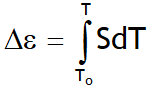
The total voltage difference between two points where temp. are T0 ­ and T, from equation (1), is given by _ _ _ _ (2)

In practice one rarely measures the absolute thermopower of the material of interest. This is due to the fact that electrodes attached to a voltmeter must be placed onto the material in order to measure the thermoelectric voltage.

The temperature gradient then also typically induces a thermoelectric voltage across one leg of the measurement electrodes.

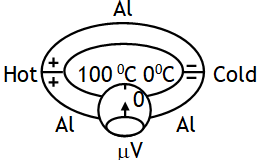
Therefore the measured thermopower includes a contribution from the thermopower of the material of interest and the material of the measurement electrodes. Suppose that we try to measure the voltage difference DV across the aluminium rod (heated at one end and cooled at the other end) by using aluminium connecting wires to a voltmeter as shown.

The same temperature difference, however, now also exists across the aluminium connecting wires and therefore an identical voltage also develops across the connecting wires, opposing that across the aluminium rod.

Consequently no net voltage will be registered by the voltmeter.

It is, however possible to read a net voltage difference, if the connecting wires are of different material, i.e. have a different coefficient than that of aluminium , so that across this material the thermoelectric voltage is different than that across the aluminium rod.

The voltage across each metal element depends upon on its Seebeck coefficient so that the potential difference between the two wires will depend on SA – SB. The emf between the two wires,  VAB = DVA – DVB, by virtue of eqn. (2), is then given by
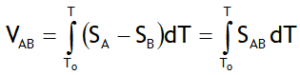
Here SAB is defined as the thermoelectric power for the thermocouple pair A – B.

The Seebeck coefficients are non-linear as a function of temperature, and depend on the conductors’ absolute temperature, material, impurities, imperfections, and structural changes. If the Seebeck coefficients are effectively constant for the measured temperature range, the above formula can be approximated as:

VAB = (SA – SB)·(T – T0)

The thermopower is an important material parameter that determines the efficiency of a thermoelectric material. A larger induced thermoelectric voltage for a given temperature gradient will lead to a larger efficiency. Ideally one would want very large thermopower values since only a small amount of heat is then necessary to create a large voltage. This voltage can then be used to provide electric power.

Typically metals have small thermopowers because most have half-filled bands. Electrons (negative charges) and holes (positive charges) both contribute to the induced thermoelectric voltage thus canceling each other’s contribution to that voltage and making it small. In contrast, semiconductors can be doped (adding impurities) with an excess amount of electrons or holes and thus can have large positive or negative values of the thermopower depending on the charge of the excess carriers.

error: Content is protected !!
Call 9872662552