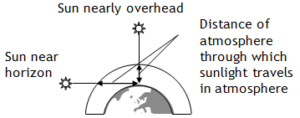
^Sun appears red at Sun rise & sun set

^Sun appears red at Sun rise & sun set

This is because at Sun rise & sun set light passes through greater thickness of atmosphere, as a result more scattering takes place & blue colour & low wavelengths are scattered away by the scattering caused by the atmosphere & the colour which reaches us is unscattered red.

General scattering

When size of obstacles encountered by the light is much greater than the wavelength of light used, all wavelengths of light are scattered equally.

^Dangers signals are made red

^Dangers signals are made red

Danger signals, traffic lights etc. are made red. Red light being longest wavelength is scattered least & hence can go to large distance without any appreciable loss due to scattering.

^Sky appears blue

^Sky appears blue

As blue colour has least wavelength, hence when white light encounters obstacles of size a << λ, blue colour is scattered max. Due to this reason sky appears blue.

^Scattering of light

^Scattering of light

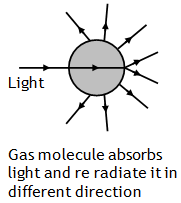
When unpolarized light falls on a gas or air molecules light falling on air molecules. The electric field of light polarises the air molecule makes it an electric dipole, which starts oscillating under the influence of oscillatory electric field of light & these dipoles radiate electromagnetic waves in all directions. This process is called scattering of light & the radiated light is called scattered light, it is unpolarized & intensity is found to be strongest along a line perpendicular to the oscillation, & drops to zero along the line of oscillation. The amount of scattering depends on the obstacle size coming in its way e.g. dust particles, rain drops, ice particles etc. We have divided scattering in two type.

1. Rayleigh scattering

When size of obstacles encountered by the light is much smaller than the wavelength (a << λ) of light used, the amount of scattering is inversally proportional to the fourth power of the wavelength of light.

^Problem solving tips

^Problem solving tips

  • If a particle is moving on a circular path with angular speed w about the center, then its angular speed about a point on the opposite side of the diameter passing through it is w/2.
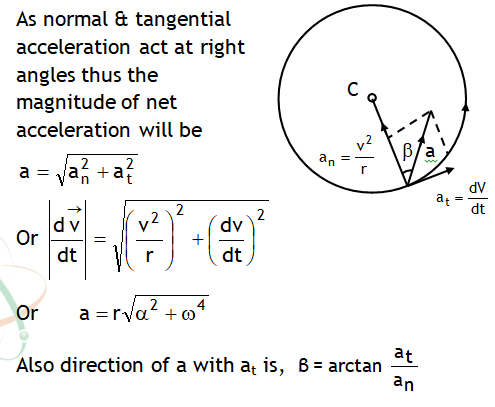
  • If uniform speed remains constant then the motion is called uniform circular motion. Magnitude of v, at & an respectively are
  • On a rigid body all points undergo same angular displacement (θ) in same time interval thus all the points on a rigid body rotate at same angular speed (ω) & have angular acceleration (α), thus v, at & an ∝ r. Thus a point situated farthest from center circle will have maximum value of speed, tangential acceleration & normal acceleration. Also a point at center will have zero values of v, at & an.
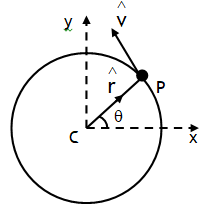
  • is a unit vector directed radially or normally outwards.

^Kinematics of circular motion

^Kinematics of circular motion

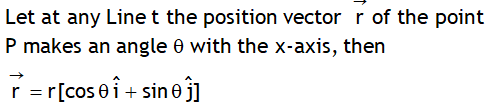
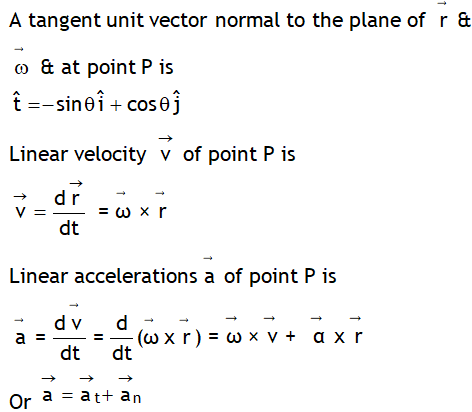
Suppose a particle is rotating anticlockwise in a circular path in xy plane. Its angular velocity vector at any point on circular path w.r.t. center is


^Inclined plane projectiles

^Inclined plane projectiles


^Horizontal range

^Horizontal range

Horizontal distance in the plane of projection is called horizontal range, it is
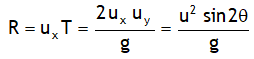
Horizontal range is same for complementary angles.

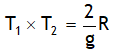
The product of time of flights of two projectiles fired from same point with same speeds at complementary angles is
Vertical range
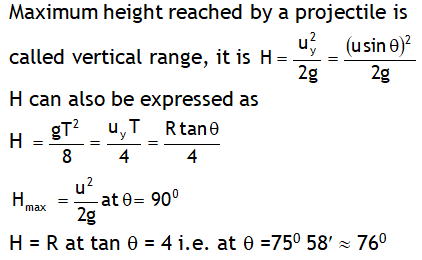
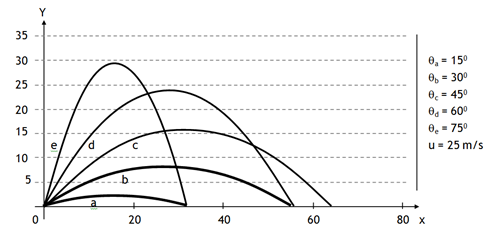
Diagram  above shows a situation a projectile is fired at a speed u = 25 m/s. On changing the angle of projection its range and height changes. Note horizontal range is same for complimentary angles. Also vertical range is maxi if projection angle is maxi.

Facts


In going from O to A the following changes take place

  1. Change in speed = zero
  2. Change in velocity = 2u sinθ
  3. Change in momentum 2 mu sinθ
  4. in kinetic energy = zero
  5. Change in potential energy = zero
  6. Change in the direction of motion = ∠ 2θ

Facts

  1. Three particles A, B and C are thrown from the top of a tower with the same speed. A is thrown straight up, B is thrown straight down and C is thrown horizontally, then the speeds & time on hitting the ground are given as:

vA = vB = vC and tA > tC > tB

2. Suppose a body projected vertically upwards from the top of tower of height ‘h’ reaches the ground in t1             second. If it is projected vertically downwards from the same top with same velocity, it reaches the ground in t2 seconds. If it is just dropped from the top, it reaches the ground in t second, then

^Time of flight

^Time of flight

From point F.5. b (ii) we know vy = zero at

projectile reaches its maximum height from point of projection. In the absence of air friction, wind & upthrust (actually all forces other than gravity) projectile takes same time to return back from maximum height to level plane of projection i.e. to travel path OPMA will be twice of this time, the total time to travel path OPMA is called time of flight (T), thus

.  Let a is the retardation due to air friction,

Describing velocity

^Describing velocity

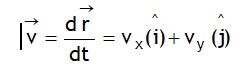
4. Velocity of a projectile is defined as

5. Using v – t relation for the motion O to P along x & y axis we can write

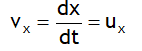
(a) v x – t relation:

As there is no term containing time, thus we can say that the horizontal component of velocity is time independent.

(b) v y – t relation:

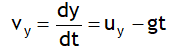
From above relation we can say that the vertical component of velocity varies with linearly time, also

error: Content is protected !!
Call 9872662552