^Parallel combinations of two springs
^Parallel combinations of two springs
Force exerted at one end is distributed undiminished to other end, but divided between the two springs, so that both spring undergoes same displacement. 


^Parallel combinations of two springs
Force exerted at one end is distributed undiminished to other end, but divided between the two springs, so that both spring undergoes same displacement.
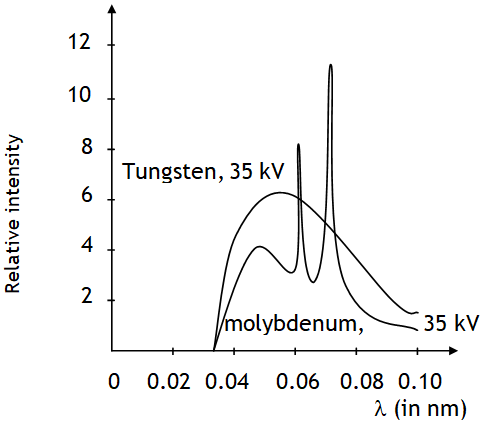
^Continuous X-rays
If the fast incident electrons undergo rapid deceleration by the electric field of the target then continuous (as having all sorts of wavelength) X-rays X-rays also called Bremsstrahlung X-rays are produced. This is the result of the inverse photoelectric effect, as the KE of the incident electrons is transformed into energy of X-ray photons. The minimum wavelength of continuous X-ray is:

^Series combinations of two springs
Force exerted at one end is distributed undiminished to other end, consequently same restoring force is developed in both the springs & the spring having more k undergoes less displacement.


^Production of X – rays
If the fast electrons incident on entering a heavy target (a metal piece of high atomic weight & high melting point) X-rays are produced.
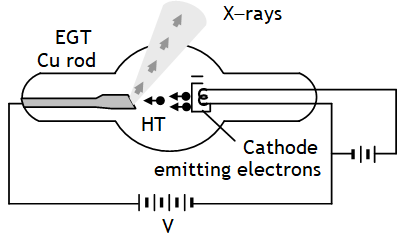
Coolidge tube is used in the production of X-rays. It is a hard glass evacuated tube (EGT). One end of the tube has a tungsten filament emitting fast moving electrons (also called cathode rays), while the other end contains the heavy target (HT).
A p.d. » 20 kV is maintained between the cathode and a metallic target accelerates the electrons toward the latter. In the Coolidge tube it is necessary to maintain vacuum of high order (P = 10–6 cm of Hg) so that the electrons may not lose energy due to the collisions with gas atoms. Majority part of the KE of the incident electrons is wasted in heating the anode & hence the X-ray production requires targets with high melting such as tungsten. Also cooling of target is required. The efficiency of production of X-rays less than 1%.
X-rays are produced by following two mechanisms
^Properties of X –rays
Are the atoms:
having same: nn
But different: A, Z, ne, np NN
Examples: 1. 1H2 & 2He3 2. 1H3 & 2He4
3. 3Li7 & 4Be8 4. 17Cl37 & 19K39
Symbols used: ne = Number of electrons
np = Number of protons
nn = Number of neutrons
NN = Number of nucleons
A = Mass Number
Z = Atomic Number
^Spring force, Fsp
A spring because of its elasticity has a tendency to resist its deformation (compression or stretching, x). It does so by producing a force that restores it back to its relaxed position, this force is called the spring force & varies linearly with the deformation given to spring.
Fsp = – kx for x << L.
Here k is called stiffness constant or force constant or elastic factor of the spring. It depends inversely on the length of the spring & directly on the elasticity (Young’s modulus, Y) of material used in making the spring.
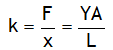
A is area of cross sectional of the material.
Using this property we can say that.
a. If a spring is cut into n equal parts then force constant of each part will be nk.
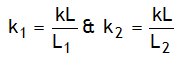
b. If a spring of length ‘L’ is cut into two parts whose lengths are in ratio L1 : L2, then the force constants will be:
^Isobars
Are the atoms:
having same: A, NN, Physical properties
But different: Element, Z, ne, np , Chemical properties
Examples: 1. 1H3 & 2He3 2. 6C14 & 7N14
3. 8O17 & 9O17 4. 11Na22, 10Ne22
5. 20Ca40 & 18Ar40 6. 17Cl37 & 16S37

mn > mp ( slightly) mp > > me , mp » 1836 me
 Call 9872662552