Posts

^Limitations of Bohr’s theory

^Limitations of Bohr’s theory

  1. It is valid only for single electron system.
  2. Nucleus was taken as stationary but it also rotates about its own axis.
  3. Couldn’t explain fine structure of spectral line.
  4. Provides no information about the relative intensities of spectral lines.
  5. Provides no distribution of electrons in an atom.
  6. Fails to explain that why do the electrons move only in circular orbits.
  7. Bohr’s theory doesn’t explain the Zeeman effect (splitting up of spectral lines in magnetic field) & Stark effect (splitting up of spectral lines in electric field).
  8. Bohr’s theory doesn’t explain the doublets in the spectrum of the some atoms e.g. in sodium (5890 A0 & 5896 A0).
  9. Silent about the selection rules which governs the transitions.
  10. Use two theories

(i) Quantum (to explain the existence of stationary orbits) &

(ii) Classical (for motion of electrons in the orbits). These two theories essentially oppose each other.

^Newton’s second law

^Newton’s second law

NSL defines force. External force is required to accelerate a body (change speed or direction or both).

When a body is seen from inertial frame of reference, the time rate of change of linear momentum is equal to the net external force acting on the body & takes place in the direction of net force

As all the three laws can be explained only from second law, that is why the 2nd law is called real law of motion.

^Spectrum of hydrogen atom

^Spectrum of hydrogen atom

^Rydberg’s formula

^Rydberg’s formula

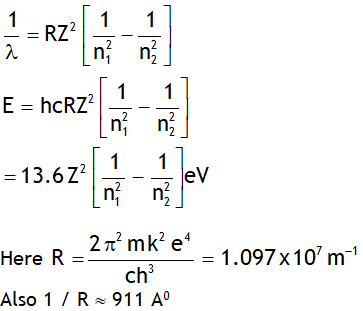
Let ‘E’ be the energy & λ be the wavelength of the photon released when an electron jumps from a higher quantum state of principal quantum number n2 to a lower quantum state having principal quantum number n1, then

Note Rydberg’s constant depends on mass of

Electron, thus it is not a universal constant.

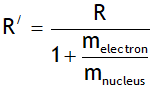
In deriving the above value the nucleus is assumed to be at rest. However if nucleus is not assumed stationary then the Rydberg constant depends on both mass of electron & nucleus & is given by

^Bohr’s frequency condition

^Bohr’s frequency condition

Energy is emitted only when an electron exited to the higher states jumps back to lower states. The energy emitted is described by the relation

h f = E1 – E2

Ionization energy = +13.6 eV Z2

^Energy level diagram

^Energy level diagram

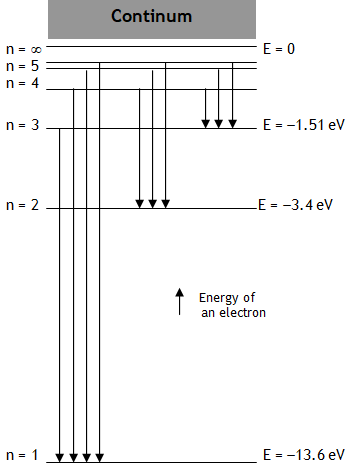
With the increase in the value of principle quantum number n

(a) r, L, T, U & E all increase while

(b) v, K, & w all decrease.

^Energy in nth orbit

^Energy in nth orbit

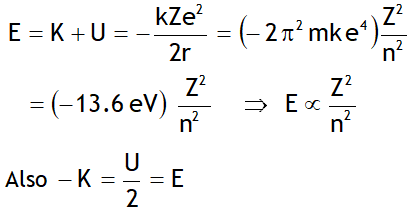
Here the -ve sign of energy shows that electron is bound to the nucleus & is not free.

The binding energy of the electron in the ground state of the H-atom is called Rydberg. i.e.

1Rydberg = 13.6 eV

^Magnetic moment generated

^Magnetic moment generated

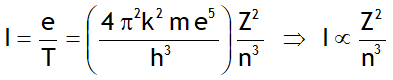
^Current generated

^Current generated

^Frequency of revolution

^Frequency of revolution

For n = 1, Z = 1; f = 6.57 x 10¹⁵ revolutions/s

error: Content is protected !!
Call 9872662552