Posts

^Characteristic X – rays

^Characteristic X – rays

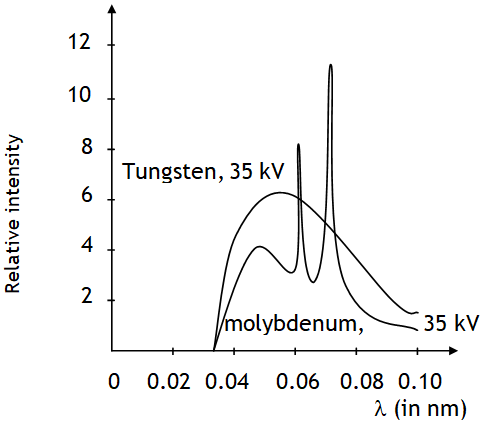
If the fast incident electrons collide with the electrons of the inner most level of the heavy target, knock them out. To fill the vacancy created electrons from the higher energy state jump & an X-ray photon of the corresponding energy gap is emitted in accordance with the Bohr’s hypothesis. Such X-rays are called characteristic X-rays.

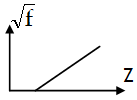
The frequency (f) of the characteristic X-rays is given by Moseley law:

f  = k ( Z b )2

Here Z is atomic no. & k, b are constants, their values depends on the series transition.

Moseley made an extensive study of the characteristic X-ray spectra of a number of heavy elements. Moseley’s work provided for the first time a way to determine experimentally the atomic number Z of an element. He concluded that the atomic number is more fundamental than atomic weight in the emission of characteristic X-rays & thus the elements in the periodic table must be arranged in the order of increasing atomic number.

^Continuous X-rays

^Continuous X-rays

If the fast incident electrons undergo rapid deceleration by the electric field of the target then continuous (as having all sorts of wavelength) X-rays X-rays also called Bremsstrahlung X-rays are produced. This is the result of the inverse photoelectric effect, as the KE of the incident electrons is transformed into energy of X-ray photons. The minimum wavelength of continuous X-ray is:

^Production of X – rays

^Production of X – rays

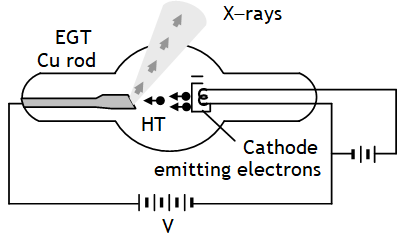
If the fast electrons incident on entering a heavy target (a metal piece of high atomic weight & high melting point) X-rays are produced.

Coolidge tube is used in the production of X-rays. It is a hard glass evacuated tube (EGT). One end of the tube has a tungsten filament emitting fast moving electrons (also called cathode rays), while the other end contains the heavy target (HT).

A p.d. » 20 kV is maintained between the cathode and a metallic target accelerates the electrons toward the latter.  In the Coolidge tube it is necessary to maintain vacuum of high order (P = 106 cm of Hg) so that the electrons may not lose energy due to the collisions with gas atoms. Majority part of the KE of the incident electrons is wasted in heating the anode & hence the X-ray production requires targets with high melting such as tungsten. Also cooling of target is required. The efficiency of production of X-rays less than 1%.

X-rays are produced by following two mechanisms

^Properties of X –rays

^Properties of X –rays

  1. EM with wavelengths from about 1 A0 to 100 A0.
  2. Travel in straight lie with speed of light.
  3. Can under go reflection, refraction, diffraction, interference & polarization.
  4. Not deflected by electric & magnetic fields.
  5. Produce flourescence.
  6. Affect photographic plates.
  7. Show photoelectric effect.
  8. Can Ionize the gases, destroy animal tissue & white blood cells.
  9. Penetrate through different depths into different substances.
  10. Don’t pass through heavy metals and bones. If such objects are placed in their path, they cast their shadow.

^Isotones

^Isotones

Are the atoms:

having same: nn

But different: A, Z, ne, np NN

Examples:  1. 1H2 & 2He3              2. 1H3 & 2He4

3. 3Li7 & 4Be8            4. 17Cl37 & 19K39

Symbols used: ne = Number of electrons

np = Number of protons

nn = Number of neutrons

NN = Number of nucleons

A = Mass Number

Z = Atomic Number

^Isobars

^Isobars

Are the atoms:

having same:  A, NN, Physical properties

But different: Element, Z, ne, np , Chemical properties

Examples:    1.  1H3 & 2He3                       2. 6C14 & 7N14

3.  8O17 & 9O17                     4. 11Na22, 10Ne22

5. 20Ca40 & 18Ar40                    6. 17Cl37 & 16S37

^Isotopes

^Isotopes

Are the atoms:

having same: elements, Z, ne , np Chemical properties

But different: A, nn, NN, Physical properties

Examples:  1. 1H1, 1H2, 1H3               2. 2He3, 2He4, 2He6

                  3. 8O16, 8O17, 8O18         4. 10Ne20, 10Ne21, 10Ne22

^Important masses

^Important masses

mn > mp ( slightly) mp > > me , mp » 1836 me

^Atomic mass unit (u)

^Atomic mass unit (u)

^Bohr correspondence principle

^Bohr correspondence principle

According to this principle the quantum theory must give same result as classical theory in the appropriate classical limit.  

error: Content is protected !!
Call 9872662552