^Arbitrary current carrying conductor
Arbitrary current carrying conductor
Magnetic field at point P around a conductor of arbitrary shape
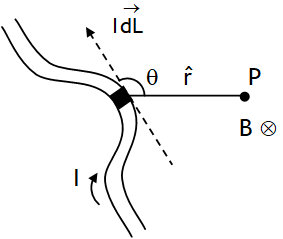
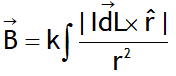
Here  is called current element.

Arbitrary current carrying conductor
Magnetic field at point P around a conductor of arbitrary shape
Here is called current element.
Sign of thermoelectric power
Sign of S is sign of cold side i.e., potential of cold side. By convention, the sign of S represents the potential of the cold side with respect to the hot side. If electrons diffuse from hot to cold end, then the cold side is negative with respect to the hot side and the Seebeck coefficient is negative. In a p – type semiconductor, on the other hand, holes would diffuse from the hot to the cold end. The cold side would be positive with respect to the hot side which would make S a positive quantity.
The total voltage difference between two points where temp. are T0 and T, from equation (1), is given by 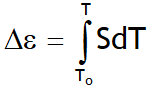 _ _ _ _ (2)
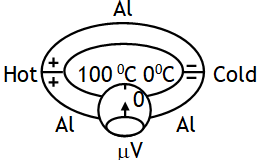
In practice one rarely measures the absolute thermopower of the material of interest. This is due to the fact that electrodes attached to a voltmeter must be placed onto the material in order to measure the thermoelectric voltage.
The temperature gradient then also typically induces a thermoelectric voltage across one leg of the measurement electrodes.
Therefore the measured thermopower includes a contribution from the thermopower of the material of interest and the material of the measurement electrodes. Suppose that we try to measure the voltage difference DV across the aluminium rod (heated at one end and cooled at the other end) by using aluminium connecting wires to a voltmeter as shown.

The same temperature difference, however, now also exists across the aluminium connecting wires and therefore an identical voltage also develops across the connecting wires, opposing that across the aluminium rod.
Consequently no net voltage will be registered by the voltmeter.
It is, however possible to read a net voltage difference, if the connecting wires are of different material, i.e. have a different coefficient than that of aluminium , so that across this material the thermoelectric voltage is different than that across the aluminium rod.
The voltage across each metal element depends upon on its Seebeck coefficient so that the potential difference between the two wires will depend on SA – SB. The emf between the two wires, VAB = DVA – DVB, by virtue of eqn. (2), is then given by
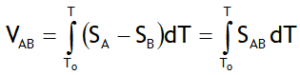
Here SAB is defined as the thermoelectric power for the thermocouple pair A – B.
The Seebeck coefficients are non-linear as a function of temperature, and depend on the conductors’ absolute temperature, material, impurities, imperfections, and structural changes. If the Seebeck coefficients are effectively constant for the measured temperature range, the above formula can be approximated as:
VAB = (SA – SB)·(T – T0)
The thermopower is an important material parameter that determines the efficiency of a thermoelectric material. A larger induced thermoelectric voltage for a given temperature gradient will lead to a larger efficiency. Ideally one would want very large thermopower values since only a small amount of heat is then necessary to create a large voltage. This voltage can then be used to provide electric power.
Typically metals have small thermopowers because most have half-filled bands. Electrons (negative charges) and holes (positive charges) both contribute to the induced thermoelectric voltage thus canceling each other’s contribution to that voltage and making it small. In contrast, semiconductors can be doped (adding impurities) with an excess amount of electrons or holes and thus can have large positive or negative values of the thermopower depending on the charge of the excess carriers.
*Quantities having same dimensions
| Momentum, impulse. | [MLT – 1] |
| Surface tension, spring constant. | [MT – 2] |
| Latent heat, gravitational potential. | [L2 T – 2] |
| Gravity, gravitational field intensity. | [LT – 2] |
| Angular momentum, Planck’s constant. | [ML2 T – 1] |
| Solar constant, pointing vector & wave intensity. | [MT – 3] |
| Frequency, angular frequency, velocity gradient, decay constant. | [T – 1] |
| Thermal capacity, gas constant, Boltzmann constant and entropy. | [ML2 T – 2 K – 1] |
| Length, breadth, height, distance, displacement, radius of gyration & wavelength. | [L] |
| Work, torque (or moment of force), Energy of any kind e.g. internal, potential, kinetic, heat etc. | [ML2 T – 2] |
| Pressure, stress, elasticity of any kind e.g., Young’s, bulk’s, modulus of rigidity, energy density. | [MLT – 2] |
| Strain, refractive index, relative density, angle, solid angle, dielectric constant, relative permeability. | [M0 L0 T0] |
| Energy gradient, force of any kind e.g. gravitational (weight), EM (upthrust, friction) nuclear etc. | [MLT – 2] |
| Momentum, impulse. | [MLT – 1] |
| Surface tension, spring constant. | [MT – 2] |
At balanced state
1. current in the galvanometer arm Ig is zero and
2. current flowing in the mesh ABCD is 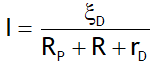
3. Potential drop across AB is V = IRp
4. Potential gradient K = V/L
5. As ξA is balanced against the potential drop of length AN, thus 
6. ξA ∝ b is called the principle of potentiometer.
7. To get the null point within the length of the potentiometer ξD > ξA
Greater the length of the potentiometer wire (L), smaller is the potential gradient (k) & more is the balancing length (b), hence more is the accuracy. ‘k’ is independent of the emf of auxillary cell (ξA) but depends upon emf of driver cell (ξD), its internal resistance (rD), resistance of potentiometer wire (AB) & any resistance (R) in the main circuit.
Dynamics
^Dynamics is a branch of physics which deals with the study of motion of the objects considering their cause also.
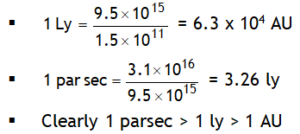
^Relations between AU, Ly and parsec
^A long horizontal fixed wire carries a current of 100 A. Directly above and parallel to it is another wire carrying a current of 20 A and weighing 0.04 N/m. The separation between the two wires so that the upper wire is just supported by the magnetic repulsion is
 Call 9872662552