Posts

^Micro waves

^Micro waves

(a) Produced by special vacuum tubes like klystrons & magnetrons. Due to their shorter wavelengths the microwaves don’t spread or bend around the corners of any obstacle coming in their way, hence can be transmitted as beam signals in a particular direction.

(b) Properties: Reflection, refraction, diffraction and polarization.

(c) Used in

  1. Radar systems used in aircraft navigation.
  2. In communication via satellites.
  3. Speed guns to determine speed of moving automobiles, cricket balls etc.
  4. Ovens for cooking
  5. In the study of atomic and molecular structure.

^Neutral points

^Neutral points

Neutral points are the positions where the magnetic field of a magnet is completely neutralised by the horizontal component of earth’s magnetic field. The position & number of neutral points depends upon the position of magnet.
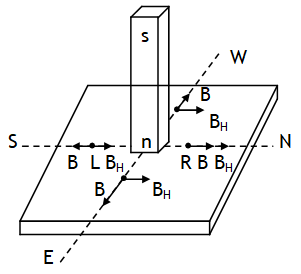
If a magnet is placed vertically as shown then we get only one neutral point situated at point L at left side of magnet if magnet’s north is down. On reversing the magnet neutral point will be at right side of magnet at point R.

Consider a magnet of dipole moment M, length 2L placed horizontally. Following drawings show the top view of the situation
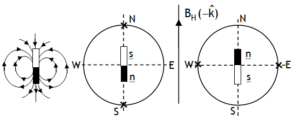
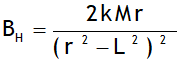
 Horizontal component of earth’s field is towards . When the magnet’s north (n) is towards earth’s south (S), then magnetic field of the magnet will be towards opposite to that of BH & both get cancelled at a point somewhere on the axial line of magnet & thus two neutral points (shown by cross marks) are obtained on the axial line (i.e. towards geographic north south line). If neutral points are situated at distance r from the centre of the magnet then at these points we can write
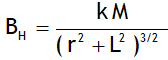
On reversing the magnet i.e. when magnet’s north (n) is towards earth’s north (N), two neutral points are obtained on the equatorial line (i.e. towards east – west line). At these points we can write
 

^Cause of earth’s magnetism

^Cause of earth’s magnetism

1. Gilbert suggested that the earth itself behaves like a giant magnet. The earth’s core is known to contain iron. Yet geologists do not regard this as a source of earth’s magnetism. As the molten iron is not ferromagnetic.

2. Due to Ionization of gases of atmosphere layer of charge particles called ionosphere is formed, which rotates with the rotation of the earth & hence produces magnetism.

Dynamo theory: Rotation of conducting ions of ferromagnetic materials like Fe & Ni in molten state produce current loops & hence magnetism is produced. Although the details of the dynamo effect are not known in detail, at present the dynamo theory seems to be most probable, because our moon which has no molten core, has no magnetism.

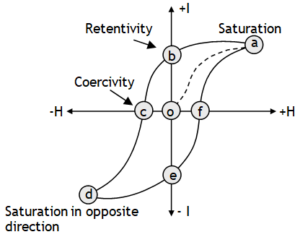
^Retentivity (ob) :

The value of I even when the H is reduced to zero.

^Hysteresis

Hysteresis

Hysteresis is the lag of intensity of magnitisation (I) behind the magnetising field (H) is called hystersis.

^Ferromagnetism

Ferromagnetism

The existence of domains leads to strongest magnetism in ferromagnetics. Due to the presence of cohesive forces in ferromagnetics the unpaired electron spins to line up parallel with each other in a region called a domain. A ferromagnetic domain is a region of crystalline matter whose volume may be between 10–12 m3 to 10–8 m3. Each domain contains about 1017 – 1021 atoms. The various atomic magnets are aligned in the same direction in a domain even in the absence of external magnetising field but different domains have magnetic moments in different directions such that within the domain, the magnetic field is intense, but in a bulk sample the material will usually be unmagnetized because the many domains will themselves be randomly oriented with respect to one another. When a ferromagnetic material is kept in external magnetising field, its domain experience force and torque which tends to align them along a definite direction, till magnetic saturation. This is called Magnetostriction effect.  The extent of alignment is found to depends directly upon the intensity of the magnetising field & inversaly upon the temperature of the material.

^Paramagnetism

Paramagnetism

About 90% paramagnetism is due to spin motion of electrons. Paramagnetics are permanent weak magnets & posses magnetism even in the absence of external magnetising field. On placing a paramagnetic in external magnetising field its atomic dipoles tend to align so as to get weakly magnetized in the direction of the magnetizing field. Paramagnetism varies inversely with the temp, with the increase temperature difficulty of ordering the magnetic moments of the individual atoms increases.

^Velocity selector

Velocity selector

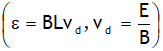
A beam of charged particles is passed in a region of electric & magnetic fields acting at right angles (called cross fields) with such a velocity that the electric & magnetic force balances each other & the beam of charge particles pass undeflected through the region of cross fields. i.e.

Felectric = Fmagnetic   ⇒ qE = Bqv  ⇒


^Hall effect

Hall effect

Is the phenomena of production of transverse emf in a current carrying strip of metal or a semiconductor when it is placed in a region of uniform magnetic field acting at right angles to current. It can be used to, calculate drift velocity of charge carriers, number density of charge carriers & nature of charge carriers.
^Ampere’s Circuital Law

Ampere’s Circuital Law

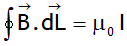
Ampere’s law is useful to find magnetic field in symmetrical situations. It states that the line integral of magnetic field for a closed plane curve is equal to ‘m 0’ times the current crossing the area bounded by the closed curve provided the electric field inside the loop remains the constant. i.e.

error: Content is protected !!
Call 9872662552