^Optical frequencies
^Optical frequencies
Using the relation c = f λ, with c = 3 x 10⁸ m /s & λ = 380 nm to 780 nm we can check that the optical frequencies are of the order of 1015 Hz.

^Optical frequencies
Using the relation c = f λ, with c = 3 x 10⁸ m /s & λ = 380 nm to 780 nm we can check that the optical frequencies are of the order of 1015 Hz.
^What is visible light
EM-radiation that can be detected by the human eye is called white light or simply visible light. It is mainly through visible light and the sense of vision that we know and interpret the world around us. Sensation of colour of light perceived by the human eye is determined by its frequency of the wave falling on ratina cells and not on its wavelength.
Visible light is a mixture of photons of wavelengths from 380 nm to 780 nm in appropriate proportion. Following table displays the wavelength range for colours.
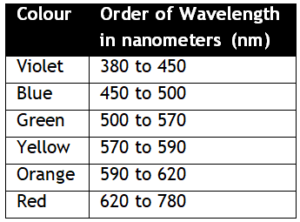
In terms of micrometer (μm) & angstroms (A0) we can write 570 nm = 0.57 μm = 5700 A0
^Quantum optics
Quantum optics treats light as a particle (localised energy packet) called photon’ to deal with photoelectric effect, Raman effect & LASER, etc.

^Wave optics
Light behaves as a wave when the size of obstacle is comparable with the wavelength of light. Wave optics branch explains the following phenomena
^Geometrical optics
Geometrical optics is also called ray optics. It treats propagation of light in terms of rays and is valid only if wavelength of light is much lesser than the size of obstacles. It deals with the following phenomena
^What is optics?
The branch of Physics which deals with light, it’s nature, cause, source, properties & it’s effects is called Optics.
^What is light?
In general light means following three parts
As these are parts of EM spectrum, thus light is electromagnetic, thus properties of light are same as that of any EM wave. Light can behave like a ray, a wave & as a particle, depending on its interaction with the objects it encounters on its way.
^Electromagnetic Force
EM – force acts between charged particles. It binds electrons with nuclei to form atoms & binds atoms together to form molecules. It is responsible for the properties of solids, liquids, & gases. Force of attraction/repulsion between two static charges is described by the Coulomb’s law i.e 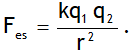
Electric forces and magnetic forces were considered to be separate forces until the 1860s when James Clerk Maxwell was able to demonstrate that they were different manifestations of the same force – the electromagnetic force. Infact, all contact forces such as: Frictional force (f), Viscous force (Fv), Air drag (fd) Spring force (Fspring or Fr), Normal reaction (N), Tension force in ropes, strings & muscles (T), Buoyant force (B or U), Surface tension force (FS) are actually due to the electromagnetic force.
^Maxwell equations
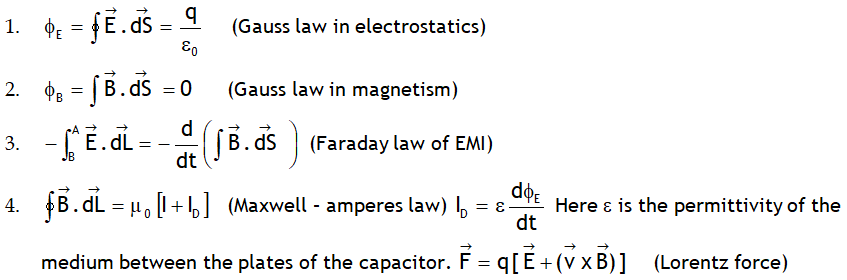
Following five equations give a complete description of all em– interactions and are called Maxwell eq:
^γ – rays
(a) Produced in nuclear reactions and are also emitted by radioactive nuclei (such as Co 60 & Cs 137).
(b) Properties: Effect on photographic plate, fluorescence, ionization, diffraction, high penetrating power & can cause serious damage if absorbed by living tissues.
(c) Used
 Call 9872662552