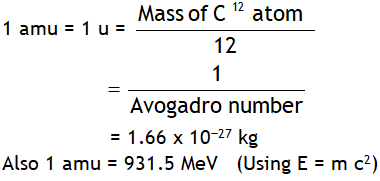
^Atomic mass unit (u)
^Atomic mass unit (u)

^Bohr correspondence principle
According to this principle the quantum theory must give same result as classical theory in the appropriate classical limit.
^Limitations of Bohr’s theory
(i) Quantum (to explain the existence of stationary orbits) &
(ii) Classical (for motion of electrons in the orbits). These two theories essentially oppose each other.


^Rydberg’s formula
Let ‘E’ be the energy & λ be the wavelength of the photon released when an electron jumps from a higher quantum state of principal quantum number n2 to a lower quantum state having principal quantum number n1, then
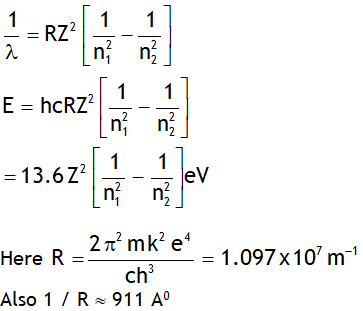
Note Rydberg’s constant depends on mass of
Electron, thus it is not a universal constant.
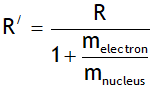
In deriving the above value the nucleus is assumed to be at rest. However if nucleus is not assumed stationary then the Rydberg constant depends on both mass of electron & nucleus & is given by
^Inertial & non inertial frame of reference
Accelerated frames are called non inertial & frames having zero acceleration are called inertial or Newtonian or Galilean frame of reference, thus any frame of reference at rest or moving with constant velocity with respect to a stationary frame of reference is also inertial. A frame of reference attached to an accelerating body is called non inertial frame of reference.
Suppose you are observing something which is at rest w.r.t. ground e.g. a tree, a building etc. If you observe it while staying at rest or while moving with uniform velocity w.r.t. ground, then your acceleration is zero & you are inertial frame observer. But while observing your velocity w.r.t. ground decreases or increases or changes in direction then you are said to be non inertial frame observer.
As earth is spinning about its own direction as well around the sun its speed & direction both vary over the time, hence for astronomical observations the Earth is non – inertial. However all the objects on earth have same acceleration & the relative acceleration of any one object w.r.t. other is zero, hence earth can be treated as inertial frame of reference in laboratory frame.
^Bohr’s frequency condition
Energy is emitted only when an electron exited to the higher states jumps back to lower states. The energy emitted is described by the relation
h f = E1 – E2
Ionization energy = +13.6 eV Z2
^Energy level diagram
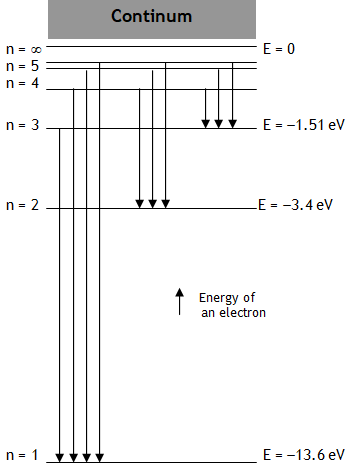
With the increase in the value of principle quantum number n
(a) r, L, T, U & E all increase while
(b) v, K, & w all decrease.
^Energy in nth orbit
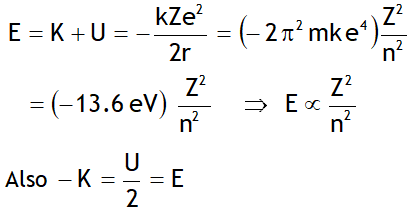
Here the -ve sign of energy shows that electron is bound to the nucleus & is not free.

The binding energy of the electron in the ground state of the H-atom is called Rydberg. i.e.
1Rydberg = 13.6 eV
^Magnetic moment generated

 Call 9872662552