^Density of nucleus
^Density of nucleus

Nuclear density is independent of Mass number.

^Density of nucleus
Nuclear density is independent of Mass number.
^Nucleus
Scattering experiments using fast electrons (instead of α – particles) as projectiles on targets of various elements, the sizes of nuclei of various elements have been accurately measured to be R = R0 A1/3
Here R0 = 1.2 × 10 -15 m known as nuclear unit.
^Neutrons
1. Neutron (discovered by James Chadwick in 1932) is an elementary particle present in the nuclei of all elements except hydrogen.
2. The mass of a neutron is slightly more than that of a proton & is now known to a high degree of accuracy.
It is mn = 1.00866 u = 1.6749×10 –27 kg
3. Neutron has no charge. Being neutral
(a) doesn’t interact with electrons & & doesn’t ionize the gas & hence doesn’t produce any track in the Wilson Cloud chamber.
(b) are not repelled or attracted by the nucleus and the electrons of an atom & consequently can easily penetrate heavy nuclei and induce nuclear reactions.
4. Inside a nucleus, a neutron is stable. But outside a nucleus, it is unstable. A free neutron spontaneously decays into a proton, electron and antineutron (an elementary particle with zero charge and zero rest mass) with a mean life of about 1000 s.

^Nucleus of an atom
Large angle scattering of α-particles by thin metal foils in Rutherford’s experiment revealed
1. Nuclear size is found to be of the order of 10–14 m whereas the diameter of an atom is of the order of 10–10 Hence most of the atom is empty or nucleus of an atom is a very tiny central region.
2. Charge of a nucleus of atomic number Z = +
3. More than 99.9% of the mass of an atom is concentrated in the nucleus.
^Facts
^Bragg’s law
If d is the spacing of the crystal planes, then diffraction of X-rays takes place according to the Bragg law : d sin θ = nλ
Here n = 1, 2, 3, _ _ _ _ _ _ _ _ & ‘θ’ is the angle of diffraction or grazing angle.
^Intensity & penetration of X–rays
^Auger or radiation less inner photo electric effect
Some times the energy emitted due to transition of electrons from one orbit to another is reabsorbed by another & that electron is emitted & consequently two electrons are emitted & no electromagnetic radiation is emitted. This is called Auger effect or Radiation less effect or Inner photoelectric effect.
^Characteristic X – rays
If the fast incident electrons collide with the electrons of the inner most level of the heavy target, knock them out. To fill the vacancy created electrons from the higher energy state jump & an X-ray photon of the corresponding energy gap is emitted in accordance with the Bohr’s hypothesis. Such X-rays are called characteristic X-rays.
The frequency (f) of the characteristic X-rays is given by Moseley law:
f = k ( Z – b )2
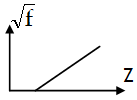
Here Z is atomic no. & k, b are constants, their values depends on the series transition.
Moseley made an extensive study of the characteristic X-ray spectra of a number of heavy elements. Moseley’s work provided for the first time a way to determine experimentally the atomic number Z of an element. He concluded that the atomic number is more fundamental than atomic weight in the emission of characteristic X-rays & thus the elements in the periodic table must be arranged in the order of increasing atomic number.
^Continuous X-rays
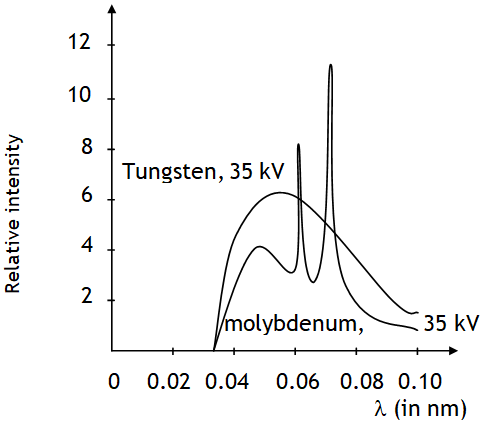
If the fast incident electrons undergo rapid deceleration by the electric field of the target then continuous (as having all sorts of wavelength) X-rays X-rays also called Bremsstrahlung X-rays are produced. This is the result of the inverse photoelectric effect, as the KE of the incident electrons is transformed into energy of X-ray photons. The minimum wavelength of continuous X-ray is:

 Call 9872662552