Posts

^Visible light

^Visible light

  1. Produced by hot bodies like sun, electric bulbs and tubes etc. as a result of electronic transitions. Our eyes are sensitive to visible light which helps us to collect the information about our surrounding.
  2. Properties: Reflection, refraction, interference, diffraction, polarization, photoelectric effect, photographic action, sensation of sight.
^Infra red waves


^Infra red waves

(a) Also called heat waves & are produced by hot bodies and molecules.

(b) Properties: Heating effect, reflection, refraction, diffraction & propagation through fog.

(c) Used

  1. In taking photographs during the conditions of fog, smoke etc. as these waves are scattered less than visible rays and hence can travel longer distances through atmosphere under fog, smoke etc.
  2. In weather forecasting
  3. In checking the purity of chemicals
  4. In the study of molecular structures
  5. For producing dehydrated fruits
  6. In green houses to keep the plants warm
  7. To provide electrical energy to satellites using solar cells.
  8. To treat muscular strain.
  9. In solar water heaters and cookers.

^Radio waves

^Radio waves

(a) Produced by the charges accelerating through LC oscillators.

(b) Properties: Reflection, diffraction

(c) Used for wireless communication purposes, like transmission of radio and TV signals and cellular phones.

^Radiation pressure

^Radiation pressure

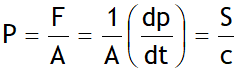
The force exerted by electromagnetic wave on unit area of the surface is called radiation pressure (P). It is defined as

If an EM wave of energy U incident normally on a surface of area A then the radiation pressure exerted by the EM wave on the surface is

^Linear momentum of the EM wave

^Linear momentum of the EM wave

EM waves carry energy and momentum. If a portion of EM wave of energy U propagates with speed c, then linear momentum of the EM wave is

^Poynting vector

^Poynting vector

Poynting vector  gives intensity of EM – wave & is defined as:   SI unit : W/m2

^Intensity of EM waves

^Intensity of EM waves

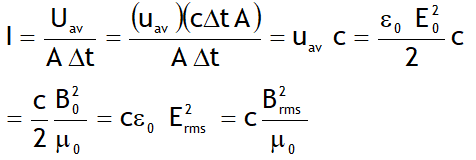
Intensity of EM wave is defined as the average energy crossing per second per unit area perpendicular to the direction of propagation of electromagnetic wave. i.e.

^Total energy density of EM waves

^Total energy density of EM waves

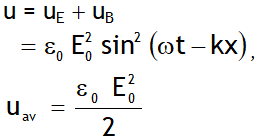
Total energy (u) of EM waves

^Magnetic energy density of EM waves

^Magnetic energy density of EM waves

Magnetic energy density (uB) of EM waves is

^Electric energy density of EM waves

^Electric energy density of EM waves

Electric energy density (uE) of EM waves is

error: Content is protected !!
Call 9872662552