Posts

^Ripple factor

^Ripple factor

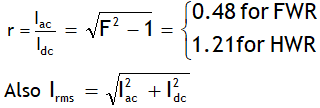
The output obtained from a rectifier is the superposition of both ac & dc components. The ratio of ac component to the dc component in the rectified output is called the ripple factor it decides the effectiveness of a rectifier. i.e.
ac power input

It is the effective input power i.e.

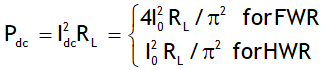
dc power output

It is the effective output power across the load i.e.
Rectifier efficiency

It is defined as the ratio of dc output power to the applied ac input power i.e.

^Intrinsic SCs

^Intrinsic SCs

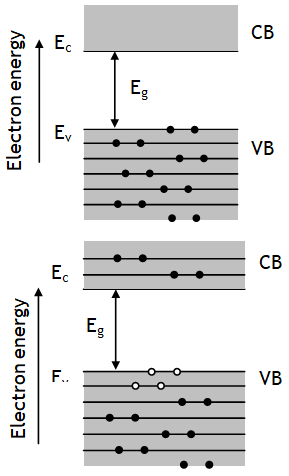
At 0 K the VB of an intrinsic semiconductor is completely filled with the electrons while the conduction band is completely empty as a result a SC behaves like an insulator at 0 K temperature.

However at higher temperatures say at room temperature some of the electrons from the VB gain sufficient thermal energy & jump to CB & occupy some level in the CB in accordance with the extent of the excitation energy. This is called thermal agitation. The vacant spaces left behind in the VB are called holes.

The vacancy of an electron with an effective positive electronic charge is called a hole. It behaves as an apparent free particle with a charge +e. For a intrinsic SC ne = nh = ni

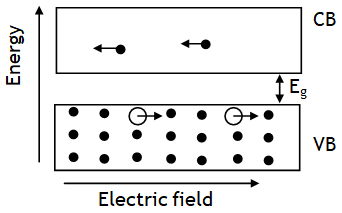
On applying external electric field electrons in the CB start drifting in a direction opposite to the electric field & holes in the VB start drifting in the direction of the electric field due to the force  exerted by the electric field as shown in the diagram.

^Energy bands in solids

^Energy bands in solids

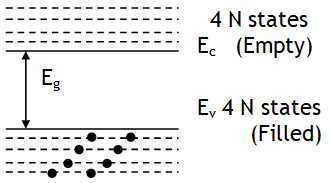
Energy levels of electrons in an isolated atom are well defined & discrete, however the valence energy levels get modified drastically when atoms interact to form the lattice. If N atoms interact, then total 8 N energy valence energy levels are available which split in two bands (called VB & CB) separated by energy gap (called Eg) as shown in the diagram.

As E(Ge) < E(Si), thus Ge is preferred in making semi conducting devices.

^Semiconductors

^Semiconductors

Semiconductors (e.g. Si, Ge) belong to 14th group, thus have 4 valence electrons & hence from covalent bonds (temperature sensitive).  

^Absorption radiations

^Absorption radiations

Radiations are absorbed by the materials according to the relation:  I =  I0 e X  

Here    μ  = absorption coefficient

I = intensity after penetrating the material through ‘x’ thickness of material

I0 = intensity of the radiation before penetrating

Absorption coefficient is highest for Pb.

^Commonly used abbreviations

^Commonly used abbreviations

1. R: Roentgen

2. Rad:  Radiation absorbed dose

3. rem: Roentgen equivalent in man

4. RBE: Relative biological effectiveness

^Fission versus fusion

^Fission versus fusion

^Moderator

^Moderator

The neutrons produced in fission of 235U nuclei have average KE about 2 MeV. Such neutrons are called fast neutrons. These fast neutrons have more tendency to escape instead of triggering another fission reaction. Slow neutrons are more efficient in inducing fission in 92U235 nuclei than fast neutrons. By the use of a moderator, the fast neutrons are slowed to thermal velocities i.e. velocities » 2200 m/s & energies » 0.0235 eV, it is same as that of atoms and molecules at room temperatures, such slow moving neutrons are called thermal neutrons. Light target are better moderators. The commonly used moderator are water, heavy water (D2O), graphite and beryllium. About 25 collisions with deutrons (present in heavy water) or 100 collisions with carbon or beryllium are sufficient to slow down a neutron from 2 MeV to thermal energies.

A good moderator must have:

  1. low atomic weight
  2. should collide elastically with neutrons.
  3. should not absorb the neutrons


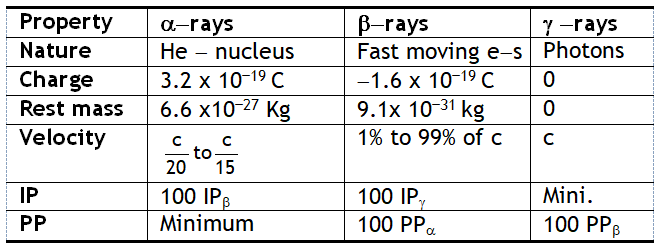
^Comparison of α, β & ϒ  rays

^Comparison of α, β & ϒ  rays

Here IP = Ionizing power & PP = Penetrating power

Also All the three type of rays namely α, β & ϒ affect photographic plate  produce flourescence & artificial radioactivity.

^γ-decay

^γ-decay

Most radioisotopes, after an alpha decay or a beta decay, leave the daughter nucleus in an excited state, these excited nuclei make a transition to a state of lower energy by emitting a photon. These photons are charge less, mass less & high energy electromagnetic waves (of the order of million electron volt) & are called the gamma rays.

ZXA (unstable nuclei) → ZXA (stable nuclei) + γ

error: Content is protected !!
Call 9872662552