^Critical angle
^Critical angle
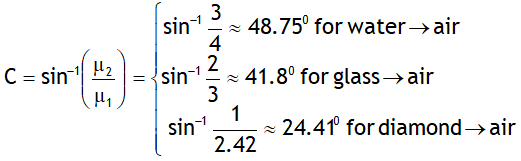
It is that angle of incidence (i = C) at which a ray going from denser to rare medium shows grazing emergence (r = 900).

^Critical angle
It is that angle of incidence (i = C) at which a ray going from denser to rare medium shows grazing emergence (r = 900).
^Optical path (L)
Distance travelled by light in vacuum in the same time in which it travels a given path length in a medium. If light travels a path length d in a medium at speed v, the time taken by it will be d/v.
Thus optical path length 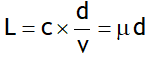
As μ > 1, optical path length is always greater than geometrical path length.
^Refraction
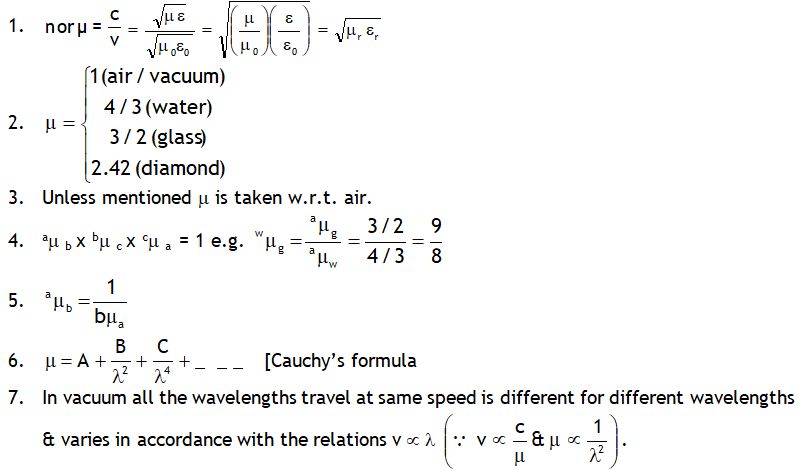
1. Snell’s law is the law of refraction. It is applicable for both plane & curved surfaces. According to this law the product μ sinθ remains constant in any medium. Thus for a light going from medium 1 to 2
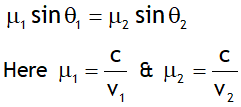
When a light wave enters a denser medium (say glass) from a rarer medium (say air)
2. The frequency (f) of the wave & hence the colour of the light wave remains the same
3. But the wavelength of the wave decreases μ times as a result its speed of the light wave decreases μ times (because v = f λ)

4. However in refraction of light, the amplitude of light may decrease or remain constant.
5. There is no change of its phase i.e. ΔΦ = 0.
6. No. of waves in ‘t’ thickness of a medium are 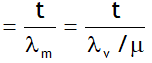
^Optical refractive index
^Uses of Convex mirror
^Uses of concave mirrors
^Uses of plane mirror
^Image by concave mirror
As an object approaches the pole of a concave mirror, the size of the image increases, also any kind of image viz. real, virtual, magnified, diminished & of same size is possible. Following is the summary of the various cases of image formation.
1. When an object is placed at ∞, a real, inverted, extremely diminished image is produced at F.

i.e. for u = ∞, v = f & m < < 1
2. When an object is placed beyond C a real, inverted, diminished image is produced between F & C.

i.e. for ∞ > u > 2 f, f < v < 2 f & m < 1
3. When an object is placed at C a real, inverted, image having size same as size that of object is produced between F & C.

i.e. for u = 2 f, v = 2 f & m = 1
4. When an object is placed between F & C, a real, inverted, magnified image is produced beyond C.

i.e. for 2 f > u > f, ∞ > v > 2 f & m > 1
5. When an object is placed at F, a real, inverted, magnified image of infinite size is produced at ∞.

i.e. for u = f , v = ∞ & m → ∞.
6. When an object is placed between F & P, a virtual, erect, magnified image of infinite size is produced beyond 2 F on the other side of mirror.

i.e. for f > u > 0, ∞ > v > 0 & m > 1
Using the image formation rules along with the sign conventions we can explain the various cases of image formation.
^Multiple images
If two plane mirrors are inclined at an angle θ, then the total no. of images (n) formed by successive reflections at the two mirrors can be calculated directly by using the following approach.
First find the value of m. Here 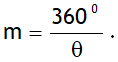 Then check for the following three possibilities:
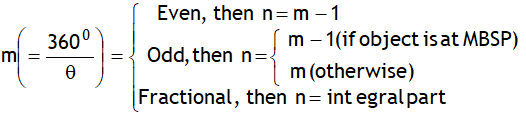
MBSP means mirrors bisector position.
^Newton’s formula
Let x1 & x2 respectively be the distance of object & image from focus instead of from the pole of a mirror or lens, then x1 x2 = f2.
 Call 9872662552