Posts

*Principle of homogeneity

*Principle of homogeneity

According to principle of homogeneity of quantities (PHQ) only those quantities can be added or subtracted which have same physical nature.

e.g. Force can’t be added in velocity, similarly or distance can’t be subtracted from time.

Also according to PHQ: L + L = L and L – L = L

L + T = not possible and T – M = not possible.

However there is no restriction on multiplication or division i.e. quantities having same or different dimensions can be both multiplied as well as divided. e.g. v = x/t, F = m.a, P = F/A, W = F.x etc.

 

^One radian

^One radian

One radian (rad) is the angle subtended at the centre of a   circle by an arc of length equal to the radius of circle.

^Gaussian surface

Gaussian surface

  1. To find electric field due to a charge configuration using Gauss’s law we draw an imaginary closed surface around that charged distribution.
  2. Gaussian surfaces are normal to electric lines of & symmetric to the charge enclosed such that electric field at every point of the Gaussian surface due to that charged distribution is same.
  3. Gaussian surfaces are spherical for point charges or spherical distribution of charges & cylindrical for linear and planar distribution of charge.
  4. Only those charges which lie inside the Gaussian surface are considered & that located outside have no contribution in the flux.
  5. Discrete charges on the surface of the -Gaussian surface are not considered (as electric field at the location of a discrete charge is not defined) but continuous charges can be considered.

^For infinite line charge

For infinite line charge

Both α & β will approach to 900 & E becomes

*Integral calculus

*Integral calculus

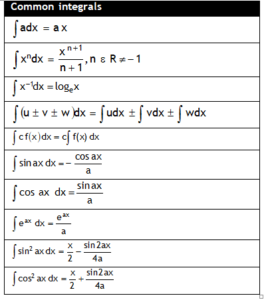
Integration is the reverse process of differentiation, thus also called anti-differentiation.

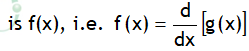
Suppose we have a function g (x) whose derivative.

The function g (x) is known as the indefinite Integral of f (x) and is denoted as:

1/d is usually abbreviated by the symbol ∫ (called integral), so one can write

∫ f (x) dx = g (x) + c

Here c is called constant of integration. Its value is arbitrary and can be calculated form the information given in the problem.

Integral of the form     is called definite integral. Here x = a & x = b are called limits of integration. x = a is called lower limit & x = b is called upper limit. If limits are not given, then the integration is called indefinite integration.
Definite integral is a number. Indefinite integral has no limits; it is a function. No integration constant is required in the final answer in definite integrals. Following examples explain how one can derive integration from differentiation.


^Charge is source of field

Charge is source of field

  1. An electric charge at rest produces only electric field around it.
  2. An electric charge moving with uniform velocity produces both electric and magnetic fields around it but radiates no energy.
  3. An accelerated charge produces both electric and magnetic fields around it as well as radiates energy in the form of electromagnetic waves.

*Graph of exponential functions

*Graph of exponential functions

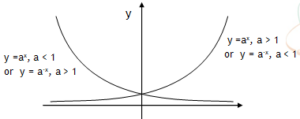
Functions y = ax, a < 1 & y = a– x, a > 1 are exponentially decreasing. Functions y = ax, a > 1 & y = a– x, a<1 are exponentially increasing.

The y intercept of the function y = ax is point (0, 1). If a = e (2.71828) then y = ex is called natural exponential function.

*Right handed or left handed parabola

*Right handed or left handed parabola

A quadratic of the form x = ay2 + by + c represents an right handed or a left handed parabola, it can also be expressed by the following function

(y – v)2 = L (x – u)

Here (u, v) represent coordinates of vertex (V) of a parabola. L= +ve for right handed parabola &

L = – ve for a left handed parabola.

*Trigonometric functions

*Trigonometric functions

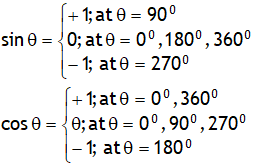
We know following values for sinθ & cosθ.

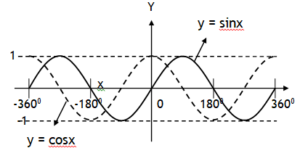
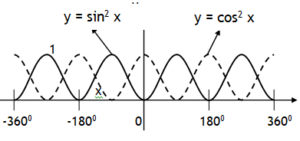
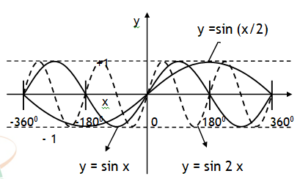
Using these values we can plot the following graphs:

Note the function y = sinx completes one cycle at 3600 where as y = sin2x completes it at 1800 & at

y = sinx/2 completes it at 7200.

*Laws of log

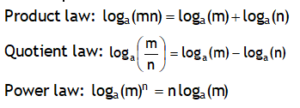
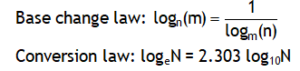
*Laws of log

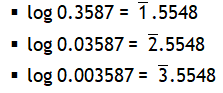
Examples

  • log 3587 = 3.5548
  • log 358.7 = 2.5548
  • log 35.87 = 1.5548
  • log 3.587 = 0.5548
  • antilog 0.5220 = 3.327
  • antilog 1.5220 = 33.27
  • antilog 2.5220 = 332.7
error: Content is protected !!
Call 9872662552