^Comparison of α, β & ϒ rays
^Comparison of α, β & ϒ rays
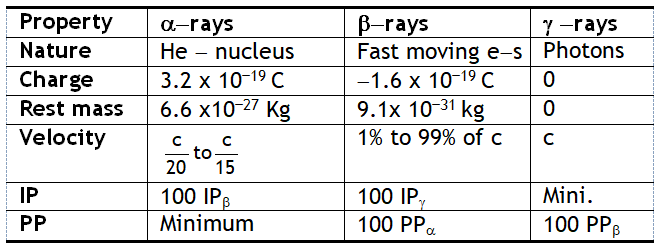
Here IP = Ionizing power & PP = Penetrating power
Also All the three type of rays namely α, β & ϒ affect photographic plate produce flourescence & artificial radioactivity.

Here IP = Ionizing power & PP = Penetrating power
Also All the three type of rays namely α, β & ϒ affect photographic plate produce flourescence & artificial radioactivity.
^γ-decay
Most radioisotopes, after an alpha decay or a beta decay, leave the daughter nucleus in an excited state, these excited nuclei make a transition to a state of lower energy by emitting a photon. These photons are charge less, mass less & high energy electromagnetic waves (of the order of million electron volt) & are called the gamma rays.
ZXA (unstable nuclei) → ZXA (stable nuclei) + γ
^β-decay
In the beta-minus decay, a neutron inside the nucleus transforms into a proton with the emission of an electron and anti-neutrino are emitted.

Note, the spins of the neutron, proton and electron are all 1/2. In the beta-plus decay, a proton inside the nucleus transforms into a neutron with the emission of a positron and neutrino are emitted.

^α-decay
Consider the following decay

As a nucleus decays due to internal force of repulsion, there is no net external force on it, hence in any nuclear reaction linear momentum must be conserved.
Before disintegration, the nucleus can be assumed to be at rest, so the total momentum was zero. After disintegration let it be mava & mD vD for alpha particle & daughter nuclei respectively. To conserve linear momentum the total vector momentum must still be zero i.e. mava + mDvD = 0 or mava = -mDvD
i.e. momentum of a particle must be equal & opposite to that of daughter’s nucleus.
In magnitude, mava = mDvD
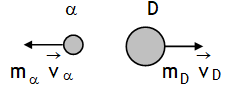
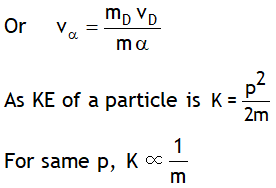
As mass of alpha particle is much lighter than thorium, thus the lighter α particle carries off most of the energy in the form its KE (about 98% of the total KE).
1. A heavy unstable nucleus (e.g. Uranium, polonium, radium, thorium, actinium, etc.) disintegrates itself naturally, spontaneously & randomly without being forced by any external agent to do so until it acquires stability.
2. The disintegration is independent of all physical and chemical conditions and so it can neither be accelerated nor retarded.
3. The disintegration is random. It is purely a matter of chance for any atom to disintegrate first. It is not possible to predict whether a particular nucleus will decay in a given time interval.
4. The activity (or rate of disintegration, A or R) of a radioactive sample at any instant is directly proportional to the number of undecayed nuclei present in the sample at that instant.
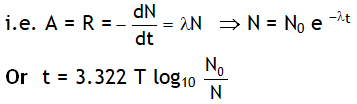
Here λ = disintegration constant or decay constant. & N0 = no. of the atoms present initially i.e. at t = 0.
From above result we can say
5. Half life (T): 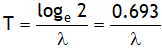
6. Fraction ‘f’ of substance left undecayed after ‘n’ half lives is given by: 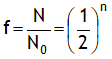
7. Mean life (τ): 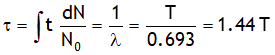
8. Decay constant (λ) is the reciprocal of time for which 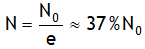
9. λ = 0 for a stable element (e.g. Pb).
10. (a) 1 Bacqueral (Bq) = 1 d.p.s.
(b) 1 Curie (rd) = 3.7 x 10¹⁰ d.p.s.
(c) 1 Rutherford (Rd) = 106 d.p.s.
Here d.p.s. = disintegrations per second.
^Binding energy per nucleon
1. is low for both heavy & light nuclei.
2. increases rapidly up to A = 20 & have peaks for 2He4, 6C12 & 8 O16 .
3. increases gradually after A = 20.
4. becomes less or more flat between A = 40 to 120.
Also it has average value in this region is 8.5 MeV.
5. has maximum value 8.8 MeV for the 26Fe56.
6. decrease after A =120 & drops to 7.6Mev for 92U238.
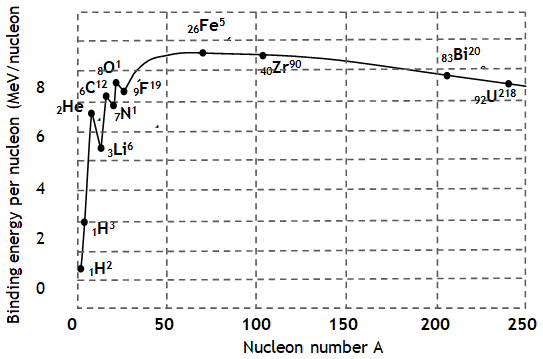
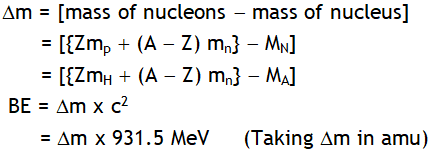
In order to increases the values of binding energies light nuclei undergo fusion while heavy nuclei undergo fission reactions i.e. heavy nuclei become more stable after fission & light nuclei become more stable after fusion.
^Nuclear Force
It binds the nucleons together protons and neutrons together in the nucleus of an atom against the repulsion of positively charged protons. It is a is short range force & believed to be due to the exchange of pions (also called π – mesons) between the nucleons. It is the strongest (as Fg: F e: Fn = 1: 1036: 1038) of the fundamental forces. Also it is Short range, Non central, Saturated, Attractive as well as repulsive.
^Density of nucleus

Nuclear density is independent of Mass number.
^Nucleus
Scattering experiments using fast electrons (instead of α – particles) as projectiles on targets of various elements, the sizes of nuclei of various elements have been accurately measured to be R = R0 A1/3
Here R0 = 1.2 × 10 -15 m known as nuclear unit.
 Call 9872662552