Posts

^Dimensionless Quantities

^Dimensionless Quantities

Strain, angle, solid angle, all Trigonometric ratios, all real numbers, logarithmic functions, exponential functions, Poisson’s ratio, refractive index, relative density, relative permittivity, relative permeability, fine structure constant etc. have no dimensions.

^Capacitance

Capacitance

1. Capacitance of a system is a measure of the its capacity to hold charge for a given potential difference.

2. Capacitance can be defined as

3. Capacitance is defined even if a capacitor is neutral.

4. SI unit of capacitance is Farad (F).

5. 1F = 1 C V – 1 = 9 x 10¹¹ stat farad.

6. Farad is a too big unit. Practical capacitors are of the order of mF, nF & pF etc.

7. Generally the two plates have equal and opposite charges. Even if, we give different charges to the plates then the inner surfaces facing each other posses equal and opposite charges.

8. The plates are separated by a distance much smaller than dimensions of a capacitor.

^Field due to sheets

Field due to sheets

Using Gauss law we can prove that electric field sheets of charge density σ

1. near a infinite sheet or thick sheet

2. near a finite sheet or thin sheet

^Rules for writing units

^Rules for writing units

  • The initial letter of a unit symbol named after a scientist is written in capital letters, however the full name begins with small letter. e.g. five newtons should be written as 5 N or 5 newtons but not as 5 n.
  • Symbols for various units are never used in plural form. e.g. 5 N should be written as 5 N and not as 5 Ns, however we can write 5 newtons but not 5 Newtons.
  • Symbols are never followed by a full stop.
  • Not more than one solidus is used. e.g. Nm– 2s– 1 shouldn’t be written as N/m2 /s.
  • The use of double prefix is avoided, when single prefix is available. e.g. instead of writing  μμN we should write pN.

In calculations the prefix is attached with the numerator and not with the denominator.

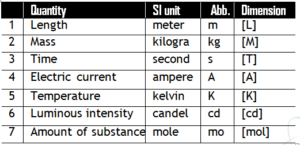
*The Seven Fundamental Quantities

*The Seven Fundamental Quantities


^Gauss’s law

Gauss’s law

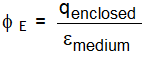
1. According to Gauss’s law the electric flux  through any arbitrary closed surface in a medium is equal to the total charge enclosed by the that surface divided by the permittivity of that medium. i.e.

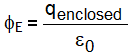
2. If medium is air or vacuum, then

3. Gauss’s law is based on the inverse square dependence on distance contained in the Coulomb’s law. Any violation of Gauss’s law will indicate departure from the inverse square law.

4. Using Gauss law we can say no. of electric line of force originating or terminating on a charge of q coulomb is equal to q/ε0.

^For infinite line charge

For infinite line charge

Both α & β will approach to 900 & E becomes

*Integral calculus

*Integral calculus

Integration is the reverse process of differentiation, thus also called anti-differentiation.

Suppose we have a function g (x) whose derivative.
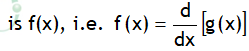
The function g (x) is known as the indefinite Integral of f (x) and is denoted as:

1/d is usually abbreviated by the symbol ∫ (called integral), so one can write

∫ f (x) dx = g (x) + c

Here c is called constant of integration. Its value is arbitrary and can be calculated form the information given in the problem.

Integral of the form     is called definite integral. Here x = a & x = b are called limits of integration. x = a is called lower limit & x = b is called upper limit. If limits are not given, then the integration is called indefinite integration.

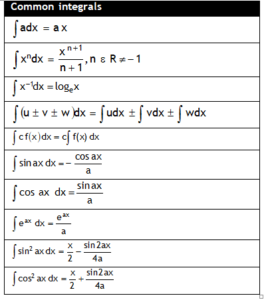
Definite integral is a number. Indefinite integral has no limits; it is a function. No integration constant is required in the final answer in definite integrals. Following examples explain how one can derive integration from differentiation.



^Equipotential surfaces

Equipotential surfaces

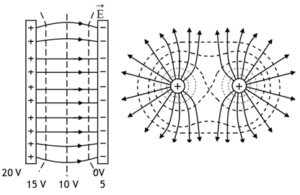
  1. An equipotential surface is an imaginary surface on which every point has one and the same value of electric potential. It can be curved or plane surfaces.
  2. No work is done in moving any charge over an EPS.
  3. Electric field is always ⊥ to EPS.
  4. EPS tells us about direction of electric field.
  5. EPS helps to distinguish regions of strong field from that of weak field. As the separation between two equipotential surfaces is more, where the field is weak & vice – versa.
  6. No EPS can intersect each other.

*Maxima & minima

*Maxima & minima


error: Content is protected !!
Call 9872662552