*Dimensional Variables
*Dimensional Variables
Are the physical quantities which have dimensions as well as variable values.
e.g. Force, Mass, Velocity, Area, Volume etc.

*Dimensional Variables
Are the physical quantities which have dimensions as well as variable values.
e.g. Force, Mass, Velocity, Area, Volume etc.
Capacitance
1. Capacitance of a system is a measure of the its capacity to hold charge for a given potential difference.
2. Capacitance can be defined as

3. Capacitance is defined even if a capacitor is neutral.
4. SI unit of capacitance is Farad (F).
5. 1F = 1 C V – 1 = 9 x 10¹¹ stat farad.
6. Farad is a too big unit. Practical capacitors are of the order of mF, nF & pF etc.
7. Generally the two plates have equal and opposite charges. Even if, we give different charges to the plates then the inner surfaces facing each other posses equal and opposite charges.
8. The plates are separated by a distance much smaller than dimensions of a capacitor.
Potential due to concentric spheres
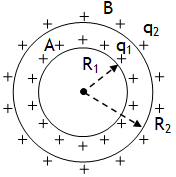
Consider two identical concentric spheres of radii R1 & R2 carry charges q1 & q2 respectively as shown in the diagram. Then total potential on A & B will be equal to sum of potentials due to charge on A & B & given by
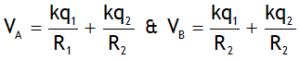
The potential diff. between two surfaces is
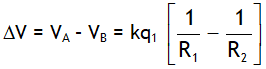
From above relation we can say
1. The potential difference is independent of the charge on the outer sphere.
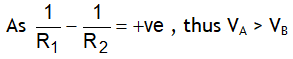
2. 
3. When the two conductors are joined by a thin wire, their potentials becomes same i.e. potential difference between them becomes zero. This is possible only when q1 is zero i.e. actually this will happen only when the entire charge on A moves to sphere B.
4. If q1 is negative, even then entire charge on A moves to sphere B, as we know negative charge moves from low to high potential.
^Advantages of SI system
Following are the advantages of SI system:
Coherent: SI system of units is coherent. i.e. any unit can be derived by simply dividing & multiplying from any seven fundamental units & two basic units.
Rational: For one physical quantity only one unit is used.
Absolute: Use of ‘g’ is avoided.
Metric: The use of multiples & submultiples is allowed. Accepted universally: As SI system can be easily reproduced, compared & time invariant.
*Fundamental quantities
Seven physical quantities have been chosen as fundamental or base quantities these are length, mass, time, electric current, thermodynamic temperature, amount of substance, and luminous intensity. Units of base quantities are called base units or fundamental units. Fundamental or base quantities are also known as the seven dimensions of the world.
Gauss’s law
1. According to Gauss’s law the electric flux through any arbitrary closed surface in a medium is equal to the total charge enclosed by the that surface divided by the permittivity of that medium. i.e. 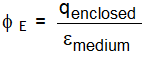
2. If medium is air or vacuum, then 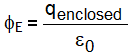
3. Gauss’s law is based on the inverse square dependence on distance contained in the Coulomb’s law. Any violation of Gauss’s law will indicate departure from the inverse square law.
4. Using Gauss law we can say no. of electric line of force originating or terminating on a charge of q coulomb is equal to q/ε0.
Finite line charge


The above result is valid even if the wire is bent to form an arc as shown.

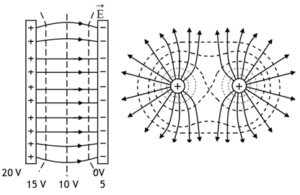
Equipotential surfaces
*Maxima & minima



Coulomb’s Law
Force of interaction (attraction or repulsion) between two static point charges is called electrostatic forces. For two static point charges electrostatic forces is described by Coulomb’s law
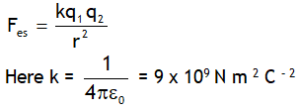
is called electrostatic constant. The quantity eo is called permitivity of free space (vacuum /air). Its value is eo = 8.98755 x 10 –12 N– 1 m – 2 C 2
Dimensions of permittivity: [M – 1 A2 L– 3 T4 ]
Charge which exerts force is called source & which experiences it is called victim.
 Call 9872662552