Posts

^PPC with a dielectric slab in plates

PPC with a dielectric slab in plates

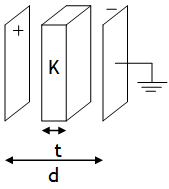
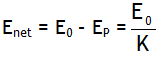
If a dielectric slab of dielectric constant K, thickness t < d is placed between the plates of a PPC then due to the electric field between the capacitor plates the dielectric gets polarized & an electric is induced in it, as a consequence net electric field in dielectric is found to be .
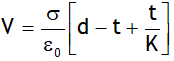
Due to this field electric field net potential difference across the capacitor plates becomes .
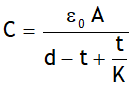
Using C = q/V, capacitance of capacitor becomes .
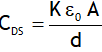
1. If the entire space between the capacitor plates is occupied by air or vacuum, then .       [using K = 1 and t = 0]

2. If the entire space between the capacitor plates is occupied by dielectric, then            [using t = d]
*What is a scalar?

*What is a scalar?

If a physical quantity can be completely described by telling its magnitude only and direction is meaningless for it, then it is called a scalar.

*Dimensional Variables

*Dimensional Variables

Are the physical quantities which have dimensions as well as variable values.

e.g.  Force, Mass, Velocity, Area, Volume etc.

^Capacitor

Capacitor

A capacitor is an arrangement of two conductors (called plates) separated from each other by a dielectric medium & used to trap (or store) electric energy in the form of electric field between its plates.

^Potential due to concentric spheres

Potential due to concentric spheres

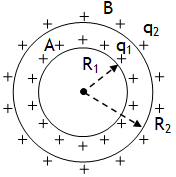
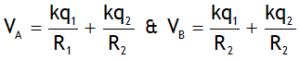
Consider two identical concentric spheres of radii R1 & R2 carry charges q1 & q2 respectively as shown in the diagram. Then total potential on A & B will be equal to sum of potentials due to charge on A & B & given by

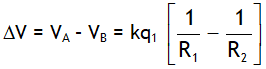
The potential diff. between two surfaces is

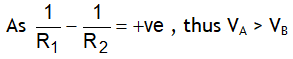
From above relation we can say

1.  The potential difference is independent of the charge on the outer sphere.

2.

3. When the two conductors are joined by a thin wire, their potentials becomes same i.e. potential difference between them becomes zero. This is possible only when q1 is zero i.e. actually this will happen only when the entire charge on A moves to sphere B.

4. If q1 is negative, even then entire charge on A moves to sphere B, as we know negative charge moves from low to high potential.

^E & V due to uniformly charged sphere

E & V due to uniformly charged sphere

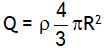
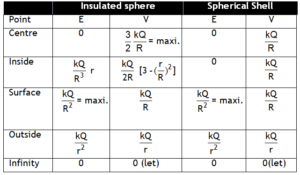
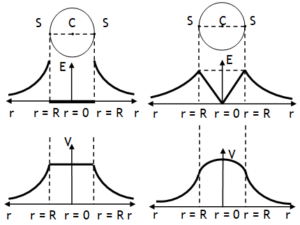
Charge on a insulated sphere of uniform volume charge density r & radius R is ,

Charge on a spherical insulated shell or a conducting sphere of uniform surface charge density s & radius R is, Q = σ 4 πR2

Using Gauss law we can write

^Advantages of SI system

^Advantages of SI system

Following are the advantages of SI system:

Coherent: SI system of units is coherent. i.e. any unit can be derived by simply dividing & multiplying from any seven fundamental units & two basic  units.

Rational: For one physical quantity only one unit is used.

Absolute: Use of ‘g’ is avoided.

Metric: The use of multiples & submultiples is allowed. Accepted universally: As SI system can be easily reproduced, compared & time invariant.

*Fundamental quantities

*Fundamental quantities

Seven physical quantities have been chosen as fundamental or base quantities these are length, mass, time, electric current, thermodynamic temperature, amount of substance, and luminous intensity. Units of base quantities are called base units or fundamental units. Fundamental or base quantities are also known as the seven dimensions of the world.

^Electric flux

Electric flux 

1. Electric flux (ΦE) linked with a surface (flat or curved) gives us an idea of the total number of electric field lines passing normally through that surface.

2. Electric flux is defined as the surface integral of the electric field inked with that surface i.e.

Here θ is the angle between electric field vector & area vector ( i.e. an area vector conventionally directed normally outwards to the area under consideration).

3. SI unit of flux: Weber (Wb)

4. CGS unit of flux: Maxwell (Mx)

5. Conversion: 1Wb = 10 8 Maxwell = 1Vm

6. Being dot product, electric flux is a scalar quantity.

7. Maximum value of flux = ± E S

8. Minimum value of flux = 0 (when θ = π/2)

9. If θ is acute flux is + ve & called leaving.

10. If θ is obtuse flux is – ve & called entering.

^Finite line charge

Finite line charge

The above result is valid even if the wire is bent to form an arc as shown.

error: Content is protected !!
Call 9872662552