Posts

^Vibration magnetometer

^Vibration magnetometer

A magnet free to vibrate about vertical axis passing through its CM is first kept in a non- magnetic hook along BH.
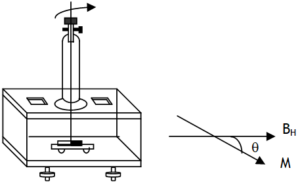
On deflecting it slightly by an amount θ, it experiences a restoring torque due to horizontal component of earth’s field BH

τ = M BH sinθ

≈M BH θ   [As sinθ ≈ θ, for small angle deflection.

Due to inertia of the magnet it start oscillating simple harmonically. We know from the theory angular SHM that linear frequency, angular frequency & time period of oscillations is,
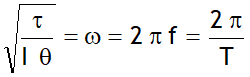
Thus for this situation we have
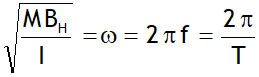
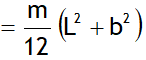
Here, I = MI of the magnet
Uses:

For two dissimilar magnets using
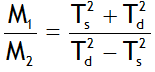
Here Ts = time period for the sum position & Td = time period for the difference position.
^Compass & dip circle

^Compass & dip circle

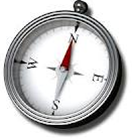
A compass needle consists of a magnetic needle is free to swing (oscillate or deflect) in a horizontal plane about a vertical axis.

A compass needle when placed in a horizontal plane & free to move aligns itself parallel to BH.

At the poles, the magnetic field lines are vertically so that the horizontal component is negligible & the compass needle can point along any direction & thus can’t be used as a direction finder. In that case we use a dip circle.

^Magnetic elements of earth

Magnetic elements of earth

Declination (θ), Dip (δ) &  Horizontal component (BH) are called magnetic elements of earth as earth’s magnetic field can be completely defined in both magnitude & direction by knowing these three.

^Geomagnetism

Geomagnetism

1. Study of magnetic field of earth is called Geomagnetism or terrestrial magnetism.

2. William Gilbert (in about 1600) was the first to demonstrate that the entire earth behaves as an enormous magnet.

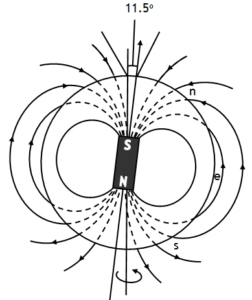
3. The magnitude & direction of Earth’s magnetic field can be obtained approximately by assuming that the earth has a magnetic dipole of dipole moment about 8 x 10²² J/T located at its centre tilted 11.5O from the spin axis of the earth as shown in the diagram.

4. The average strength of the earth’s magnetic field is about half a Gauss. Also Bequator = 30 μT, Bpole = 60 μT. Range of magnetic field is about 5 R from the radius of earth.

5. Earth’s mag. field changes both in magnitude & direction with the time. It is fairly constant over a span of few years but noticeable changes occur in say 10 yrs.

^Motional emf

Motional emf

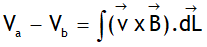
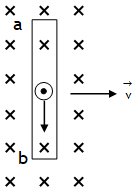
No motional emf will be produced across the conductor if any two vectors are parallel to each other.

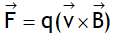
Polarity of the emf can be checked knowing the direction of drift of electrons using .


^Biot–savart’s law

Biot–savart’s law

The magnitude of the magnetic field produced depends upon

  1. strength of current flowing in the conductor
  2. shape, size of conductor &
  3. position of observation point where the field is to be calculated.

Direction of magnetic field due to both straight as well as curved conductor can be calculated by right hand stretched thumb rule. For straight conductor thumb point current & curl of fingers point magnetic lines while in a curved conductor reverse of it. On reversing the direction of current the direction of magnetic field produced is reversed.

^What is a vector

Description of motion along a straight line the role of direction is played by +ve & -ve signs of that direction, however to describe motion in 2 & 3 dimensions we need vectors.

^What is a vector

If both magnitude and direction are required to completely described a physical quantity, then it is called a vector. A vector quantity is  represented by putting on arrow above it or by bold letter e.g. it Q is vector then we represent it as  or Q. If a quantity can have any direction it is called polar vector. If its direction is along axis (axis of rotation), then called axial vector.
^Thermoelectric effect

Thermoelectric effect

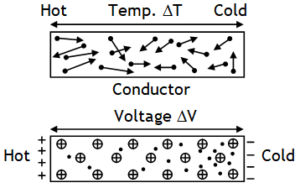
Consider an metal rod heated at one end & cooled at the other end as shown.

The electrons in the hot region are more energetic and therefore have greater velocities than those in the cold region. Consequently there is a net diffusion of electrons from the hot end towards the cold end which leaves behind positive metal ions in the hot region and accumulated electrons in the cold region. This situation prevails until the electric field developed between the positive ions in the hot region and the excess electrons in the cold regions prevents further electron motion from the hot to cold end. A voltage developed between the hot and closed ends with the hot end at positive potential at the steady state.

This effect in which a temperature gradient between two points in a material (may be a conductor or semiconductor) gives rise to a built in electric field or a voltage difference between two points. This phenomenon is called the Seebeck effect or the thermoelectric effect.


^General

^General

QUANTITY SYMBOL DEFINITION/RELATION SI UNITS DIMENSIONS
Mass M or m Also called inertia. kg [M]
Area A or S Region bounded by lines or curves in 2D. M2 [L2]
Volume V Space bounded by lines or curves in 3d. m3 [L3]
Density r Mass per unit volume kg m – 3 [ML – 3]
Linear density m Mass per unit length kg m – 1 [ML – 1]
Surface density s Mass per unit area kg m – 2 [ML – 2]
Specific volume 1/r Volume per unit mass kg – 1 m 3 [M – 1 L3]
Number density n Number of particles per unit volume. m– 3 [L– 3]
Specific gravity Or relative density SG density of body /density of water at 4 0C no units no dimensions

^Electrolytes

Electrolytes

Liquids are categorized in to three types

  • 1st type which don’t conduct e.g. Pure water or distilled water, vegetable oil.
  • 2nd type which conduct but don’t dissociate into ions. e.g. Mercury.
  • 3rd type which dissociate into ions & conduct when electric current is passed through them. Such liquids are called electrolytes.
error: Content is protected !!
Call 9872662552