Posts

^The magnitude of the difference between the individual measurement and the actual or true value is called the absolute error in the

^The magnitude of the difference between the individual measurement and the actual or true value is called the absolute error in the

measurement of that quantity. It is represented by

The ratio of the absolute error to the actual quantity measured is called the relative error of the measurement.

Relative error 

^Continuity equation for Conductors

Continuity equation for Conductors

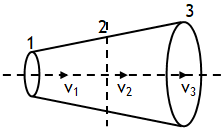
For a conductor of variable cross section

= constant at all sections but drift speed varies inversely with area of cross section.


^Electric current (I) & current density (J)

Electric current (I) & current density (J)

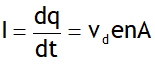
Electric current is the rate at which electric charge crosses a plane. i.e. mathematically,

Current per unit area is called current density, i.e. mathematically,

Electric current is scalar, while current density is vector. I & J are parallel to applied E – field.

^Kirchoff’s laws

Kirchoff’s laws

1st or junction rule: Σq = 0 at any isolated junction to conserve charge.

2nd or mesh rule: ΣV = 0 for any closed mesh to conserve energy.

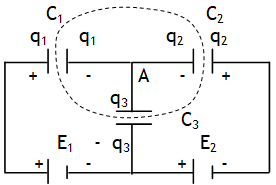
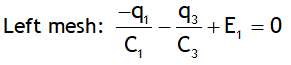
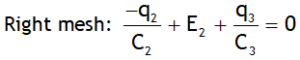
For shown circuit we can write

At jn. A: – q1 + q2 + q3 = 0

^Parallel grouping of capacitors

Parallel grouping of capacitors

1. Potential difference across all the components connected in parallel is same (i.e. V = constant)

2. Charge is among the various capacitors in accordance with q ∝ C i.e. a capacitor of greater capacitance will get more charge & vice versa.

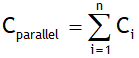
3. Effective capacitance is is given by,

^Spherical capacitor inner earthed

Spherical capacitor inner earthed

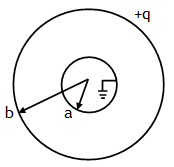
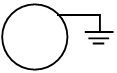
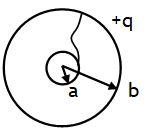
Suppose a neutral metal sphere radius a is placed concentrically inside a metal shell of radius b having surface charge +q.

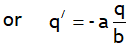
If inner sphere a is earthed then charge q/ appears on its surface from earth so that the potential of b becomes zero. i.e.,

Due to earthing & induction the final charge distribution will be

Due to this charge distribution electric field will be

1. E = 0 for r < a (i.e. inside a)

2. (radially outward) for a ≤  r ≤ b

3. (radially outward) for r > b

Due to earthing potential of a is zero & potential on b due to charge on outer surface of a & inner surface of b get cancelled & final potential on b is

Using C = q/V, capacitance for this system is

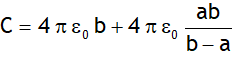
The above relation can be expressed as

^Spherical capacitor outer earthed

Spherical capacitor outer earthed

Suppose a metal sphere of charge +q & radius a is placed concentrically inside a metal shell of radius b. The charge of a induces charge – q on inner surface & +q on its outer surface of shell b. If shell b is earthed then its +q leaks to earth so that the potential of b becomes zero. Due to earthing & induction the final charge distribution will be
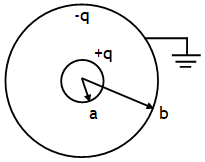
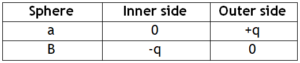
Due to this charge distribution electric field will be

1. E = 0 for r < a (i.e. inside a)

2. (radially outward) for a ≤  r ≤ b

3. E = 0 for r > b (i.e. outside b)

Due to this charge distribution the potential on a & b will be
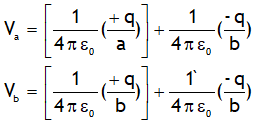
On subtracting above relations we get the potential difference between the a & b, it is
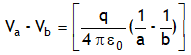
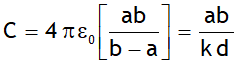
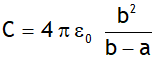
Using C = q/V, capacitance for this system becomes
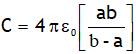
From above result it is clear

1. Let b – a = d is the distance between two spheres & , then we can write
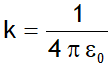
2. in order to have maximum  capacitance the radii of two spheres should be as high as possible & separation between them should as small as possible.

3. Suppose the shell b is situated ∞,  then we can say sphere a is isolated, then its using b = ∞,  we get C = 4 π ε0 a

4. If a & b are very large such that b – a = d & , then .

5. As , thus we can say that the capacitance of a spherical capacitor is always greater than the capacitance of an isolated sphere.

6. If the outer sphere is not earthed & inner sphere is connected to outer by a metallic wire, then entire charge moves outer & capacitance becomes C = 4 π ε0 b.
^Isolated spherical conductor

Isolated spherical conductor

1. Capacitance of an isolated spherical conductor of radius ‘a’ is Cearth = 4 πε0 a

2. As C ∝ a, thus big spheres have more capacitance than small spheres.

3. If the spherical isolated conductor is earthed, then entire charge leaks to earth, making its potential zero & thus C = ∞.

4. For earth capacitance is


^Type of physical quantities

^Type of physical quantities

Physical quantities can be categorized in following four types:

(a) Scalars    (b) Vectors   (c) Ratios  (d) Tensors

^Parallel plate capacitor

Parallel plate capacitor

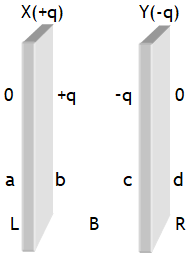
If the plates X & Y have equal & opposite charges, then charge distribution on plates is as shown in the adjacent drawing. Usually for a parallel plate capacitor we consider this picture.

Let A is the area of each plate, then the charge density of face A, b, c & d are,

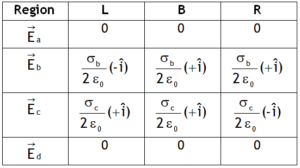
Elec. field on the left side (L) of plates, right side of plate (R) & between the plates due to the charge on face a, b, c & d is

Outside the two plates (i.e. in the regions L & R) the electric field due to the charge on the faces a, b, c & d will cancel out, there will no net electric field outside the plates.

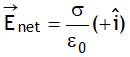
Net elec. field between the plates will be

i.e. electric field due to a capacitor plates of equal & opposite charge is  zero outside it & inside is which is uniform both in magnitude & direction, (neglecting fringing). Due to this field there will be attractive force between plates, on each plate it will be,
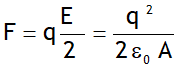
Due to this electric field the potential difference between the plates X & Y separated by distance d is,

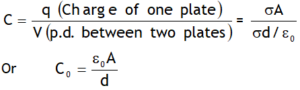
Capacitance of a PPC is

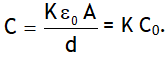
If the entire space is filled with a dielectric, then ε0 →  Kε0 & capacitance becomes

error: Content is protected !!
Call 9872662552