Posts

*Circle The locus of a point P (x, y) which moves in a plane so that its distance from a fixed point is always a

*Circle The locus of a point P (x, y) which moves in a plane so that its distance from a fixed point is always a constant.  The fixed point is called the centre C (u, v) of the circle and the constant  distance is called its radius (R).

Also a radius of a circle is a straight line joining the centre any point on the circumference. As CP = R, thus using displacement formula we can write
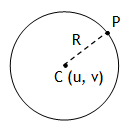
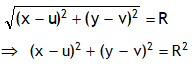
The above expression is called Central form of a circle.
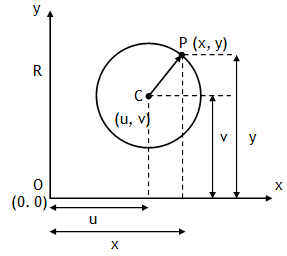
A circle can also be expressed as

ax2 + by2 + 2 gx + 2 fy + c = 0

This expression is called general form of a circle.

Here (-g, -f) is the center of the circle
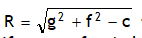
is radius

If centre of a circle coincides with origin O (0, 0) then the above expression can be written as,

x2 + y2 = R2.              

This expression is called Standard form of a circle.


*Intercept form

*Intercept form

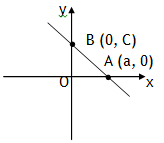
Suppose a line cuts x axis at point A (a, 0) and cuts y axis at a point B (0, C), then it can be described by the equation,

[called intercept form].


*Harmonic progression

*Harmonic progression

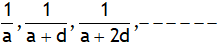
If a, a + d, a + 2d, _ _ _ _ _ _ _ are in AP, then their reciprocals are in harmonic progression (HP).
 

*Logarithms Let a is an arbitrary positive real number except 0. If ax = y, then logay = x

*Logarithms

Let a is an arbitrary positive real number except 0. If ax = y, then logay = x

Conversely, the antilogarithm of x is the number y i.e. y = antilogax.

Here ax = y is called arbitrary exponential function and loga y = x is read is log of y to the base a is equal to x. If a = 10, log is called common & if it is e, then called natural.

*Slope of a straight line

*Slope of a straight line

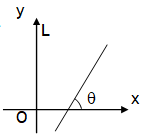
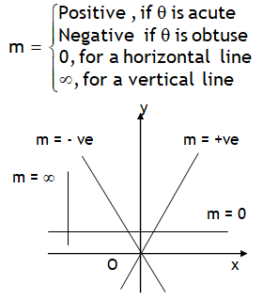
  • Slope (symbol, m) of a straight line is defined as the tan of the anticlock wise angle made by that line with the positive horizontal axis.
  • i.e. m = tan θ             
  • As tan θ can have any real value, so we can say
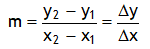
  • Slope of a straight line passing through points A (x1, y1) & B (x2, y2) is given by
  • Here Δx, Δy represents change in x & y coordinates respectively.
  • If two lines are ||, then their slopes are equal.
  • If two lines are perpendicular then the product of their slope is – 1.

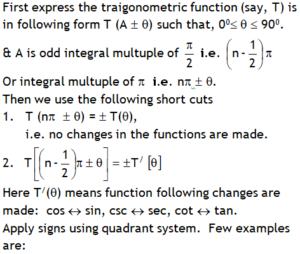
*Finding values of θ > 90

*Finding values of θ > 900

*Expansion formulae sin (A ± B) = sin A cos B ± cos A sin B

*Expansion formulae

sin (A ± B) = sin A cos B ± cos A sin B

cos (A ± B) = cos A cos B ± sin A sin B

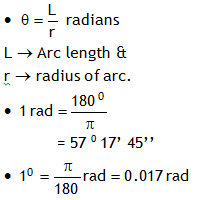
Angle measurement

<Angle measurement

  • Anticlock wise angles are taken as positive & clockwise as negative (using right hand rule).

  • 1revolution =1rotation = 1 cycle = 2p rad = 3600

^A long horizontal fixed wire carries a current of 100 A. Directly above and parallel to it is another wire carrying a current of 20 A and weighing 0.04 N/m.

^A long horizontal fixed wire carries a current of 100 A. Directly above and parallel to it is another wire carrying a current of 20 A and weighing 0.04 N/m. The separation between the two wires so that the upper wire is just supported by the magnetic repulsion is

error: Content is protected !!
Call 9872662552