^MECHANICS
^MECHANICS


^MECHANICS
Cu voltameter
It consists of a glass vessel containing an aqueous solution of CuSO4 as electrolyte & two copper rods as electrodes. Copper sulphate in aqueous solution dissociated as  .
.
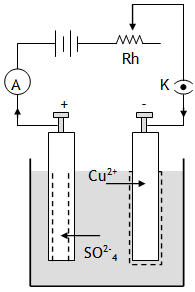
Due to the applied p.d. the SO2-4 ions drift towards the anode & the Cu2+ ions drift towards the cathode.
The SO2-4 ions on reaching the anode react with Cu atoms of anode to form CuSO4. i.e.
Cu + SO2-4 → Cu2+ SO2-4 + 2 e–
Also the oxidation reaction at the anode is
Cu → Cu2+ + 2e–
These Cu2+ ions dissolve into the solution, while the electrons so released flow towards the positive terminal of the battery via the external circuit. The Cu2+ ions on reaching the cathode get neutralized by the electrons flowing in from the negative terminal of the battery i.e. reduction occurs at the anode, Cu2+ + 2e– → Cu.
The net effect of electrolysis is that one copper atom is deposited at the cathode for each pair of electrons flowing through the connecting wires, thus copper is dissolved from the anode and deposited at the cathode in such a way that the concentration of CuSO4 in the solution remains constant & there is no accumulation of charge any where.
^General
| QUANTITY | SYMBOL | DEFINITION/RELATION | SI UNITS | DIMENSIONS |
| Mass | M or m | Also called inertia. | kg | [M] |
| Area | A or S | Region bounded by lines or curves in 2D. | M2 | [L2] |
| Volume | V | Space bounded by lines or curves in 3d. | m3 | [L3] |
| Density | r | Mass per unit volume | kg m – 3 | [ML – 3] |
| Linear density | m | Mass per unit length | kg m – 1 | [ML – 1] |
| Surface density | s | Mass per unit area | kg m – 2 | [ML – 2] |
| Specific volume | 1/r | Volume per unit mass | kg – 1 m 3 | [M – 1 L3] |
| Number density | n | Number of particles per unit volume. | m– 3 | [L– 3] |
| Specific gravity Or relative density | SG | density of body /density of water at 4 0C | no units | no dimensions |

Electrolysis
Electrolytes
Liquids are categorized in to three types
*Physical quantities
| Quantity (symbol) | Definition / Relation | Type |
| Mass (m) | Quantity of matter contained in a substance | Scalar |
| Distance (D) | Actual path length | Scalar |
| Speed (v) | Distance covered per unit time spent | Scalar |
| Time (t) | Reference to measure duration of an event. | Scalar |
| Electric current (I) | Rate of flow of charge. | Scalar |
| Pressure (P) | Normal force per unit area | Scalar |
| Surface tension (S) | Tangential force per unit length | Scalar |
| Work (W) | Line integral of force | Scalar |
| Power (P) | Rate of work | Scalar |
| Energy (E) | Capacity to do work | Scalar |
| Heat (H) | Energy in transit due to temperature difference | Scalar |
| Electric potential (V) | Line integral of electric field | Scalar |
| Electric flux (f) | Surface integral of electric field | Scalar |
| Specific heat (s) | Heat per unit temp. change per unit mass | Scalar |
| Latent heat (L) | Heat per unit mass for changing state of a material | Scalar |
| Temperature (T) | Degree of hotness or coldness | Scalar |
| Electric charge (q) | Measure of amount of electrification | Scalar |
| Density (r) | Mass per unit volume | Scalar |
| Moment of inertia (I) | Reluctance for rotational changes | Scalar |
Circuit to find ‘r’ of a cell
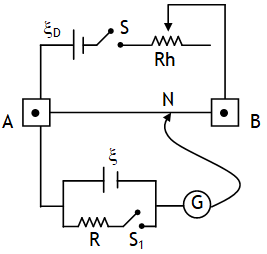
When the switch S is closed & the switch S1 is kept open, then the cell of emf ξ is said to be in open circuit. Let here the balancing length is b1, then ξ ∝ b1 Now when the switches S & S1 are closed, then the cell of emf ξ is said to be in closed circuit.
Let here the balancing length is b2, then V ∝ b2
Dividing above two relations we get 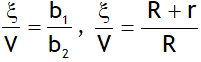
Circuit to compare emf of two cells
When S & S1 closed let the balancing length is b1, ξ1 ∝ b1.
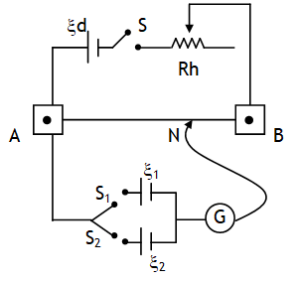
When S & S2 closed let the balancing length is b2, ξ2 ∝ b2. Dividing above two relations we get
At balanced state
1. current in the galvanometer arm Ig is zero and
2. current flowing in the mesh ABCD is 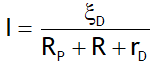
3. Potential drop across AB is V = IRp
4. Potential gradient K = V/L
5. As ξA is balanced against the potential drop of length AN, thus 
6. ξA ∝ b is called the principle of potentiometer.
7. To get the null point within the length of the potentiometer ξD > ξA
Greater the length of the potentiometer wire (L), smaller is the potential gradient (k) & more is the balancing length (b), hence more is the accuracy. ‘k’ is independent of the emf of auxillary cell (ξA) but depends upon emf of driver cell (ξD), its internal resistance (rD), resistance of potentiometer wire (AB) & any resistance (R) in the main circuit.
Potentiometer
It is an arrangement used to measure accurate potential difference & is equivalent to an ideal voltmeter & based on null method.
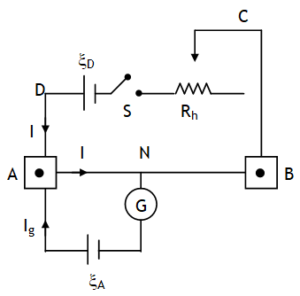
It is based on the principle that if a constant current is passed through a wire of uniform resistivity than potential difference across a given length of wire is directly proportional to length of that part.
 Call 9872662552