^Bending while turning

^Bending while turning

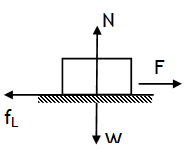
If anything is pressed straight down, its reaction is straight up & has no horizontal component. But if pressing is done at some angle, then the reaction force has both horizontal & vertical components.

This trick is the basis of bending while turning of a bike, aircraft, ice skater etc.
The vertical component of the reaction of the pressing force balances the weight of the system

i.e.  mg = Ncosθ

The horizontal component of the reaction of the pressing force provides centripetal force helping him to take turn (change the direction)
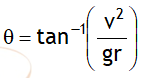
Dividing the two equations we can say that the required angle of bending of cyclist is
^Conical pendulum 

^Conical pendulum 

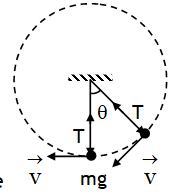
Horizontal component of the tension provides the necessary centripetal force & vertical component balances the weight of the particle.

& T cos θ = mg

Using simple rearrangements of above relations we can write following results


^Cars on curved bridges

^Cars on curved bridges

Three identical cars A, B and C are moving at the same uniform, speed on three bridges. The car  A goes  on  a  plane  bridge, B on a  bridge convex  upward  and  C goes  on   a  bridge concave upward . Let  NA, NB and NC be  the normal  forces exerted  by  the cars  on the bridges  when they  are at  the  middle  of  bridges.

^Centrifugal force

^Centrifugal force

A pseudo force experienced due to change in direction is called centrifugal force. Centripetal force is a real force while centrifugal force is pseudo. Mathematically both are equal in magnitude.

^Centrifugal force

^Centrifugal force

A pseudo force experienced due to change in direction is called centrifugal force. Centripetal force is a real force while centrifugal force is pseudo. Mathematically both are equal in magnitude.


^Forces in circular motion

^Forces in circular motion

When seen from inertial frame two types of forces act is a circular motion, one that changes speed & the other that changes direction.

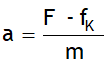
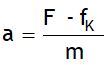
A force that acts tangential of velocity changes the speed only, called tangential force. Its

magnitude is given by

A force acting normal to velocity towards turning centre, along the radius & changes direction is called centripetal force or radial force.

It is not a different type of force. It is actually the resultant of the forces acting on a system & directed towards the center of the circle. For planet revolving around sun gravitational force is centripetal. For a string whirled in a horizontal circle tension in the string is centripetal force. For oscillating pendulum resultant of tension in the string & normal component of weight is centripetal.

Example 1

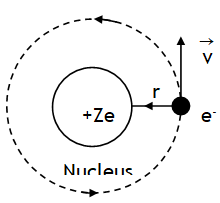
The electrostatic force of attraction between electrons & nucleus changes the direction of electrons revolving around the nucleus thus we can write

FCP = Felctrostatic    


Example  2

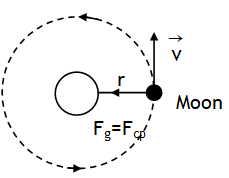
Gravitational force of attraction between the moon & the earth changes the direction of moon thus we can

write, FCP = Fgravitational

Example 3

Magnitude of centripetal force on a mass moving with velocity v in a circular path of radius r at constant speed (i.e. uniform circular motion) is


^Logic Gates

^Logic Gates

Basic building blocks of digital electronics made of semiconducting material & used to control the flow of information from input to output in a logical manner & are used in calculators, digital watches, computers, robots, industrial control systems, and in telecommunications.

^SCs Versus VT devices

^SCs Versus VT devices 

Semiconducting devices are the basic building blocks of all the modern electronic circuits & have following advantages over conventional vacuum tubes:

  1. don’ require a heating battery & thus set in to operation as soon as the circuit is switched on.
  2. require comparatively low voltage for their operation.
  3. don’t produce any humming noise during their operation.
  4. shock proof, small & compact in size, cheaper than vacuum tubes, have a very long life & are free from vacuum deterioration trouble.

Limitations

  1. higher noise level.
  2. can’t handle as much as power as ordinary tubes can.
  3. poor response in high frequency range.
  4. temperature sensitive (maxi. tolerance 50 0C).

^Oscillator

^Oscillator

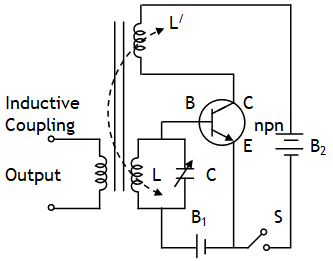
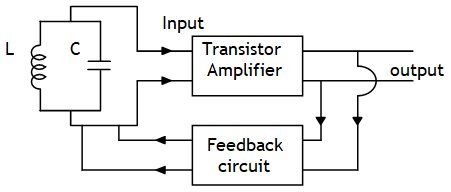
An oscillator is self sustained transistor amplifier with a positive feedback which produce electric oscillation of constant frequency

& amplitude without requiring any external input signal. It converts dc energy obtained from a battery into ac energy in same oscillatory circuit.
^CEA

^CEA

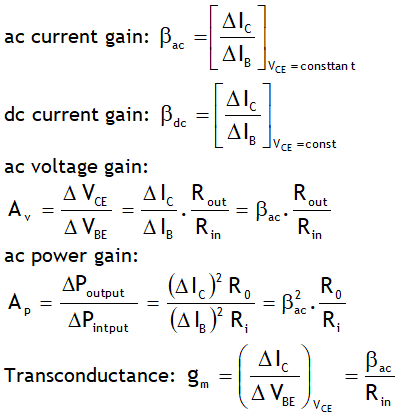
Output is 1800 out of phase with input.

Transconductance is also called mutual conductance.

As β > > α, thus the ac power gain of a CEA is much larger than that of a CBA. Remember the transistor is not generating any power. The energy for the higher ac power at the output is supplied by the battery.


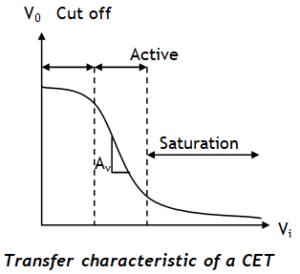
Saturation state:

Both the junction are forward biased & here IC is maximum & does not depend on the input current IB.

Cut off state:  Both the junctions are reverse biased as a result IC = 0. Between cut off & saturation state a transistor works as switch as here it turns over rapidly from OFF state (i.e. IC = 0 or cut off) to the ON state (i.e. IC is maximum or saturation state).

Active state: Emitter base junction is forward biased and the collector base junction is reverse biased. A transistor works as an audio amplifier in this regions.

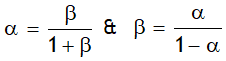
Relation between α and β:

As the value of IB is about 1 – 5 % of IE or IC is 95 – 99 % of IE, α is about 0.95 and 0.99 and β is about 20 to 100.  It is found that α and β are independent of current if the emitter base junction is forward biased and the collector base junction is reverse biased. Also the above definitions of α and β do not hold when both the junctions of a transistor are forward biased or reverse biased.

The CE configuration is frequently used as it gives high current gain as well as voltage gain.

error: Content is protected !!
Call 9872662552