^Magnetic elements of earth

Magnetic elements of earth

Declination (θ), Dip (δ) &  Horizontal component (BH) are called magnetic elements of earth as earth’s magnetic field can be completely defined in both magnitude & direction by knowing these three.

^Geomagnetism

Geomagnetism

1. Study of magnetic field of earth is called Geomagnetism or terrestrial magnetism.

2. William Gilbert (in about 1600) was the first to demonstrate that the entire earth behaves as an enormous magnet.

3. The magnitude & direction of Earth’s magnetic field can be obtained approximately by assuming that the earth has a magnetic dipole of dipole moment about 8 x 10²² J/T located at its centre tilted 11.5O from the spin axis of the earth as shown in the diagram.
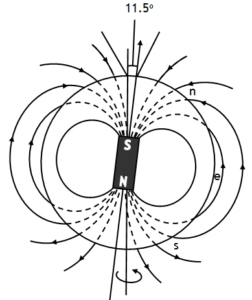
4. The average strength of the earth’s magnetic field is about half a Gauss. Also Bequator = 30 μT, Bpole = 60 μT. Range of magnetic field is about 5 R from the radius of earth.

5. Earth’s mag. field changes both in magnitude & direction with the time. It is fairly constant over a span of few years but noticeable changes occur in say 10 yrs.

^Dipole’s natural alignment

Dipole’s natural alignment

Any magnetic needle (or a dipole) free to move in a region of external magnetic field aligns so that its dipole moment become parallel to external magnetic field i.e. i.e. the position of stable equilibrium. This is because the position of stable equilibrium is the position of maximum stability or minimum potential energy.

^Superconductors: Perfect diamagnetics

Superconductors: Perfect diamagnetics

For super conductors cooled to very low temperatures χ = –1 & μr = 0.

Thus the super conductors are perfect diamagnetic materials. The phenomenon of perfect diamagnetism in superconductors is calledthe Meissner effect. In superconductors the field lines are completely expelled. Also a superconductor repels a magnet and (by Newton’s third law) is repelled by the magnet.

Superconducting magnets can be used in variety of situations, for example, for running magnetically levitated super fast trains.

Magnetic lines prefer to pass through air than through a diamagnetic material & through a ferromagnetic material than through air.

^Magnetic screening

Magnetic screening 

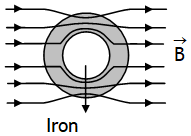
Magnetic field inside a ferromagnetic substance e.g. soft iron is zero. Thus any  object can be saved from magnetic field by placing it inside a ferromagnetic cavity. This is called magnetic screening or shielding.

^Ceramics

Ceramics

Or ferrites (usually brittle) are made by heat & pressure treatment from the powders of BaO & FeO. Used to coat tapes for tape recorders & as computer memory stores.

^Magnetic keepers

Magnetic keepers

The bar magnets are stored in pairs with their opposite poles together & a soft iron piece across them called magnetic keepers and used to make the circuit continuous, so that no free pole is left to cause demagnetize) in order to retain the magnetism. As otherwise they may demagnetize each other. Also it protects the magnets from external demagnetizing fields.


^Electromagnets

Electromagnets

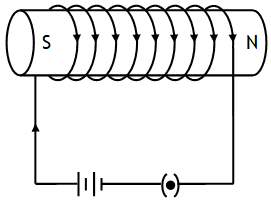
Core of electromagnets are made of ferromagnetic materials which have high permeability and low retentivity.

Soft iron is a suitable material for electromagnets. On placing a soft iron rod in a solenoid and passing a current, we increase the magnetism of the solenoid by a thousand fold. When we switch off the solenoid current, the magnetism is effectively switched off since the soft iron core has a low retentivity. Electromagnets have temporary magnetism & are used in making electromagnets, cores of transformers, motors & generators etc.. e.g.   Soft iron, Stalloy

^Permanent magnets

Permanent magnets

The materials used in making permanent magnets should have high retentivity, high coercivity & high permeability. High retentivity makes the magnet is strong and high coercivity ensures the magnetisation is not erased by stray magnetic fields, temperature fluctuations or minor mechanical damage.

Suitable materials for permanent magnets are steel, alnico, cobalt steel and ticonal. Steel is one-favoured choice. Coercivity of steel is very large as compared to that of the soft iron but its retentivity is slightly smaller retentivity. Permanent magnetism is used in making Electric meters, Loudspeekers etc.. e.g.   Steel, Alnico, Alcomax & Ticonal.

^Corecivity (oc):

Corecivity (oc):

The value of –H which has to be applied to a magnetic material so as to reduce residual magnetism to zero.  The area of hysteresis loop is proportional to the thermal energy loss per unit volume for one hysteresis cycle of magnetization & demagnetization. Thus in order to minimize the energy losses that material must be selected which have minimum area of the hysteresis loop. e.g.  Soft iron is preferred over steel.

The hysteresis curve allows us to select suitable materials for permanent magnets.


error: Content is protected !!
Call 9872662552