^Vibration magnetometer

^Vibration magnetometer

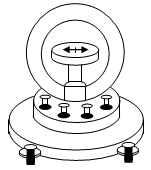
A magnet free to vibrate about vertical axis passing through its CM is first kept in a non- magnetic hook along BH.
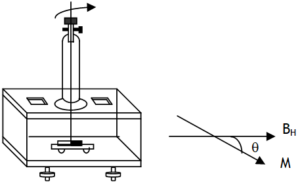
On deflecting it slightly by an amount θ, it experiences a restoring torque due to horizontal component of earth’s field BH

τ = M BH sinθ

≈M BH θ   [As sinθ ≈ θ, for small angle deflection.

Due to inertia of the magnet it start oscillating simple harmonically. We know from the theory angular SHM that linear frequency, angular frequency & time period of oscillations is,
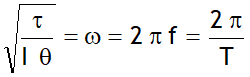
Thus for this situation we have
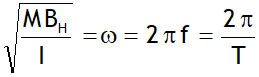
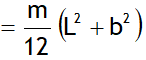
Here, I = MI of the magnet
Uses:

For two dissimilar magnets using
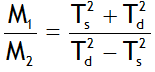
Here Ts = time period for the sum position & Td = time period for the difference position.
^Tangent galvanometer

^Tangent galvanometer

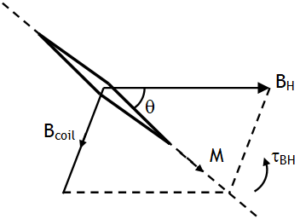
It is an instrument used to detect small currents using tangent law by keeping the magnetic needle at equilibrium under the torques of the Bcoil & BH.

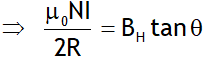
The plane of the coil is set parallel to the magnetic meridian such that the magnetic needle points 0– 0 position. Now current to be measured is passed in the coil. The magnetic field produced by this current acts at right angles to the plane of the coil. Torque due to this field deflects the needle while the torque due to BH tends to restore the needle till the equilibrium is achieved. Let in equilibrium the magnetic needle makes an angle θ with the horizontal component of earth’s magnetic field, then we can write

Bcoil = BH tanθ

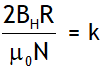
or    I = k tanθ

Here   is called reduction factor.

It is the amount of current required to produce a deflection of 450 in the magnetic needle. A tangent galvanometer is said to be both sensitive & accurate, if the change in its deflection is large for a given fractional change in current. The percentage error in the measurement of current is minimum when the deflection is 450.

^Neutral points

^Neutral points

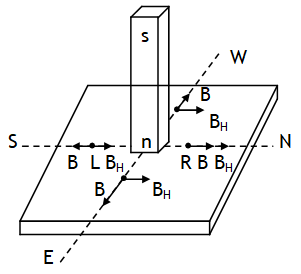
Neutral points are the positions where the magnetic field of a magnet is completely neutralised by the horizontal component of earth’s magnetic field. The position & number of neutral points depends upon the position of magnet.

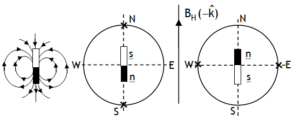
If a magnet is placed vertically as shown then we get only one neutral point situated at point L at left side of magnet if magnet’s north is down. On reversing the magnet neutral point will be at right side of magnet at point R.

Consider a magnet of dipole moment M, length 2L placed horizontally. Following drawings show the top view of the situation

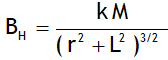
 Horizontal component of earth’s field is towards . When the magnet’s north (n) is towards earth’s south (S), then magnetic field of the magnet will be towards opposite to that of BH & both get cancelled at a point somewhere on the axial line of magnet & thus two neutral points (shown by cross marks) are obtained on the axial line (i.e. towards geographic north south line). If neutral points are situated at distance r from the centre of the magnet then at these points we can write
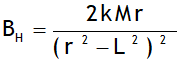
On reversing the magnet i.e. when magnet’s north (n) is towards earth’s north (N), two neutral points are obtained on the equatorial line (i.e. towards east – west line). At these points we can write


^Cause of earth’s magnetism

^Cause of earth’s magnetism

1. Gilbert suggested that the earth itself behaves like a giant magnet. The earth’s core is known to contain iron. Yet geologists do not regard this as a source of earth’s magnetism. As the molten iron is not ferromagnetic.

2. Due to Ionization of gases of atmosphere layer of charge particles called ionosphere is formed, which rotates with the rotation of the earth & hence produces magnetism.

Dynamo theory: Rotation of conducting ions of ferromagnetic materials like Fe & Ni in molten state produce current loops & hence magnetism is produced. Although the details of the dynamo effect are not known in detail, at present the dynamo theory seems to be most probable, because our moon which has no molten core, has no magnetism.

^Evidence earth’s magnetism

^Evidence earth’s magnetism

The following facts provide sufficient evidence in support of the existance of earth’s magnetism.

1. Directive property of magnet.

2. Availability of neutral points.

3. Iron piece burried under earth becomes magnet.

4. Behaviour of magnetic needle is different at different points.

^Aclinic line

^Aclinic line

Lines joining the places of zero dip. At all places on the aclinic line a freely suspended magnet will remain horizontal.

^Agonic line

^Agonic line

Lines joining the places of zero declination. Along Agonic lines a compass needle will point geographical north. Thus the places east of agonic line will have the west declination as the compass needle point west of north.

^Isodynamic lines

^Isodynamic lines

Lines joining the places of equal horizontal component of earth’s magnetic field (BH).

^Isoclinic lines

^Isoclinic lines

Lines joining the places of equal dip (δ).

^Isoclinic lines

^Isoclinic lines

Lines joining the places of equal dip (δ).

error: Content is protected !!
Call 9872662552