^Bohr’s frequency condition

^Bohr’s frequency condition

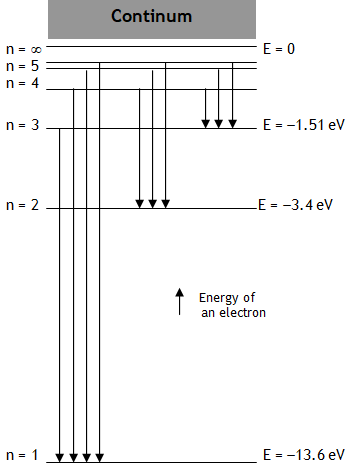
Energy is emitted only when an electron exited to the higher states jumps back to lower states. The energy emitted is described by the relation

h f = E1 – E2

Ionization energy = +13.6 eV Z2

^Frame of reference

^Frame of reference

Position or a place of observing an event is called a frame of reference. It is of two types: inertial & non inertial.

^Force, F

^Force, F

A push or a pull or an agent that breaks the inertia (tendency of opposition) changes its state from rest to motion or from motion to rest or from moving in one direction to other or accelerates it.

^Energy level diagram
^Energy level diagram

With the increase in the value of principle quantum number n

(a) r, L, T, U & E all increase while

(b) v, K, & w all decrease.

^Accelerated body

^Accelerated body

If with the passage of time the state of a body changes i.e. its velocity w.r.t. ground decreases or increases or changes in direction then the body is said to be accelerated. Some external force is required to change the state of the body.

^Examples of inertia
^Examples of inertia

  1. More initial effort is required to set up heavy objects in motion. Also more effort is required to stop them or change their direction.
  2. A man stepping out of a moving bus falls with his head in the forward direction. As otherwise due to inertia of motion the upper part of his body will be in motion & feet on touching the ground will come to rest. Due to this, unbalanced forces acting on his body may cause him to fall down.
  3. A clean hole is made when a bullet is fired at a glass window pane, while it is broken into pieces by a stone. Due to small speed, the stone remains in contact with the windowpane for a longer duration, thus transferring its motion to the pane & beaks it into pieces. On the other hand the particles of windowpane near the hole are unable to share the rapid motion of the bullet & remain undisturbed.
  4. Place a coin on a playing card covering a glass. On giving a sudden jerk to the card, the card flies off and the coin drops into the glass. This is because the coin tends to remain at rest due to inertia of rest.
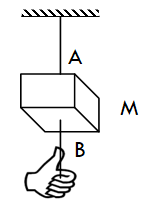
  5. Consider the shown situation. A mass M suspended from a rigid support by means of string A is pulled down by applying a force F  on another thread B. When a jerk is given to string B, the upper portion of the system is not able to share the force in short time and the block tends to remain at rest due to inertia of rest & consequently the string B breaks. While if we apply a steady force to string B, the force gets sufficient time to reach the position A & consequently the string A breaks.
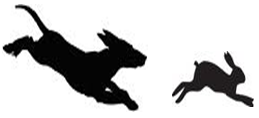
  6. When a dog chases a hare, the hare runs along a zig-zag path. The dog

    has more mass and hence has more inertia of direction than that of hare, thus it becomes difficult for the dog to catch the hare.
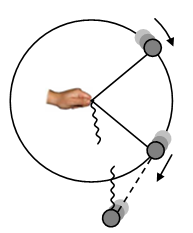
  7. Suppose a stone is whirled in a circle at the end of a string. The velocity of the stone at any instant is along the tangent to the circle. When the string suddenly breaks, the stone flies off tangentially due to directional inertia. As earlier their direction of motion at any point was along the tangent to that point & due to inertia of direction the stone has a tendency to maintain its direction of motion.

^Energy in nth orbit

^Energy in nth orbit

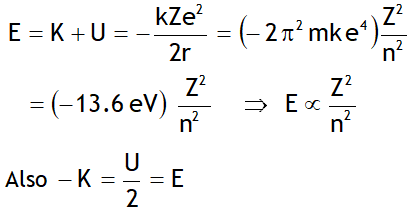
Here the -ve sign of energy shows that electron is bound to the nucleus & is not free.

The binding energy of the electron in the ground state of the H-atom is called Rydberg. i.e.

1Rydberg = 13.6 eV

^Magnetic moment generated

^Magnetic moment generated

^Current generated
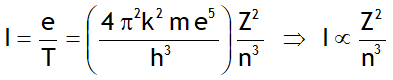
^Current generated

^Frequency of revolution

^Frequency of revolution

For n = 1, Z = 1; f = 6.57 x 10¹⁵ revolutions/s

error: Content is protected !!
Call 9872662552