^Internal force

^Internal force

  1. Acting with in the system selected & can’t accelerate a body.
  2. For a complete system internal forces are equal & opposite (i.e. obey third law) & thus cancel out.
  3. The work done internal forces for a complete system cancel out.

^Examples of Newton’s third law

^Examples of Newton’s third law

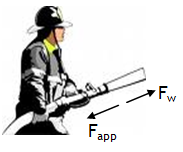
  1. A fireman has to hold the pipe strongly to prevent it form going backward as the water flowing out of the pipe pushes it backwards.
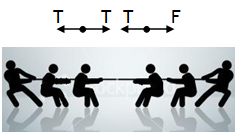
  2. No action can occur in the absence of a reaction. e.g. in a tug-of-war, one team can pull the rope only if the

    other team is pulling the other end of the rope. No force can be exerted if the other end is free. One team exerts the force of action and the other team provides the force of reaction.

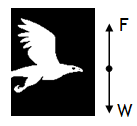
  3. The birds push down on the air with their wings, the air pushes their wings up and gives them lift against the weight.

^Newton’s third law

^Newton’s third law

3rd law is called action reaction law.

^Newton’s second law

^Newton’s second law

NSL defines force. External force is required to accelerate a body (change speed or direction or both).

When a body is seen from inertial frame of reference, the time rate of change of linear momentum is equal to the net external force acting on the body & takes place in the direction of net force

As all the three laws can be explained only from second law, that is why the 2nd law is called real law of motion.

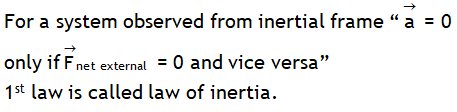
^Newton’s first law

^Newton’s first law

^Newton’s law of motion

^Newton’s law of motion

Isaac Newton (1643 – 1727) published Principia Mathematical in 1687. In this work, he proposed three “laws” of motion.


^Spectrum of hydrogen atom

^Spectrum of hydrogen atom

^Pseudo force

^Pseudo force

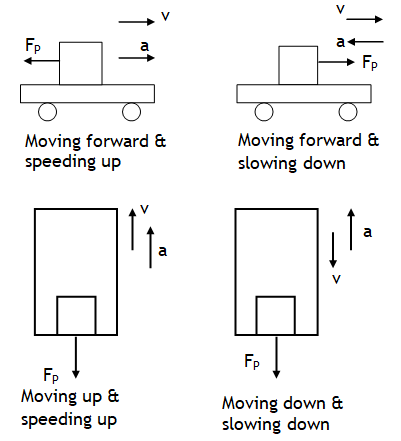
Imaginary forces experienced in non – inertial frame are called pseudo forces. A pseudo force experienced due to increase or decrease of speed is called tangential pseudo force.

Following drawings show direction of pseudo force acting on a block in different situations:

^Rydberg’s formula

^Rydberg’s formula

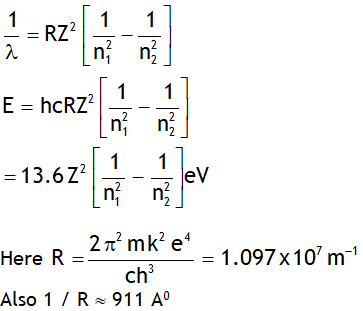
Let ‘E’ be the energy & λ be the wavelength of the photon released when an electron jumps from a higher quantum state of principal quantum number n2 to a lower quantum state having principal quantum number n1, then

Note Rydberg’s constant depends on mass of

Electron, thus it is not a universal constant.

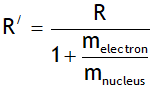
In deriving the above value the nucleus is assumed to be at rest. However if nucleus is not assumed stationary then the Rydberg constant depends on both mass of electron & nucleus & is given by

^Inertial & non inertial frame of reference

^Inertial & non inertial frame of reference

Accelerated frames are called non inertial & frames having zero acceleration are called inertial or Newtonian or Galilean frame of reference, thus any frame of reference at rest or moving with constant velocity with respect to a stationary frame of reference is also inertial. A frame of reference attached to an accelerating body is called non inertial frame of reference.

Suppose you are observing something which is at rest w.r.t. ground e.g. a tree, a building etc. If you observe it while staying at rest or while moving with uniform velocity w.r.t. ground, then your acceleration is zero & you are inertial frame observer. But while observing your velocity w.r.t. ground decreases or increases or changes in direction then you are said to be non inertial frame observer.

As earth is spinning about its own direction as well around the sun its speed & direction both vary over the time, hence for astronomical observations the Earth is non – inertial. However all the objects on earth have same acceleration & the relative acceleration of any one object w.r.t. other is zero, hence earth can be treated as inertial frame of reference in laboratory frame.

error: Content is protected !!
Call 9872662552