^Ceramics
Ceramics
Or ferrites (usually brittle) are made by heat & pressure treatment from the powders of BaO & FeO. Used to coat tapes for tape recorders & as computer memory stores.

Ceramics
Or ferrites (usually brittle) are made by heat & pressure treatment from the powders of BaO & FeO. Used to coat tapes for tape recorders & as computer memory stores.
Magnetic keepers
The bar magnets are stored in pairs with their opposite poles together & a soft iron piece across them called magnetic keepers and used to make the circuit continuous, so that no free pole is left to cause demagnetize) in order to retain the magnetism. As otherwise they may demagnetize each other. Also it protects the magnets from external demagnetizing fields.
Electromagnets
Core of electromagnets are made of ferromagnetic materials which have high permeability and low retentivity.
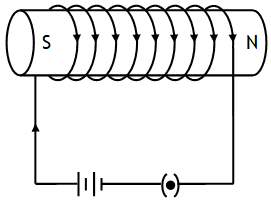
Soft iron is a suitable material for electromagnets. On placing a soft iron rod in a solenoid and passing a current, we increase the magnetism of the solenoid by a thousand fold. When we switch off the solenoid current, the magnetism is effectively switched off since the soft iron core has a low retentivity. Electromagnets have temporary magnetism & are used in making electromagnets, cores of transformers, motors & generators etc.. e.g. Soft iron, Stalloy
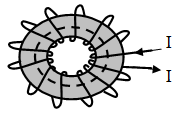
Toroid
Magnetic field inside is B = m0 nI & outside is zero.
*Instantaneous speed
Speed at a particular instant of time is called instantaneous, also speed means magnitude of instantaneous velocity. Reading of a speedometer of a vehicle is the instantaneous speed. It is scalar & always positive. Mathematically it is measured as the limiting value of the average speed i.e.
Instantaneous speed =

Thermocouples
The arrangement of two different metals (or semiconductors) joined at their ends to form a loop is called a thermocouple. Ends are called junctions. Temperature difference applied to a thermocouple creates a voltage in it & vice versa. This effect of direct conversion of temp. differences to electric voltage & voltage differences to temp. is called the thermoelectric effect or thermoelectricity.
Traditionally, the term thermoelectricity encompasses three separately identified effects, the Seebeck effect, the Peltier effect, and the Thomson effect. Peltier effect is due to the contact of different metals. Thomson effect is the absorption or evolution of heat along a non-uniformly heated conductor, Basic cause of thermoelectric effects is the diffusion of free electrons from the regions of high electron density to the regions of low electron density.
Position
^Position of an arbitrary point P at any time is described using cartesian coordinates i.e. P (x,y, z).
For 1 D motion along x axis, y & z coordinates are zero, where as x coordinate may be + ve or – ve.
1, 2 & 3 – D motion
If coordinate required to specify the position of a moving object at any instant are;
Two cells in parallel
I = I1 + I2


^A long horizontal fixed wire carries a current of 100 A. Directly above and parallel to it is another wire carrying a current of 20 A and weighing 0.04 N/m. The separation between the two wires so that the upper wire is just supported by the magnetic repulsion is
 Call 9872662552