Posts

^Binding energy per nucleon

^Binding energy per nucleon

1. is low for both heavy & light nuclei.

2. increases rapidly up to A = 20 & have peaks for 2He4, 6C12 & 8 O16 .

3. increases gradually after A = 20.

4. becomes less or more flat between A = 40 to 120.

Also it has average value in this region is 8.5 MeV.

5. has maximum value 8.8 MeV for the 26Fe56.

6. decrease after A =120 & drops to 7.6Mev for 92U238.
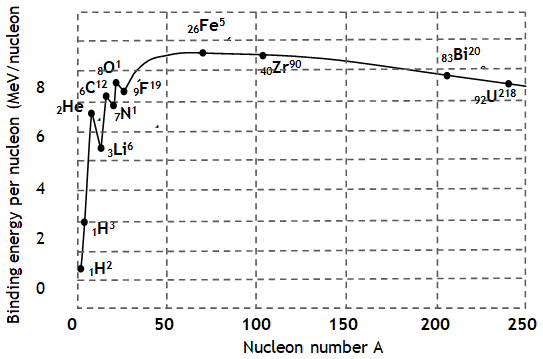
In order to increases the values of binding energies light nuclei undergo fusion while heavy nuclei undergo fission reactions i.e. heavy nuclei become more stable after fission & light nuclei become more stable after fusion.

^Mass defect

^Mass defect

^Nuclear Force

^Nuclear Force

It binds the nucleons together protons and neutrons together in the nucleus of an atom against the repulsion of positively charged protons. It is a is short range force & believed to be due to the exchange of pions (also called π – mesons) between the nucleons. It is the strongest (as Fg: F e: Fn   = 1: 1036: 1038) of the fundamental forces. Also it is Short range, Non central, Saturated, Attractive as well as repulsive.

^Density of nucleus

^Density of nucleus

Nuclear density is independent of Mass number.

^Nucleus

^Nucleus

Scattering experiments using fast electrons (instead of α – particles) as projectiles on targets of various elements, the sizes of nuclei of various elements have been accurately measured to be R = R0 A1/3

Here R0 = 1.2 × 10 -15 m known as nuclear unit.

^Neutrons

^Neutrons

1. Neutron (discovered by James Chadwick in 1932) is an elementary particle present in the nuclei of all elements except hydrogen.

2. The mass of a neutron is slightly more than that of a proton & is now known to a high degree of accuracy.

It is mn = 1.00866 u = 1.6749×10 27 kg

3. Neutron has no charge. Being neutral

(a) doesn’t interact with electrons & & doesn’t ionize the gas & hence doesn’t produce any track in the Wilson Cloud chamber.

(b) are not repelled or attracted by the nucleus and the electrons of an atom & consequently can easily penetrate heavy nuclei and induce nuclear reactions.

4. Inside a nucleus, a neutron is stable. But outside a nucleus, it is unstable. A free neutron spontaneously decays into a proton, electron and antineutron (an elementary particle with zero charge and zero rest mass) with a mean life of about 1000 s.

^Nucleus of an atom

^Nucleus of an atom

Large angle scattering of α-particles by thin metal foils in Rutherford’s experiment revealed

1. Nuclear size is found to be of the order of 1014 m whereas the diameter of an atom is of the order of 1010 Hence most of the atom is empty or nucleus of an atom is a very tiny central region.

2. Charge of a nucleus of atomic number Z = +

3. More than 99.9% of the mass of an atom is concentrated in the nucleus.

^A block hanging on two strings

^A block hanging on two strings

^Facts

^Facts

  1. In an H-atom the energy gap of any transition is not enough to emit X- Electronic transitions in an H-atom can produce IR, UV & visible radiations only.
  2. Production of the X-rays is an atomic phenomenon whereas the production of γ-rays is a nuclear

^Bragg’s law

^Bragg’s law

If d is the spacing of the crystal planes, then diffraction of X-rays takes place according to the Bragg  law : d sin θ = nλ

Here n = 1, 2, 3, _ _ _ _ _ _ _ _ & ‘θ’ is the angle of diffraction or grazing angle.

error: Content is protected !!
Call 9872662552