
Posts

^At balanced state

At balanced state

1. current in the galvanometer arm Ig is zero and

2. current flowing in the mesh ABCD is
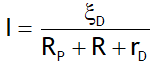
3. Potential drop across AB is V = IRp

4. Potential gradient K = V/L

5. As ξA is balanced against the potential drop of  length AN, thus

6. ξA ∝ b is called the principle of potentiometer.

7. To get the null point within the length of the  potentiometer ξD > ξA

Greater the length of the potentiometer wire (L), smaller is the potential gradient (k) & more is the balancing length (b), hence more is the accuracy. ‘k’ is independent of the emf of auxillary cell (ξA) but depends upon emf of driver cell (ξD), its internal resistance (rD), resistance of potentiometer wire (AB) & any resistance (R) in the main circuit. 

^Description of motion 

^Description of motion 

Three parameters used to describe the motion of a body are; position, velocity & acceleration. Usually a reference point plus a clock is used to describe motion of an object.

*Some Practical Units of Mass

*Some Practical Units of Mass

  • 1 slug = 14.57 kg
  • 1 quintal(q) = 100 kg
  • 1 tonne (t) = 1000 kg
  • Chandrasekhar Limit (CSL)= 1.4 solar masses

= 1.4 x (2 x 1030 kg)

= 2.8 x 1030 kg

  • 1 unified atomic mass unit (u)= 1.66 x 10 -27 kg
  • 1 carat (c) * = 200 mg

*carat is also a measure of purity of gold, pure gold being 24 carat.

^A long horizontal fixed wire carries a current of 100 A. Directly above and parallel to it is another wire carrying a current of 20 A and weighing 0.04 N/m.

^A long horizontal fixed wire carries a current of 100 A. Directly above and parallel to it is another wire carrying a current of 20 A and weighing 0.04 N/m. The separation between the two wires so that the upper wire is just supported by the magnetic repulsion is

error: Content is protected !!
Call 9872662552