^Polarisers
^Polarisers
Any device or material that plane polarizes the unpolarised light passed through it is called a polarizer. Nicol prism, Tourmaline crystal, Polaroid etc. are some commonly used Polarisers.

^Polarisers
Any device or material that plane polarizes the unpolarised light passed through it is called a polarizer. Nicol prism, Tourmaline crystal, Polaroid etc. are some commonly used Polarisers.
^Plane polarized light
If the electric field vector of a light wave vibrates just in one direction perpendicular to the direction of wave propagation, then it is said to be linearly polarized along that direction. Human eyes can’t distinguish between an unpolarised light and a polarized light, but the eyes of a bee can.

^Ordinary or unpolarized light
Light is made up of the superposition of a huge number of light waves emitted by individual atoms whose electric fields are in random directions. As a result the direction of vibration (DOV) of electric field vector at any given point of space keeps on changing very rapidly & randomly but always remain perpendicular to the direction of propagation (DOP). Such a light is called randomly polarized or simply unpolarized light. If a light wave propagates along x axis then tip of the electric field vector traces an irregular planar curve & there can be infinite directions of vibrations of electric field vector in the yz plane as shown in the diagram.

Light from a light bulb, candle, Sun is unpolarized. Usually we represent electric field vibrations in a ordinary light by dots & double arrows. Here double arrows represent the vibrations in the plane of paper (let xy plane) i.e. along ± y – axis and small dots represent vibrations perpendicular to the plane of paper along i.e. ± z – axis.
^Polarisation
A wave having vibrations is only in one direction & that is normal to its direction of propagation is called a polarized wave & the phenomenon of restricting the oscillation of a wave to just one direction in a direction transverse plane or normal to its direction of propagation is called polarisation of waves. Only transverse waves can be polarized or longitudinal waves can’t be polarized. Any transverse wave can be linearly polarized in any direction perpendicular to the direction of propagation.
^Interference versus diffraction
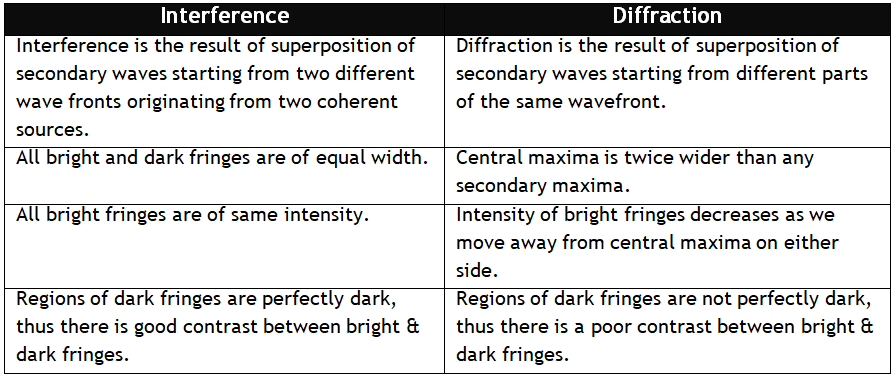
Following table gives some important points of difference between interference and diffraction
^Resolving power of a compound microscope

Here, λ = wavelength of light used
μ = refractive index of the medium between the object & objective lens
θ = Half angle of the cone of light from each point object.
Also μ sinθ is called numerical aperture.
From above relation it is clear that the resolving power of a compound microscope can be increased by increasing refractive index of the medium. It is due to this reason that oil immersion objectives are used to increase the resolving power. Also, higher the value of numerical aperture, larger will be the resolving power of the microscope.
^Resolving power a telescope
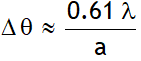
For the two stars to be just resolved,

Implying, Resolving limit of a telescope is,
Resolving power of a telescope is,
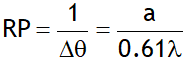
Thus Δθ will be small if the diameter (2 a) of the objective is large. This implies that the telescope will have better resolving power if a is large. It is for this reason that for better resolution, a telescope must have a large diameter objective. Also a bigger objective collects more light & hence produces more bright images. We can also say by increasing the diameter of the objective lens we can increase the range of a telescope. The stars which are not resolved in the image produced by the objective can’t be resolved by any further magnification produced by the eyepiece. The primary purpose of the eyepiece is to provide magnification of the image produced by the objective.
^Resolving limit of human eye
For human eye resolving limit is one minute (abbreviated as, 1), this means that the human eye can see two point objects separately if they subtend angle more than one minute of arc at the eye. The diameter of the pupil of human eye is about 2 mm. If we use λ= 5000 A0 to see objects, then the smallest angular separation between two distant point objects that the human eye can resolve is
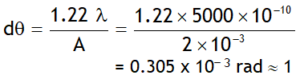
Thus the human eye can see two point objects distinctly if they at the eye an angle equal to one minute of arc. This angle is called the limit of resolution of the eye.
Light rays coming from any object after passing through pupil & eye lens get focused on the retina (screen) in the form of diffraction pattern. We know the maximum intensity of light is diffracted mainly in the central maxima. If the light rays is coming from two objects situated either too close to each other or very far away from eye then their central maxima of their diffraction pattern overlap at the retina, stimulating almost same cells on retina & brain gets one signal & we have perception that we are viewing one object in other words eye fails to resolve (or separate) the two objects if they subtend small angles at eye. e.g. a vehicle with its head lamps ON is approaching us. When the distance of the vehicle from us is large then the angle subtended by the head lamps at the eye is very small, if this is less than one minute then the diffraction pattern of their images at the retina overlap & we have perception of one head lamp. But as the vehicle approaches us the angle subtended by the head lamps at the eye increases, once this angle is more than one minute of arc, diffraction pattern of their images at the retina are formed at different points, exciting retina cells at two different & there by sending two signals to brain & we have perception of two different head lamps now.
Due to the same reason we fail to resolve two nearby stars.
^Resolving power
The reciprocal of the limit of resolution of an optical instrument is called the resolving power. The resolving power of an optical instrument is its ability to resolve or separate the images of two nearby point objects so that they can be distinctly seen.
^Resolving limit
Inability of an optical instrument (eye, microscope, telescope) to resolve the separation of two objects is called its resolving limit or limit of resolution & can be define as the smallest linear or angular separation between two points that can be just resolved i.e. visible distinctly & clearly by it.
 Call 9872662552